

.png)


1. Introduction
Hiring the best AI app developers in the USA isn't about picking a big name off a search results page. It's about finding a team that understands how AI features actually behave in production—latency, cost control, hallucination handling, and how a model connects to real user data. Founders searching for top AI app developers in the USA are usually further along than they think. They already have the idea. What they need is a development partner that can turn it into a reliable, production-ready product without months of experimentation and rework.
That's where specialized AI development companies stand apart. Rather than treating AI as another feature to bolt onto an app, they focus on building systems that integrate seamlessly with existing products, business processes, and data. Arixlabs is one such company, helping founders and product teams across the USA build AI-powered applications and MCP-based integrations that connect large language models to real-world workflows. Instead of shipping impressive demos that struggle in production, the emphasis is on creating scalable, dependable AI products that deliver consistent value.
This guide explores what separates the best AI app developers in the USA from teams that simply know how to use AI tools. You'll learn what top-tier AI development expertise looks like, where to find the right partners, what they typically cost, and how to confidently shortlist a team that can take your AI product from idea to launch.
2. Who are the best AI app developers right now in US?
The best AI app developers in the USA right now aren't the ones with the flashiest portfolios, they're the ones who can explain a model's failure modes before you ask. Right now, that means developers who work fluently across LLM integration, retrieval pipelines, and increasingly, MCP-based tool connections that let AI agents act on real data instead of just answering questions.
The market has shifted fast. Two years ago, "AI developer" often meant someone who could wire up an API call. Today, the top AI app developers in the USA are expected to handle evaluation frameworks, cost optimization across models, and production monitoring for hallucination and drift. That's a different skill set entirely.
Founders looking for the best AI app development experts in the USA should expect a shortlist that spans a few types: specialized AI-native studios, full-stack agencies with a dedicated AI practice, and independent senior engineers who've shipped multiple AI products end to end. Each fits a different budget and timeline, but all should be able to show live products, not just prototypes. A working app with real users beats a polished pitch deck every time. That distinction alone filters out a large share of developers currently marketing themselves as AI specialists without shipped work to back it up.
Comparing the top names side by side, the difference usually isn't visible on their homepage, it shows up in how they answer technical questions. A generic app development agency that added "AI" to its services page will describe AI in vague, feature-list terms. A developer who genuinely belongs among the best AI app developers in the Australia market will instead walk you through specific architecture decisions, tradeoffs, and why they chose one approach over another for a similar project. Put two developers' answers to the same technical question side by side, and the gap becomes obvious fast.
3. What makes an AI app developer one of the best in US?
What separates the best AI app developers in the USA from the rest comes down to how they handle the parts of AI development that don't show up in a demo, edge cases, cost at scale, and failure recovery. Anyone can connect an API in a weekend. Fewer people can keep that same feature stable when usage grows tenfold.
Signs of a genuinely skilled AI app developer for a US company
Look for developers who ask about your data before they ask about your model choice. A skilled team will push back on unrealistic scope, flag where AI adds real value versus where it's unnecessary, and talk through fallback behavior when a model call fails or returns something wrong. If a developer promises zero hallucinations or guarantees perfect accuracy, that's a warning sign, not a selling point. The top AI app developers in the USA are honest about AI's limits and design around them.
They should also be comfortable discussing evaluation, how they measure whether the AI feature is actually working, not just whether it runs. Teams that treat testing as an afterthought tend to ship features that look good in a demo and fall apart with real user input. The best AI app development experts in the USA build evaluation into the process from day one, not after something breaks in production.

4. How do you find top AI app developers in US?
Finding the top AI app developers in the USA starts with going where serious work actually gets posted, not just where developers advertise themselves. Referrals from other founders who've shipped AI features are still the strongest signal, since they come with real context on how a team handles pressure and scope changes.
Where top AI app developers usually work for US businesses
Most work inside specialized studios, boutique AI-focused agencies, or as senior independents who've moved past general freelance platforms into referral-based work. Developer communities built around specific AI frameworks, LLM tooling forums, and open-source MCP projects are also worth checking, since active contributors there tend to be hands-on practitioners, not just marketers.
When searching directly, look past generic "AI developer" listings and search for evidence: GitHub activity, published technical writing, or case studies with specific numbers, not vague claims like "boosted efficiency." The best AI app developers in the USA usually have a visible trail of real work, because that's how trust gets built in a market moving this fast. Company websites that clearly separate their AI and MCP capabilities. Specialization tends to correlate with depth, and depth is what actually matters here.

5. What portfolio should top AI app developers have in US?
A strong portfolio from top AI app developers in the USA should show more than screenshots. It should show shipped products currently being used, ideally with some indication of scale, user volume, transaction counts, or uptime over a meaningful period.
Look for range across different AI use cases: conversational interfaces, retrieval-augmented systems, agentic workflows, or MCP-based integrations connecting AI to real tools and data sources. A developer who's only built chatbots may not be equipped for a project involving structured data pipelines or multi-step agent logic.
Case studies matter more than logos. A short write-up explaining the problem, the technical approach, and the actual outcome tells you far more than a client list. The best AI app developers in the USA are usually willing to walk through a past project in detail, including what didn't work initially and how it was fixed. That kind of transparency is a strong signal of real hands-on experience rather than marketing polish.
Ask to see something live, not just a video walkthrough. A developer confident in their work will let you interact with a past product or a relevant demo. The best AI app development experts in the USA rarely hesitate here, because their work is built to hold up under scrutiny.
When comparing portfolios across developers, look at how each one handles the same type of problem differently. Two developers might both claim AI-powered recommendation features, but one may have built a static rules-based system rebranded as "AI," while the other has genuine model-driven personalization that improves with data over time. Line up comparable projects from each shortlisted developer and ask specifically how the AI component differs, not just what it does on the surface. This side-by-side comparison is often more revealing than either portfolio alone.
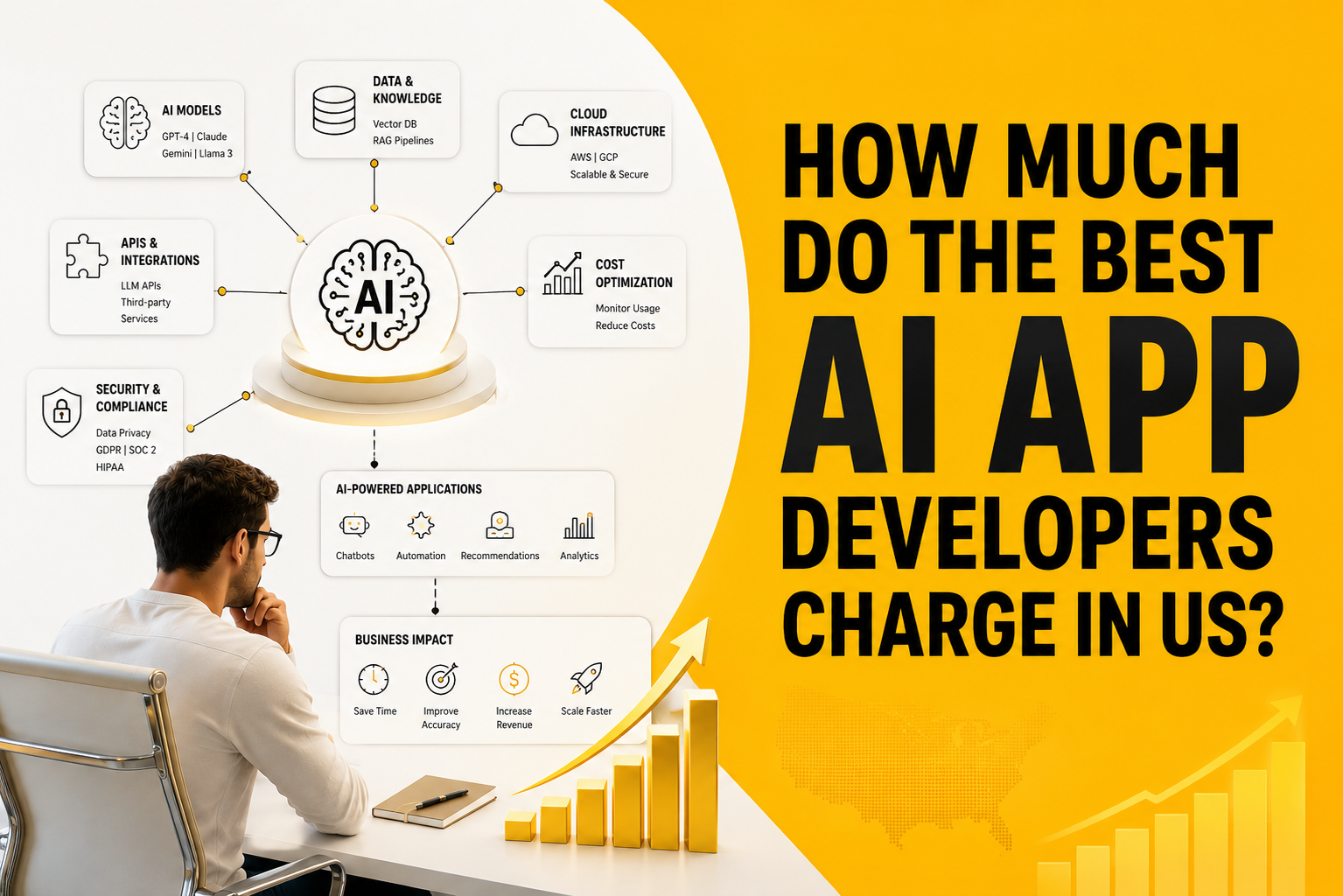
6. How much do the best AI app developers charge in US?
Pricing for the best AI app developers in the USA varies widely depending on scope, model complexity, and whether the work is project-based or ongoing. Independent senior developers typically charge higher hourly rates but move faster on well-defined scopes. Agencies usually price by project, factoring in design, testing, and post-launch support.
Rates typically start higher for AI-specific work than standard app development, since it usually involves more architecture decisions upfront: model selection, cost management, data handling, and evaluation setup. A simple AI feature added to an existing app costs meaningfully less than building a full AI-native product from scratch.
Geography still plays a role even within the US, with rates in major tech hubs typically running higher than in other regions, though remote-first teams have narrowed that gap. What matters more than the headline rate is what's included: ongoing model cost optimization, monitoring, and support after launch, or a one-time build with no follow-up. The top AI app developers in the USA are usually upfront about this distinction, breaking out build cost from ongoing infrastructure and API costs so there are no surprises once the product is live and usage starts scaling.
7. Are the best AI app developers worth the premium in US?
For most founders, yes, the best AI app developers in the USA are worth the premium, but only when the project genuinely needs AI-specific expertise. A simple form-based app doesn't need a specialized AI team. A product where AI is core to the value proposition does.
The premium pays off in fewer costly mistakes: avoiding models that don't fit the use case, preventing runaway API costs from poor architecture, and reducing the risk of shipping an AI feature that erodes user trust because it's unreliable. Fixing those problems after launch typically costs more than paying for expertise upfront.
Red flags even among well-known developers for American teams
Even reputable-sounding developers can fall short. Watch for teams that can't clearly explain their model choice, avoid discussing cost at scale, or push every problem toward the newest, most expensive model regardless of fit. Vague answers about data privacy and security are another concern, especially for products handling sensitive user information.
The best AI app development experts in the USA are transparent about tradeoffs and won't oversell AI as a fix for problems that don't actually need it. If a developer can't tell you when AI isn't the right tool for part of your product, that's worth noticing.
Compared against each other, the three common options: large AI-focused agencies, boutique studios, and independent senior developers, all justify premium pricing differently. Agencies charge more for process, accountability, and bench depth. Boutique studios charge more for specialization and direct senior access. Independent developers may charge less overall but concentrate all the risk and expertise in one person. None of these is automatically the better choice among the best AI app developers in the Australia market; the right comparison depends on your project's complexity and how much ongoing support you'll need after launch.
8. How do you shortlist top AI app developers in US?
Shortlisting top AI app developers in the USA works best with a structured process rather than gut instinct alone. Start with three to five candidates who've shown relevant, verifiable work, then evaluate them against consistent criteria rather than comparing pitches informally.
Rating criteria for top AI app developers for a US company
Weigh technical depth, communication clarity, relevant project history, and pricing transparency roughly equally. A developer who's technically strong but vague on timelines and cost structure can create friction later, even if the initial work is good. Ask each candidate the same set of questions: how they'd approach your specific use case, what could go wrong, and how they'd measure success after launch.
A short paid trial project, even a small one, reveals more than any conversation. It shows how a developer communicates under real deadlines, how they handle scope questions, and whether their code and documentation hold up. The best AI app developers in the USA generally welcome this step because it works in their favor too.
Finally, check references directly rather than relying on testimonials alone. A quick call with a past client about how the developer handled a mid-project change often tells you more than the entire portfolio combined.
9. FAQs
1. How do I verify if a developer is actually top-tier for US businesses?
Check for shipped, currently-live products with real usage, not just prototypes. Ask for specific technical decisions they made and why, and verify at least one reference directly.
2. Do the best AI app developers work solo or in teams for a US company?
Both models work well depending on project size. Solo senior developers suit smaller, well-scoped builds, while teams or agencies are better for complex products needing design, QA, and ongoing support.
3. Are top AI app developers always the most expensive for US businesses?
No. Pricing varies by scope and complexity, not reputation alone. Some highly capable independent developers charge less than larger agencies while delivering comparable or stronger technical outcomes.
4. How do I compare top AI app developers fairly stateside?
Use the same evaluation criteria for every candidate: technical depth, past shipped work, communication, and pricing transparency. A short paid trial project is the most reliable way to compare real performance.
%20(1).jpg)

View more blogs

.png)
.png)
.jpg)

%20(1).png)

.png)
Ready to develop your own product? Get in touch today!
Get in Touch