



1. Introduction
A working Replit app and a production mobile app are not the same product, even when they share every line of backend code. ArixLabs (previously FlutterFlowDevs) has run enough Replit project native development engagements to see the same pattern every time: the app that impressed early users starts breaking under real traffic, real edge cases, and real app store scrutiny. Getting a production mobile app from Replit into that state is not a cleanup task, it is a distinct phase of engineering with its own checklist. This piece covers what that checklist looks like, from architecture to crash handling to the kind of Replit mobile architecture development that survives a busy launch week.
2. How do you make a Replit app production-ready?
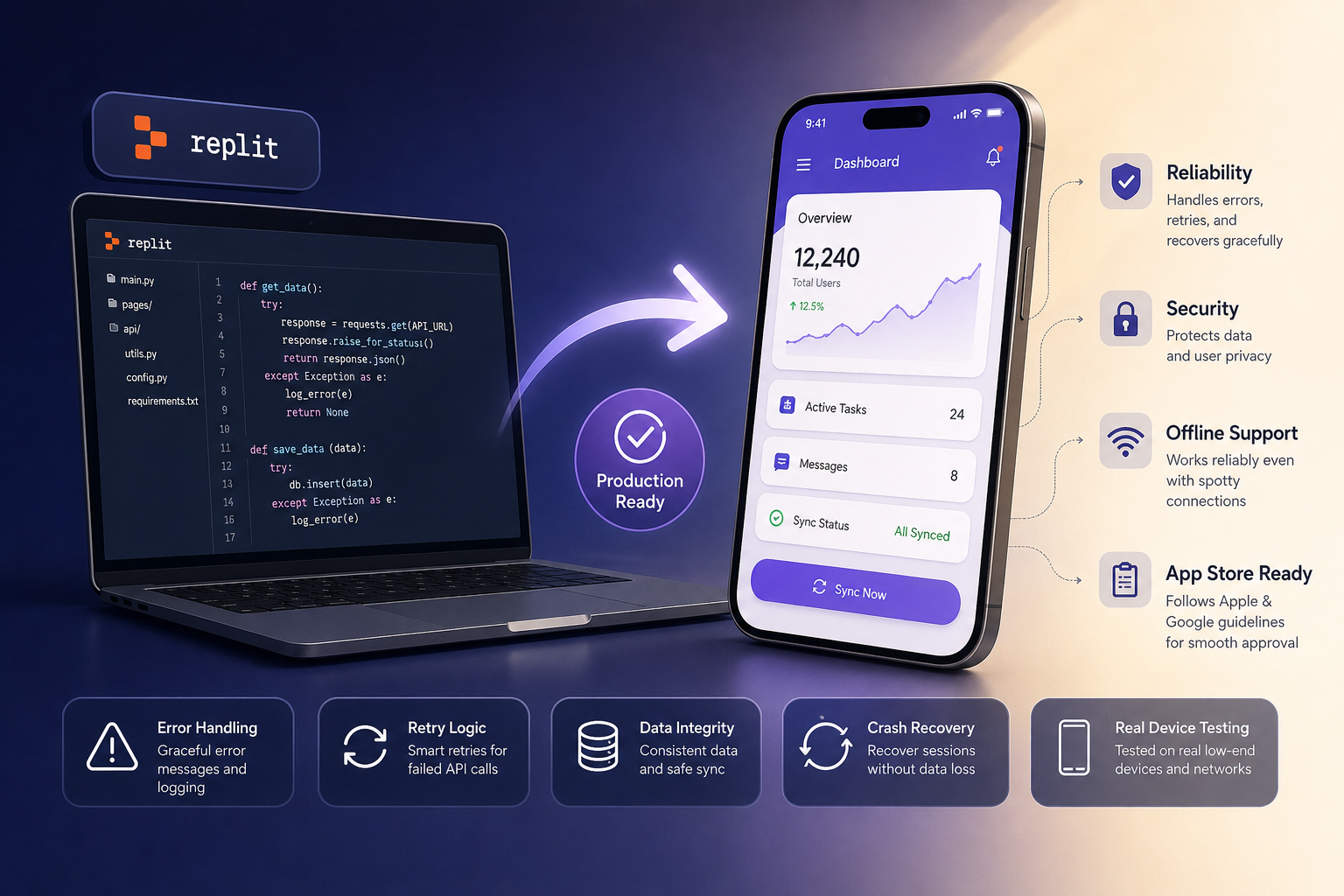
You make a Replit app production-ready by treating reliability, security, and compliance as first-class requirements rather than an afterthought. A production mobile app from Replit needs to handle spotty connections without corrupting data, recover from a crash without losing a user's session, and pass Apple and Google's review guidelines on the first submission. This is different work from the fast iteration Replit is built for, which rewards quick fixes and visible progress over defensive engineering, and it is exactly the kind of work most production mobile app from Replit engagements underestimate at the start. Replit project native development at a production standard means writing proper error boundaries, adding retry logic around API calls, and testing on real low-end devices instead of a fast development machine. None of this shows up in a demo, which is exactly why so many founders are surprised by how much Replit app production engineering separates a working prototype from something ready for a real app store audience. Every one of these steps is part of what actually makes a production-ready Replit mobile app, not a single dramatic rewrite, and it is exactly what Replit app production engineering is for.
3. What separates an AI-built Replit app from production?
What separates an AI-built Replit app from production is depth: the parts of an application that never appear on screen but decide whether a Replit project native development effort survives contact with real users. AI-assisted tools inside Replit are excellent at generating working screens and functional logic quickly, but they optimize for "it runs," not "it runs correctly under every condition a user can create," which is exactly the blind spot Replit app production engineering exists to fix. A production-ready Replit mobile app needs input validation on every form, rate limiting on public endpoints, and proper handling of the countless small failures that never occur during a demo, expired tokens, slow networks, duplicate submissions, background app kills mid-request. Replit app production engineering is the work of finding and closing these gaps systematically rather than one bug report at a time after launch. The gap is rarely visible in a walkthrough, which is exactly why it catches so many teams off guard once real users start using a production mobile app from Replit in unpredictable ways. Closing that gap is really what Replit project mobile optimization and disciplined Replit project native development are for.
4. How can Replit projects achieve reliable mobile performance?
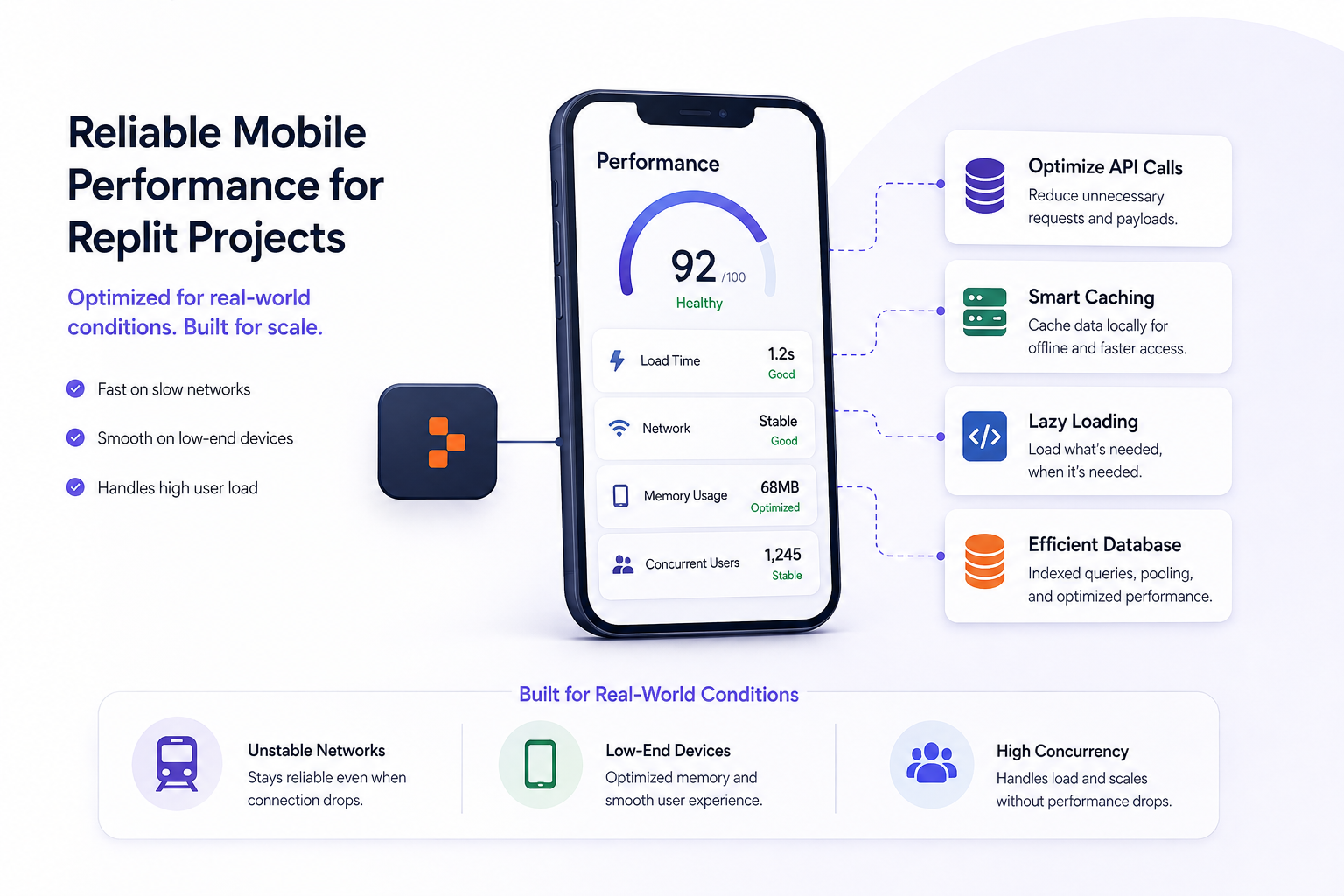
Replit projects achieve reliable mobile performance through disciplined attention to what happens outside the happy path, which is the practical definition of Replit project mobile optimization done well. Reliability on mobile means the app behaves predictably on a train losing signal, on a five-year-old Android device with limited memory, and during a spike of concurrent users hitting the same backend. Replit project mobile optimization typically starts with reducing unnecessary API calls, caching data sensibly on the device, and lazy-loading anything that is not needed on first screen load. Database queries that felt instant with ten test users can slow considerably under real concurrent load, so Replit mobile architecture development has to account for indexing, connection pooling, and query efficiency long before a launch date, not after users start complaining. Reliable performance is rarely one big fix; it is dozens of smaller ones inside a broader Replit mobile architecture development effort, each fixing a way real-world conditions differ from a controlled dev environment, which is exactly what separates a genuine production-ready Replit mobile app from one that only performed well in testing.
5. What technical work does Replit mobile production require?
Replit mobile production requires a defined body of technical work that a fast prototype simply skips, the exact scope a proper production-ready Replit mobile app demands: proper authentication and session management, structured error logging, crash reporting, automated testing, and a deployment pipeline that does not depend on manual steps. Replit app production engineering covers securing API keys that may have been hardcoded during rapid prototyping, adding server-side validation so the mobile client is never the only line of defense, and setting up monitoring that alerts a team before users notice something is broken. A production mobile app from Replit also needs a real environment strategy, separate staging and production backends, so new features can be tested without risking live user data. None of this is glamorous work, and none of it appears in a product demo, but skipping this stage of Replit project native development is the most common reason a promising Replit build struggles once it reaches app stores and a wider audience. Teams that skip it also tend to under-invest in Replit project mobile optimization, which only compounds the problem as usage grows.
6. How should a Replit app be optimized for launch?
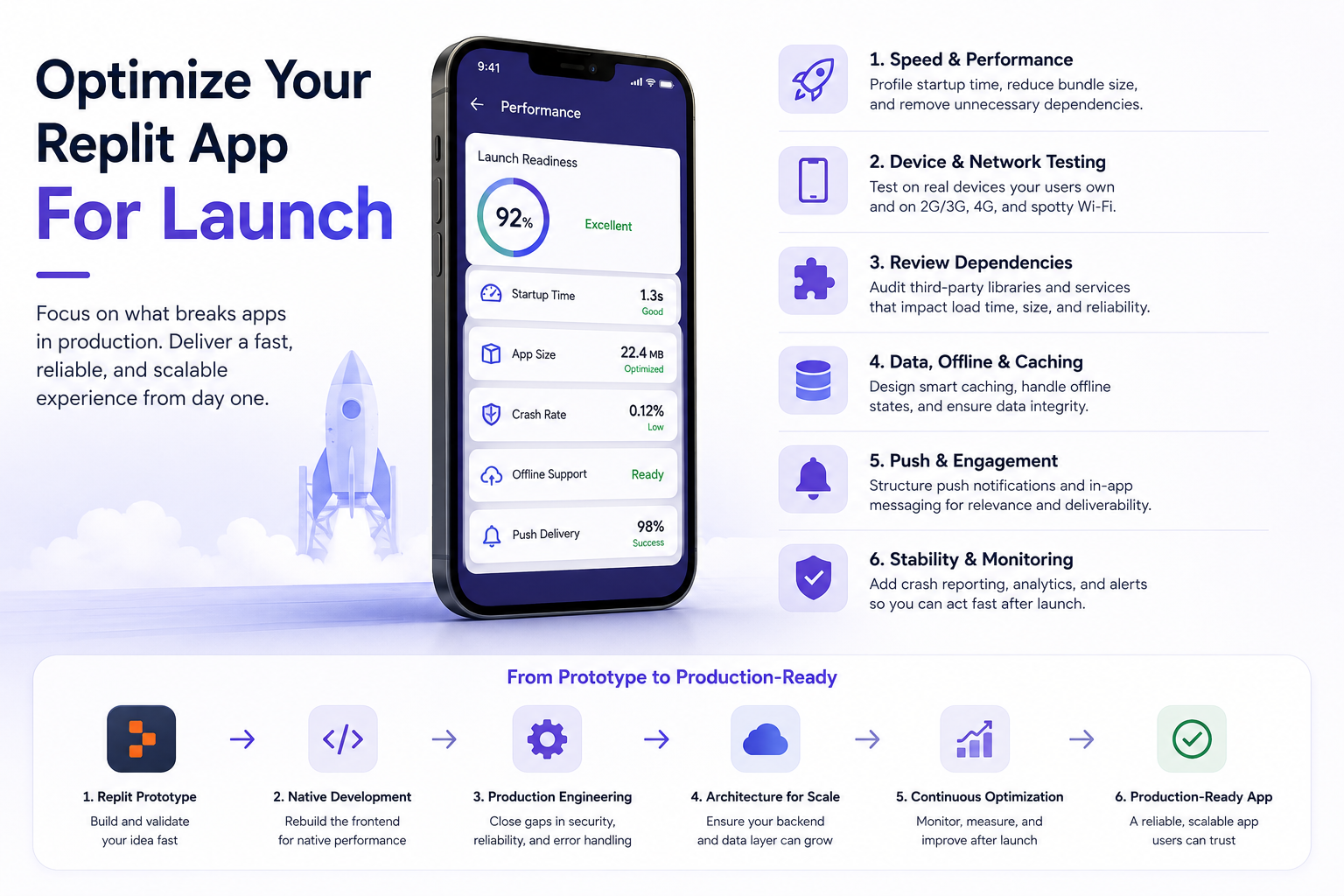
A Replit app should be optimized for launch by working backward from what actually breaks apps in production rather than adding features until the deadline arrives, the same discipline that underlies good Replit mobile architecture development. Replit project mobile optimization at this stage means profiling app startup time, reducing bundle size, and testing on the specific range of devices target users actually own, not just the newest flagship phone. Every third-party dependency should be reviewed for what it adds to load time and app size, since a slow launch screen is one of the fastest ways to lose a first-time user. Replit mobile architecture development decisions made at this stage, like how data is cached, how offline states are handled, and how push notifications are structured, tend to be expensive to change later, so getting them right before launch matters more than adding one more feature. A production-ready Replit mobile app treats launch week as the real test, not the finish line, which is the whole point of doing Replit project mobile optimization ahead of time instead of after.
Put simply, this stage touches six things: a production mobile app from Replit built for reliability, Replit project native development that rebuilds the front end properly, Replit app production engineering that closes hidden gaps, Replit mobile architecture development that survives scale, ongoing Replit project mobile optimization, and, at the end of it, a genuine production-ready Replit mobile app rather than a polished demo.
7. When does Replit need professional mobile development?
Replit needs professional mobile development when the cost of an unreliable app starts to outweigh the cost of doing the production mobile app from Replit work properly, usually right around the point where real users, not just testers, start depending on it daily. Signs that a Replit project native development engagement is overdue include recurring crashes that are hard to reproduce, performance that degrades as the user base grows, and app store rejections that keep repeating for reasons the original build never anticipated, all classic symptoms of skipped Replit app production engineering. This is precisely the gap ArixLabs works to close: taking a Replit-built app through structured Replit app production engineering so its founders stop firefighting and start shipping a genuine production-ready Replit mobile app confidently. ArixLabs treats every engagement as a full production mobile app from Replit effort, not a patch job, addressing architecture, security, and performance together instead of one crisis at a time, with Replit project mobile optimization built in from the start rather than bolted on later. Founders who bring in help at this stage typically save months compared to those who wait until a bad app store review or a lost customer forces a Replit mobile architecture development decision.
8. Why ArixLabs is the right team for this work
Most developers who touch a Replit project after the fact focus on the visible bugs and miss the structural issues underneath, which means the same Replit mobile architecture development problems resurface a few weeks later in a different form. ArixLabs approaches every production mobile app from Replit engagement by first mapping the entire system, backend, data flow, and mobile client, before writing a single fix, which is what separates real Replit app production engineering from surface-level patchwork. ArixLabs provides this service end to end: architecture review, security hardening, performance optimization, crash monitoring setup, and app store resubmission support, all handled by a team that has done Replit project native development across dozens of production launches, each one built toward a real production-ready Replit mobile app. That depth of experience with Replit mobile architecture development specifically, not generic mobile development, is what lets ArixLabs catch problems a generalist team would miss, the same instinct behind every production mobile app from Replit engagement ArixLabs runs. For a founder who has already validated the product and now needs it to hold up under real usage, ArixLabs is built for exactly this stage of the journey, turning a fragile production-ready Replit mobile app candidate into one that genuinely is ready.
Different founders describe this same need differently: some search for a production mobile app from Replit partner, others ask specifically about Replit project native development or Replit app production engineering, and some just want Replit project mobile optimization without a long explanation of why their app slows down under load. Whatever the phrasing, ArixLabs' approach to Replit mobile architecture development stays the same: audit first, fix systematically, and hand back a genuinely production-ready Replit mobile app rather than a longer list of patches.
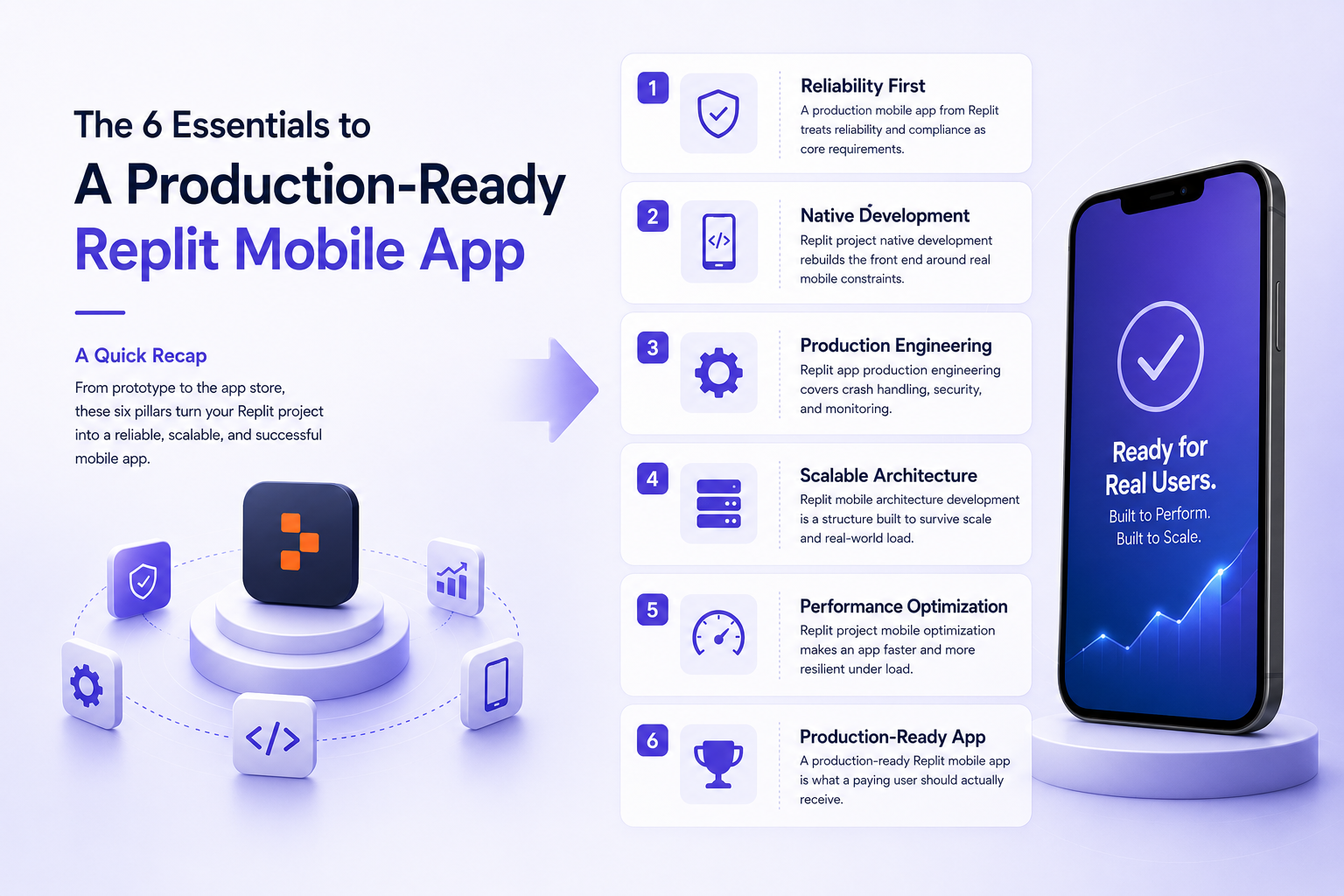
Quick recap of the same six ideas, phrased once more for anyone skimming: production mobile app from Replit work is about reliability first; Replit project native development rebuilds what needs rebuilding; Replit app production engineering closes the gaps a demo never reveals; Replit mobile architecture development is what lets an app hold up under real load; Replit project mobile optimization keeps it fast as usage grows; and the result, a true production-ready Replit mobile app, is the actual deliverable ArixLabs is hired to produce.
One more recap before the FAQ, since this is the kind of page a founder often shares with a technical co-founder:
- A production mobile app from Replit treats reliability and compliance as core requirements
- Replit project native development rebuilds the front end around real mobile constraints
- Replit app production engineering covers crash handling, security, and monitoring
- Replit mobile architecture development is a structure built to survive scale
- Replit project mobile optimization makes an app faster and more resilient under load
- A production-ready Replit mobile app is what a paying user should actually receive
9. FAQs
1. Is a Replit app ready for production?
Most Replit apps are ready for demos and early validation but not for production until they receive dedicated Replit app production engineering: proper error handling, security review, and performance testing under real conditions. A quick way to tell is whether the app has been tested on weak networks and older devices, not just the developer's own setup, since that gap is usually the difference between a demo and a true production-ready Replit mobile app.
2. Can a developer improve an existing Replit app?
Yes, an experienced team can improve an existing Replit app without discarding it, since most of the value sits in the backend logic and data model rather than the original interface, which is exactly why Replit project native development and targeted Replit project mobile optimization rarely mean starting from a blank screen. This kind of Replit project mobile optimization typically starts with an audit to identify the highest-impact fixes before any code changes begin, and it is usually far faster than a full Replit project native development rebuild from scratch.
3. How do I make Replit apps more reliable? Reliability comes from handling failure cases deliberately: retrying failed API calls, validating data on both client and server, and monitoring the app in production so issues surface before users report them. This is the core of Replit mobile architecture development done properly, and it rarely happens by accident, which is exactly why Replit project mobile optimization work and sound Replit mobile architecture development tend to pay for themselves quickly.
4. When should I hire a developer for Replit?
Hire a developer once real users depend on the app daily and any downtime or bug has a real cost, since that is when a production mobile app from Replit effort pays for itself. Waiting until after a public launch to invest in Replit app production engineering almost always costs more than doing it beforehand, and it usually means starting Replit project native development work under far more pressure than necessary to reach a genuine production-ready Replit mobile app state.
%20(1).jpg)

View more blogs


.png)
.png)
.png)




%20(1).png)
Ready to develop your own product? Get in touch today!
Get in Touch