



1. Introduction
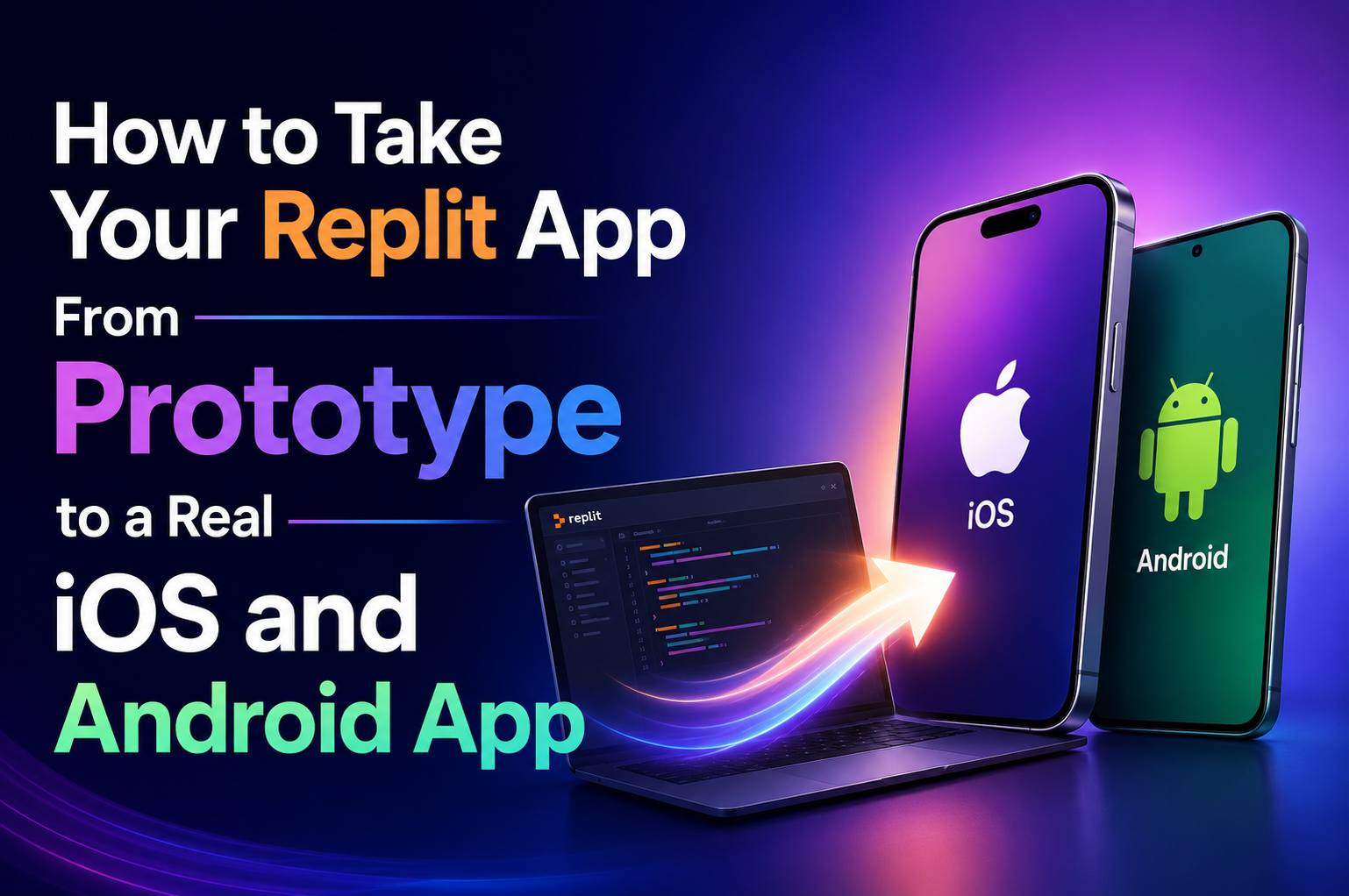
Validating an idea on Replit is the easy part compared to what comes next. Plenty of founders reach a working MVP, get real signups, and then stall, unsure whether the next step is more Replit features or something bigger. ArixLabs (previously FlutterFlowDevs) works with founders at exactly this fork in the road, helping them plan a Replit prototype to mobile app path that respects what they already validated instead of throwing it away. This piece is written for that specific moment: you have proof people want the product, and now you need to decide how a Replit MVP to native application move actually happens, and when Replit prototype iOS development and Replit prototype Android development should start.
2. How do you move a Replit prototype to mobile?
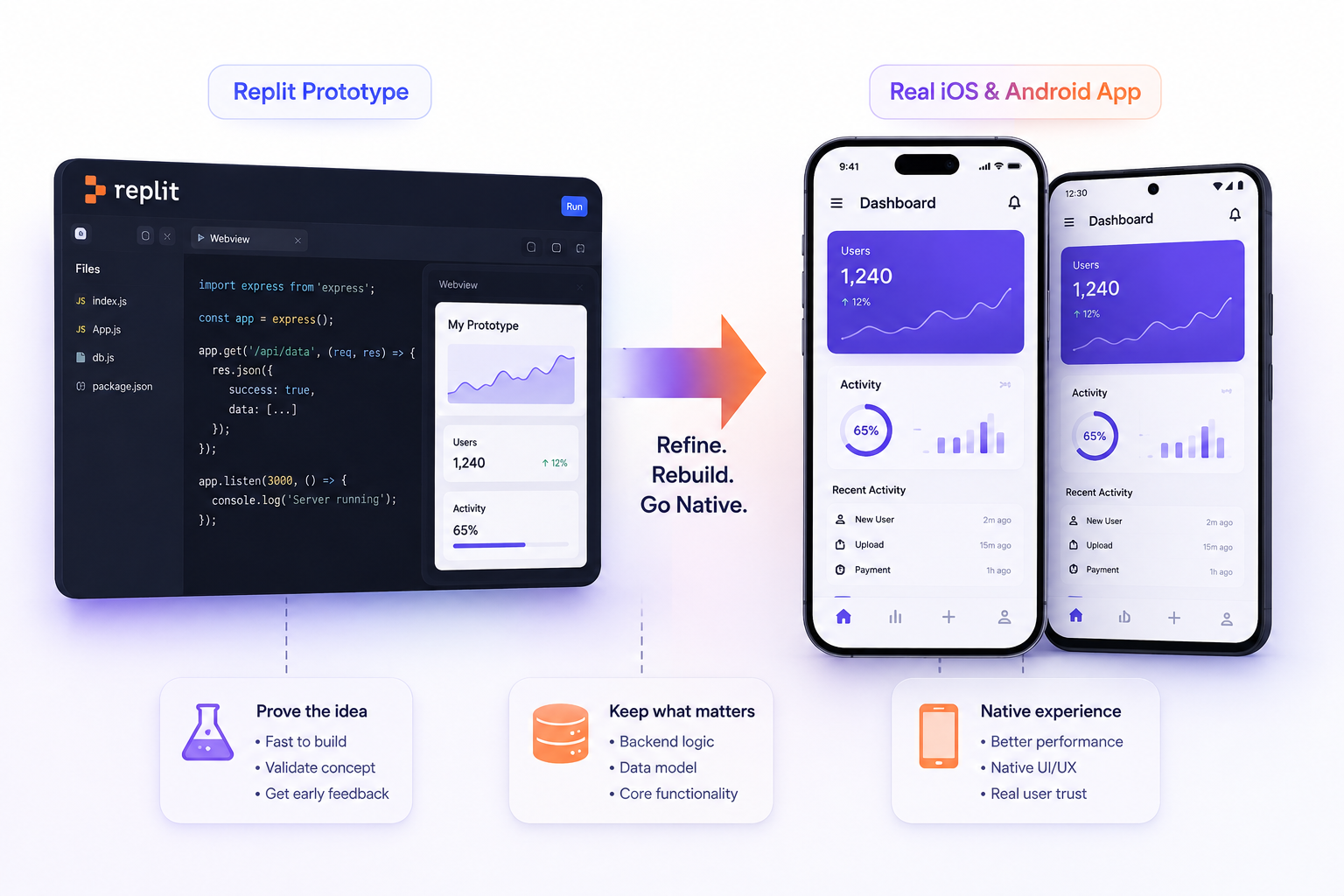
You move a Replit prototype to mobile by first deciding what "prototype" actually means for your specific app, since that word covers everything from a rough proof of concept to a fully functional product with paying users. A genuine Replit prototype to mobile app plan starts by separating the parts of the build that were only ever meant to prove a concept from the parts, usually the backend logic and data model, that are worth carrying forward, the same separation that drives every Replit MVP to native application decision later, and the first thing any real Replit prototype to mobile app audit should check. From there, the front end gets rebuilt natively rather than patched, since a prototype interface built quickly rarely survives the redesign a real mobile audience expects. Founders who skip this separation step tend to either rebuild too much, wasting money re-doing work that was already solid, or too little, carrying prototype shortcuts straight into a Replit project production mobile build real users will depend on daily.
3. What should founders do after a Replit MVP?
Founders should treat validation as the finish line of one phase and the start of another, not proof that the current build is ready to scale as-is. Once a Replit MVP to native application decision is on the table, the smart move is an honest technical audit: which parts of the backend hold up under more users, where the authentication and data model need hardening, and what the interface needs to look like once it is not just early adopters using it, before any Replit app prototype conversion work is scheduled. Founders who jump straight into adding features on the existing Replit build often find themselves adding complexity to something that was never designed to carry it, which makes the eventual Replit app prototype conversion more expensive later than if it had happened right after validation and proper Replit prototype iOS development planning. The right sequence after an MVP is usually audit, then plan, then build, not simply build more, and it applies just as much to Replit prototype iOS development as it does to Android.
4. How can a Replit prototype become production mobile?
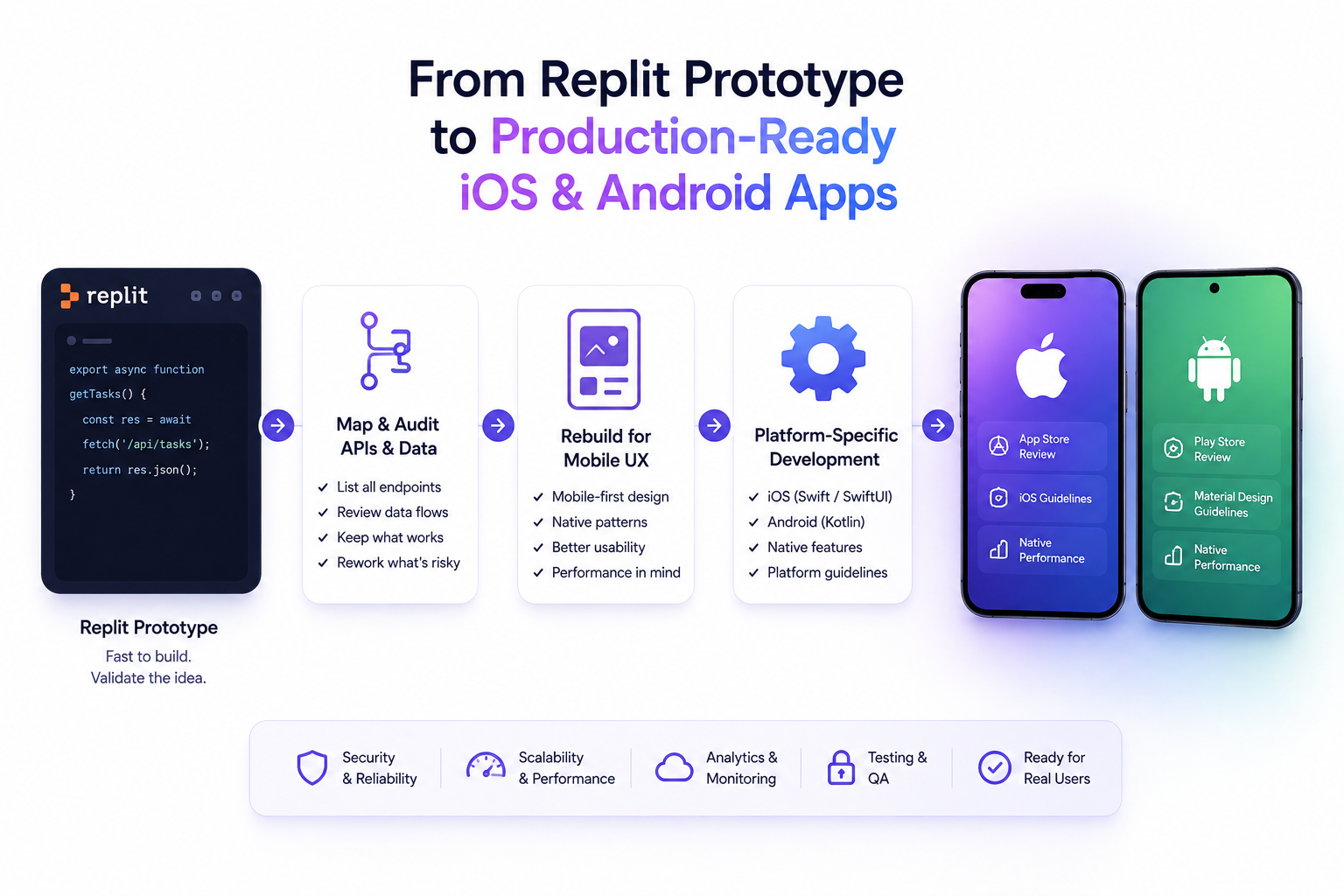
A Replit prototype becomes production mobile through a structured Replit app prototype conversion rather than continuous small patches applied to the original build. Replit project production mobile work typically starts with mapping every API endpoint and data flow the prototype currently relies on, confirming which of those are solid enough to keep and which need rework before a native front end depends on them, work that directly feeds into both Replit prototype iOS development and Replit prototype Android development. The interface itself gets rebuilt from scratch around real mobile patterns, since a prototype UI optimized for fast iteration rarely holds up to the polish real users expect from an app they pay for or rely on daily, which is exactly why Replit prototype iOS development cannot simply reuse prototype screens. This is also where Replit prototype iOS development and Replit prototype Android development genuinely diverge from web development, since each platform has its own review process, its own interaction patterns, and its own performance expectations that a prototype never had to meet, and it is exactly the work a real Replit MVP to native application transition has to account for.
5. When should a Replit MVP get dedicated development?
A Replit MVP should get dedicated development once it has proven the core idea works and the cost of staying on a prototype foundation starts outweighing the cost of a proper Replit MVP to native application rebuild. Common signals include: user growth outpacing what the current backend comfortably handles, feature requests that the prototype's architecture cannot easily support, and founders spending more time firefighting bugs than shipping anything new, all clear signs a Replit MVP to native application move is overdue, whether the priority is Replit prototype Android development or iOS. This is usually the point where a Replit prototype to mobile app conversion stops being optional and starts being the fastest path forward, since continuing to build on prototype foundations tends to slow a team down more with every additional feature, whether on the Replit prototype Android development side or iOS. Waiting too long past this point usually means a harder, more expensive Replit app prototype conversion later, since more code and more users make an eventual Replit project production mobile rebuild riskier.
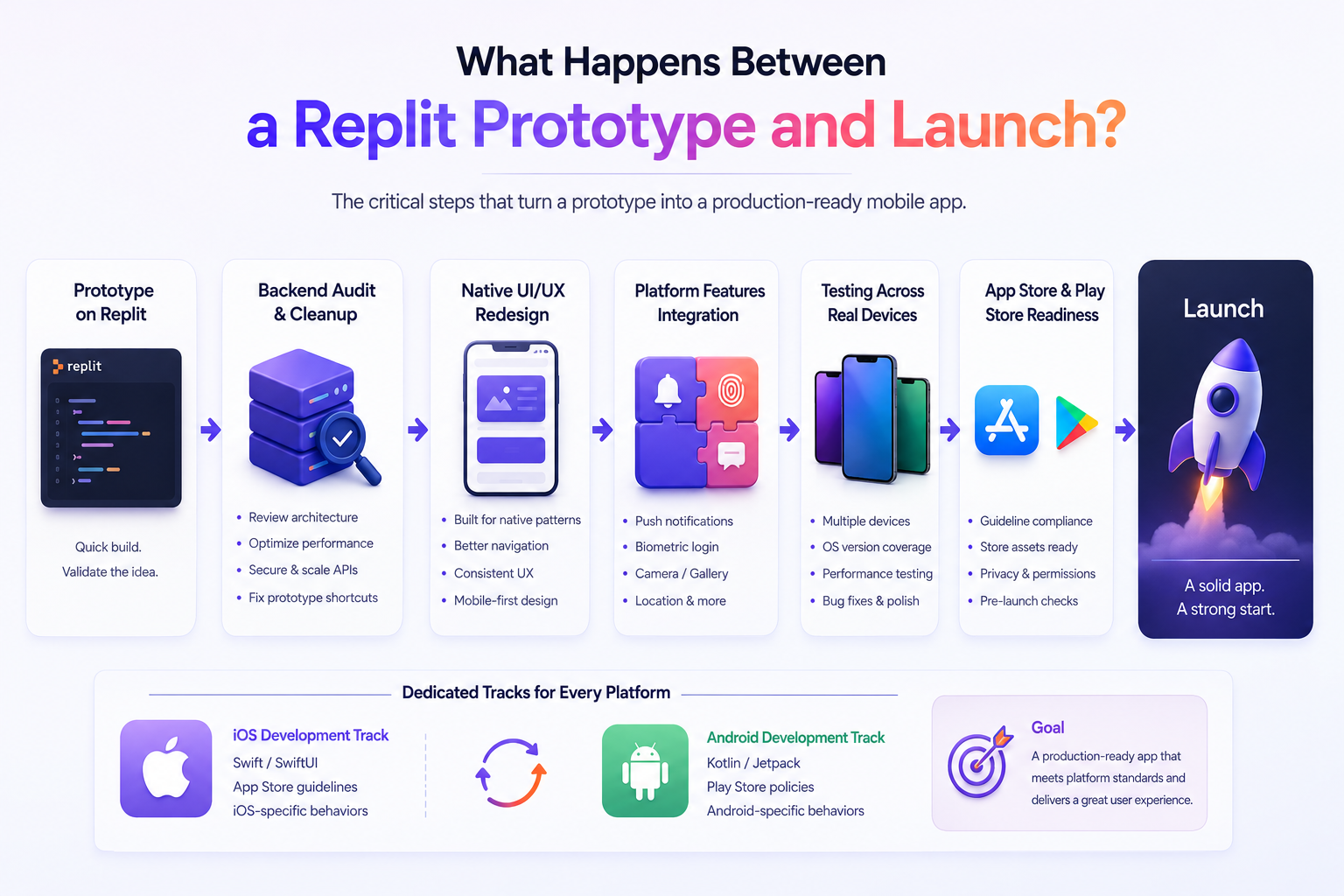
6. What happens between a Replit prototype and launch?
Between a Replit prototype and launch sits a distinct body of work that determines whether the eventual Replit project production mobile release feels solid or shaky to real users. This stretch typically includes a backend audit, a full interface redesign for native mobile patterns, integration of platform-specific features like push notifications and biometric login, and a testing phase across a real range of devices rather than just the one used during original development, all core parts of any serious Replit prototype Android development timeline and the matching Replit prototype iOS development track. Replit prototype iOS development and Replit prototype Android development both need dedicated attention here, since App Store and Play Store review processes each carry requirements a prototype was never built to satisfy. Skipping stages in this stretch is the most common reason a launch gets delayed by app store rejections that could have been caught earlier with proper Replit app prototype conversion planning across both Replit project production mobile workstreams, the same discipline behind any smooth Replit prototype to mobile app timeline.
7. How can a Replit product scale into mobile?
A Replit product scales into mobile by treating the transition as an investment in the next stage of growth rather than a one-time technical chore. Replit project production mobile architecture needs to anticipate more users, more data, and more edge cases than the prototype ever encountered, which usually means revisiting database structure, adding proper monitoring, and building an interface that can absorb new features without a redesign every few months, the same forward planning good Replit prototype to mobile app work requires from day one. Founders who plan this transition early, right after validating their Replit MVP to native application direction, generally spend less overall than those who wait until growth forces the issue under pressure. Put simply, this stage touches six things: a Replit prototype to mobile app plan that keeps validated work, a properly scoped Replit MVP to native application move, a real Replit app prototype conversion rather than patchwork, a scalable Replit project production mobile foundation, and coordinated Replit prototype iOS development and Replit prototype Android development so both platforms launch together. Scaling into mobile is rarely about adding more code; it is about making sure the code that exists can support what comes next, which is the real goal behind every Replit prototype to mobile app engagement worth doing properly.
8. Why ArixLabs is the right partner for this stage
Most agencies either want to rebuild a Replit prototype from zero, discarding validated work unnecessarily, or patch it indefinitely without ever addressing the underlying Replit project production mobile architecture. ArixLabs takes a different approach to every Replit prototype to mobile app engagement: audit what exists, decide deliberately what to keep, and build the rest with the same discipline as a first-time native app, whether the immediate priority is Replit prototype Android development or iOS. That audit-first process is what makes ArixLabs' approach to Replit MVP to native application work faster and cheaper than a blind rebuild, since validated backend logic gets reused instead of rewritten out of caution, a discipline that carries into ArixLabs' Replit project production mobile delivery too. On the front-end side, ArixLabs provides the full service end to end for this exact stage: technical audit, Replit app prototype conversion planning, native interface design, and coordinated Replit prototype iOS development and Replit prototype Android development, so both platforms launch together. For a founder who has proven the idea and now needs a real Replit project production mobile foundation under it, ArixLabs is built specifically for this Replit prototype to mobile app transition, not a generic mobile build from scratch.
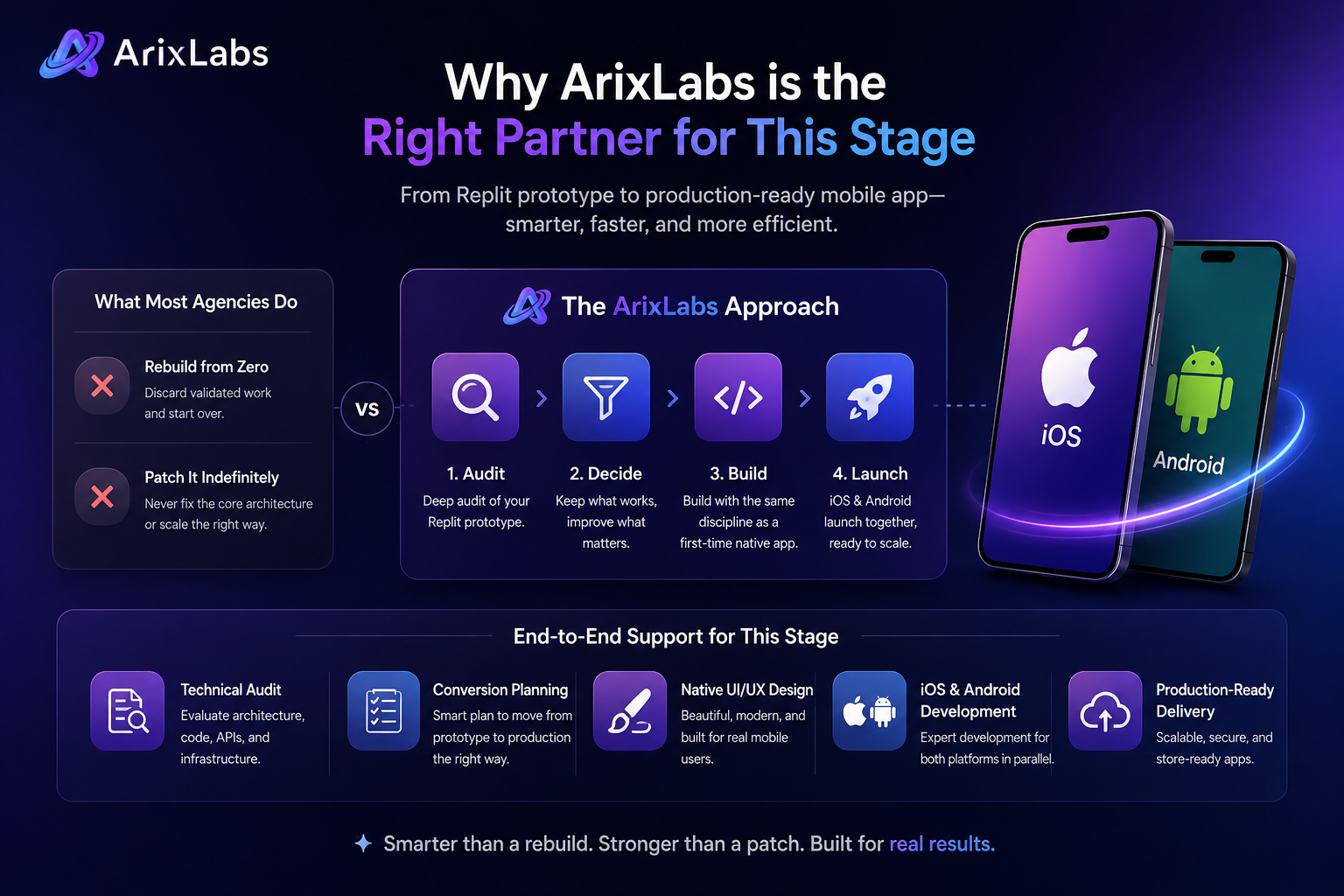
Different founders phrase this same need differently: some ask how to move a Replit prototype to mobile app, others specifically want to know what a Replit MVP to native application engagement involves, and some just want a straight Replit app prototype conversion without extra jargon. Whatever the phrasing, the underlying need is the same: a Replit project production mobile foundation built by people who know which parts of a prototype are worth keeping, delivered through disciplined Replit prototype iOS development and Replit prototype Android development rather than a rushed Replit MVP to native application rebuild.
Quick recap before the FAQ:
- A Replit prototype to mobile app plan keeps what already works and rebuilds the rest
- A Replit MVP to native application move is usually phased, not an overnight rewrite
- A proper Replit app prototype conversion separates lucky code from real architecture
- Replit project production mobile is the target state once the work is done
- Replit prototype iOS development and Replit prototype Android development run together
- The right sequence is always audit, then Replit app prototype conversion, then Replit project production mobile launch
9. Frequently Asked Questions
1. Can a Replit MVP become a business app?
Yes, a Replit MVP can become a genuine business app once the validated backend logic goes through a proper Replit app prototype conversion and the interface is rebuilt for real mobile use. The core idea proven on Replit rarely needs to change, only the engineering underneath it, including dedicated Replit prototype iOS development and Replit prototype Android development work, plus a solid Replit MVP to native application plan up front.
2. What should I do after validating with Replit?
After validating with Replit, the next step is an honest technical audit rather than adding more features on the existing build, since a Replit prototype to mobile app plan built on a clear audit tends to cost less than one built on guesswork. This audit should identify what stays and what gets rebuilt before any Replit app prototype conversion work begins, since a rushed Replit app prototype conversion almost always costs more later.
3. Can a Replit prototype keep its existing data?
Yes, in almost every case a Replit MVP to native application conversion preserves existing user data and database structure, since the database rarely needs to change even when the front end is fully rebuilt for Replit prototype iOS development and Replit prototype Android development, which is one more reason a full Replit prototype to mobile app rebuild is less risky than it sounds.
4. Is native development worth it after an AI MVP?
Native development is worth it once real users depend on the app daily, since a Replit project production mobile build delivers the performance, reliability, and app store presence a browser-based or wrapped prototype cannot match. Waiting too long to make this move usually costs more than making it early, and it typically means a harder Replit app prototype conversion later.
%20(1).jpg)

View more blogs
.png)


.png)
.png)

Ready to develop your own product? Get in touch today!
Get in Touch