



1. Apps Are Changing Fast — But Why Are AI Agents Leading the Shift?
A year ago, most apps simply responded to user inputs. Today, users expect more-personalized recommendations, natural conversations, and automated actions. This shift is driving the rapid growth of AI Agent Development in 2026.
Unlike traditional chatbots, AI agents can understand context, remember users, and perform tasks within an app. Combined with FlutterFlow, teams can build, test, and launch AI-powered experiences much faster, making innovation more accessible than ever. In a fast-moving market, speed is becoming just as important as the idea itself.
2. Isn’t This Just Another AI Chatbot App?
Not really.
A typical AI chatbot app responds to questions. An AI agent goes further — it can remember context, trigger actions, and adapt based on user behavior.
That difference matters more than people think.
For example, a chatbot may answer, “Your order is delayed.” An AI agent can check the delivery status, notify the customer, offer support options, and update the workflow automatically.
That’s why businesses are investing more heavily in AI Agent Development instead of basic chat experiences.
You’ll see this shift across industries already. Ecommerce apps are building AI shopping assistants. Fitness apps are generating dynamic plans. SaaS platforms are adding AI copilots directly into dashboards.
And most users don’t even call them “AI agents.” They just notice the app feels smarter.
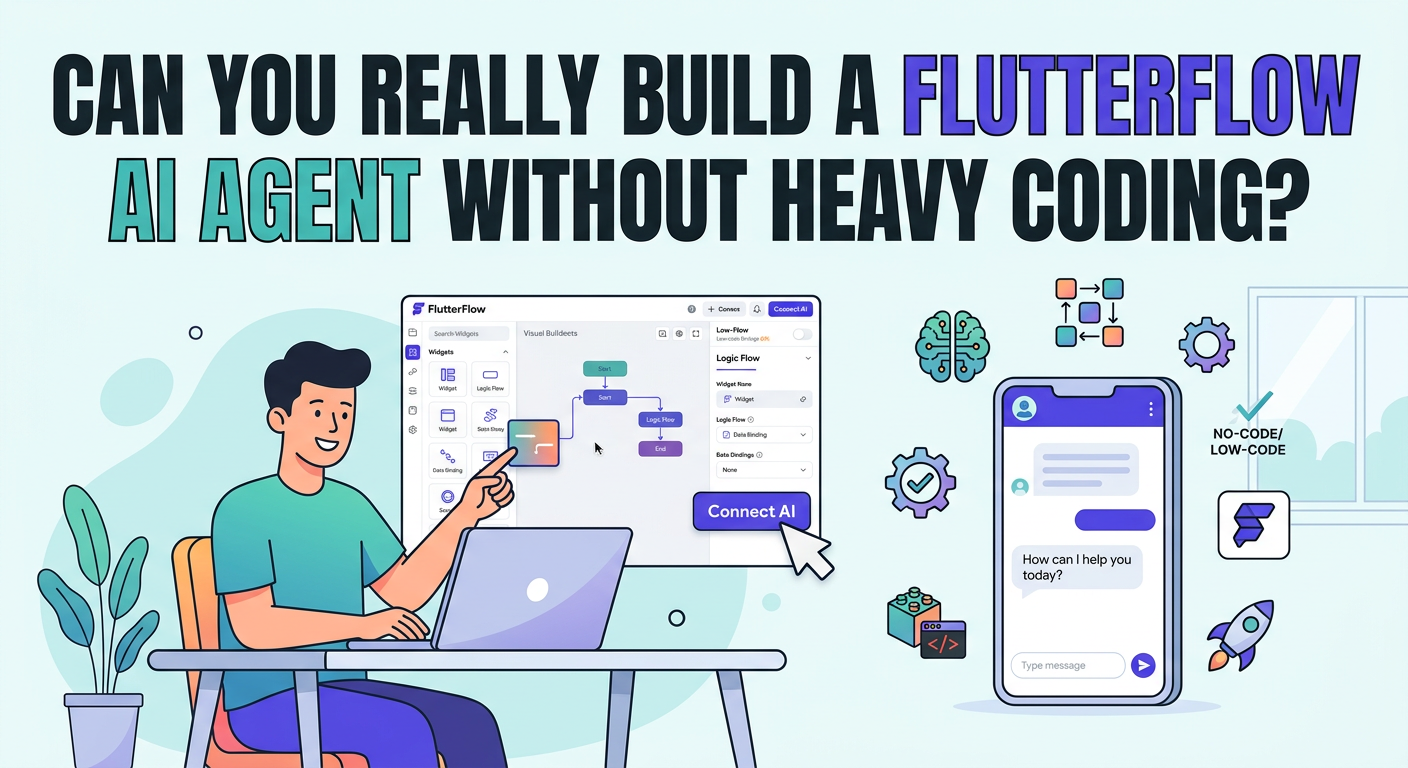
3. So, Can You Really Build a FlutterFlow AI Agent Without Heavy Coding?
Surprisingly, yes.
A few years ago, building AI-powered apps meant setting up complex backend systems from scratch. Now, teams are using FlutterFlow as a visual layer for faster AI App Development.
The process is much simpler than most people expect.
You design the app UI, connect APIs like OpenAI or Gemini, create workflows, and manage responses visually. That’s one reason FlutterFlow is becoming popular as a No-code AI app builder for startups and internal tools.
The real advantage isn’t “no coding.” It’s faster iteration.
Teams can test AI features quickly, change prompts, improve workflows, and launch updates without rebuilding the entire app. For early-stage products, that flexibility matters a lot.
And yes, developers are still important. But they’re spending less time building repetitive infrastructure and more time improving the actual user experience.
4. Why Are Startups Suddenly Choosing No-Code AI App Builders?
Mostly because speed wins.
Startups don’t want to spend months building infrastructure before testing an idea. They want to launch fast, collect feedback, and improve quickly. That’s exactly why the No-code AI app builder space is growing so aggressively in 2026.
AI products also change constantly.
A workflow that works today might need adjustments next month. Teams need flexibility — not rigid systems that take weeks to update. Visual app builders make that process much easier.
This is also changing how founders approach MVPs. Instead of building a large platform first, many are starting with one focused AI feature. Sometimes it’s an assistant. Sometimes it’s automation. Sometimes it’s a smart recommendation engine.
Small products. Faster launches.
And when combined with modern APIs, even smaller teams can now build experiences that used to require dedicated AI departments.
5. What Kind of AI Apps Are Businesses Actually Building Right Now?
A lot of them don’t even look like “AI apps” at first.
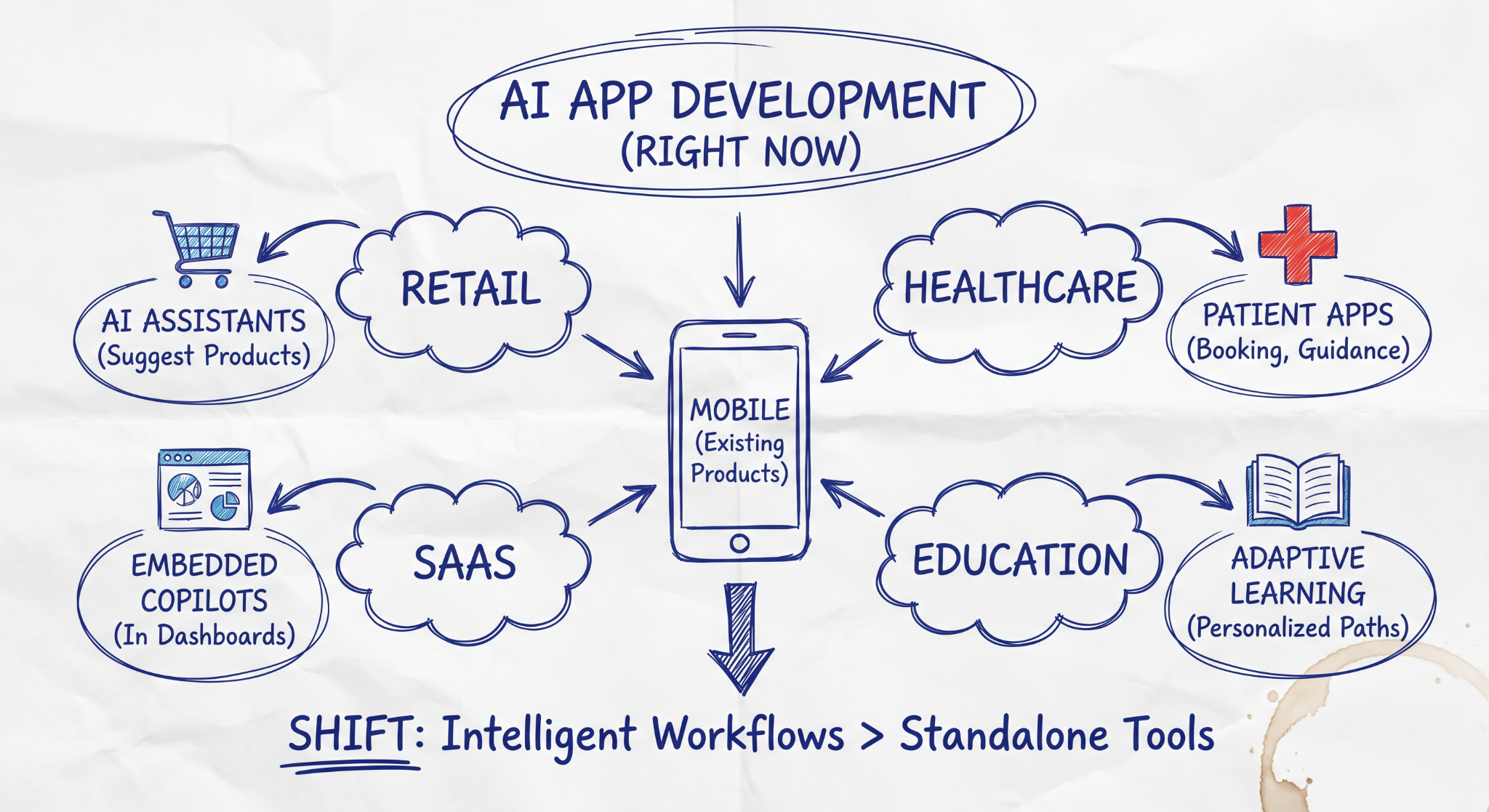
Retail brands are adding AI shopping assistants that suggest products based on browsing behavior. Healthcare apps are helping patients book appointments and get basic guidance faster. SaaS companies are embedding AI copilots directly into dashboards.
Even education apps are changing.
Instead of static lessons, some platforms now generate personalized learning paths in real time. The experience feels more adaptive, less repetitive.
This is where AI App Development is moving now — toward apps that respond differently for every user.
And mobile plays a huge role here. Most businesses aren’t building standalone AI tools anymore. They’re adding intelligent workflows inside existing products users already open daily.
That shift is happening quietly, but fast.
6. AI Agent Development Sounds Great… But What’s the Catch?
AI agents still make mistakes. Sometimes very confident mistakes.
That’s probably the biggest challenge in AI Agent Development right now.
Responses can be inaccurate, workflows can fail, and poorly designed prompts can create unpredictable outputs. Businesses also have to think about API costs, privacy, and moderation — especially when apps handle user data.
There’s another issue people underestimate: over-automation.
Not every workflow should be controlled entirely by AI. In many cases, the best products still keep humans involved for approvals, support escalation, or sensitive decisions.
So while AI agents are becoming more capable, guardrails matter just as much as intelligence.
The companies building reliable AI products in 2026 aren’t the ones adding AI everywhere. They’re the ones using it carefully where it actually improves the experience.
7. What Will FlutterFlow AI Apps Look Like After 2026?
Probably more invisible than people expect.
AI features are slowly moving into the background instead of acting like standalone tools. Users won’t open an app thinking, “I’m using AI.” They’ll just notice the experience feels faster, more personal, and less repetitive.
Voice interactions will grow too. So will AI-driven workflows that can handle scheduling, recommendations, support, and automation without constant user input.
At the same time, businesses are becoming more selective about implementation. Many are now working with the Best FlutterFlow agency teams to build AI features that actually fit the product instead of adding AI just for marketing.
That shift matters.
Because the next generation of apps probably won’t be judged by how much AI they use — but by how naturally the experience works.
8. Conclusion
The conversation around AI has changed quickly. Businesses are no longer asking whether they should use AI. They’re trying to figure out where it creates the most value.
That’s why AI Agent Development is becoming part of modern product strategy instead of an experimental feature.
FAQ
Can FlutterFlow connect with OpenAI or Gemini?
Yes. FlutterFlow supports API integrations, which makes it possible to connect models like OpenAI, Gemini, and Claude inside mobile or web apps.
Are AI agent apps expensive to build?
It depends on the complexity. Basic AI workflows are now much cheaper to launch compared to a few years ago, especially with visual builders and existing AI APIs.
Can AI agents work inside mobile apps?
Absolutely. Many businesses are already embedding AI assistants, recommendation systems, and automation features directly into mobile apps.
Is FlutterFlow good for AI-powered products?
For many startups, yes. It speeds up prototyping, testing, and iteration, especially when combined with modern AI APIs and backend services.
%20(1).jpg)

View more blogs
-p-1600.png)
.png)

.png)
.png)
.png)

.png)

Ready to develop your own product? Get in touch today!
Get in Touch