.png)

.png)


1. Introduction
Building a music streaming platform is far more complex than most founders expect. A modern apple music clone requires audio streaming infrastructure, playlist systems, user management, recommendations, offline listening, and scalable backend architecture before the app is even ready for launch.
That is exactly why we created LoopIt - Music Player App.
LoopIt was built to help startups, creators, and businesses launch faster using a ready-made apple music template instead of spending months developing everything from scratch. Many teams enter the streaming industry with strong ideas but struggle with long development cycles and high production costs. Even a basic music streaming app clone can take months to build properly.
The purpose behind LoopIt is simple: give businesses a faster way to launch scalable music platforms while keeping full flexibility for customization, branding, and user experience. Instead of rebuilding common streaming features, teams can focus more on growth, audience engagement, and content strategy from day one.
2. Why We Built LoopIt ?
Most music app templates stop at design.
A few screens. A music player. Maybe playlists. But building a real music streaming app clone takes far more than UI components. Streaming platforms need smooth playback systems, scalable architecture, search performance, notifications, user management, and backend optimization working together continuously.
That gap is exactly why we created LoopIt - Music Player App.
We wanted to build a practical music app template that helps startups move beyond prototype-level apps and launch something closer to a production-ready streaming platform. Instead of giving businesses disconnected screens, LoopIt was designed as a flexible apple music template with the core streaming structure already prepared for scaling and customization.
Another reason behind LoopIt was speed.
A lot of founders spend months rebuilding features that already exist across most streaming platforms. Using ready-made apple music code allows teams to skip repetitive development work and focus more on audience growth, branding, and content strategy instead of rebuilding infrastructure from zero every single time.
3. Core Features Included in LoopIt
A modern apple music clone needs much more than a music player.
People now expect personalized recommendations, offline listening, playlists, podcasts, artist pages, smooth search, and fast streaming across every device. If any of these feel slow or incomplete, users leave quickly.
That mindset shaped how we built LoopIt.
Instead of creating another basic UI-based music streaming app clone, we focused on building something founders could actually launch and scale.
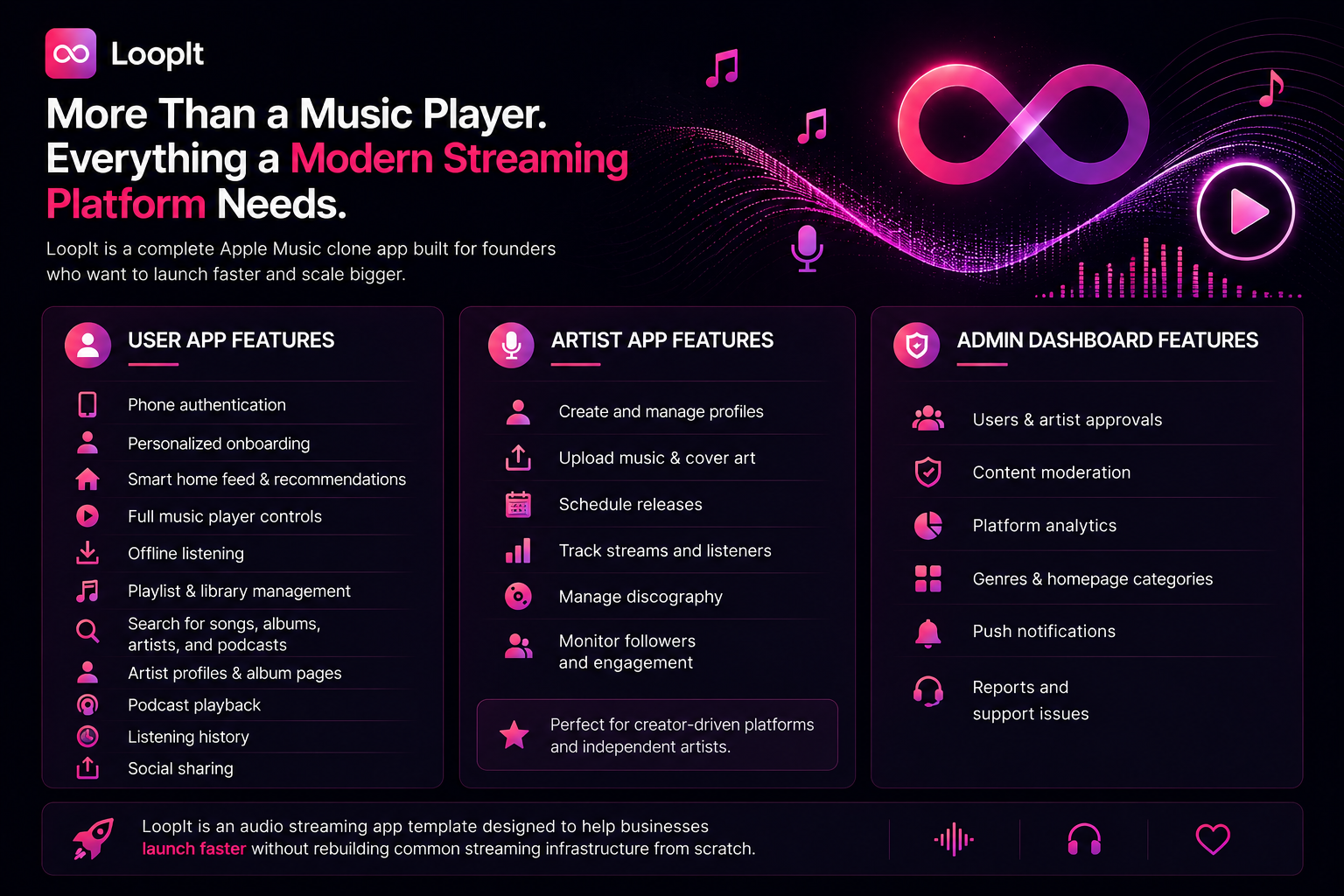
User App Features
The user side of LoopIt includes:
- Phone authentication
- Personalized onboarding
- Smart home feed & recommendations
- Full music player controls
- Offline listening
- Playlist & library management
- Search for songs, albums, artists, and podcasts
- Artist profiles & album pages
- Podcast playback
- Listening history
- Social sharing
Artist App Features
Artists can:
- Create and manage profiles
- Upload music & cover art
- Schedule releases
- Track streams and listeners
- Manage discography
- Monitor followers and engagement
That makes the music app template useful for creator-driven platforms as well.
Admin Dashboard Features
Admins can manage:
- Users & artist approvals
- Content moderation
- Platform analytics
- Genres & homepage categories
- Push notifications
- Reports and support issues
As an audio streaming app template, LoopIt was built to help businesses launch faster without rebuilding common streaming infrastructure from scratch.
4. Why Flutter Made Sense for LoopIt
We tested a lot of ideas before building LoopIt properly.
At first, the goal was simple.. create a clean streaming app. But once features like playlists, podcasts, offline listening, recommendations, and artist uploads started coming together, performance became a serious priority.
Music apps break easily when the experience feels slow.
If songs buffer too much, search feels delayed, or scrolling becomes heavy, users leave almost immediately. That pushed us toward Flutter. It gave us smoother UI performance and a faster way to manage both Android and iOS from the same codebase.
For startups building an apple music clone flutter app, that matters a lot because maintaining separate native apps usually increases both cost and development time.
We also wanted the project to stay customizable.
Businesses using LoopIt can still modify layouts, streaming flows, branding, and platform structure without touching the entire architecture. The backend was structured carefully too, so authentication, playlists, notifications, and streaming systems already work together instead of being patched later using random plugins or disconnected services.
That is where ready-made apple music code saves a huge amount of effort during development.
5. Tech Stack Behind LoopIt
The tech stack behind a streaming platform matters more than most people realize.
Music apps constantly handle playback requests, search queries, playlists, notifications, uploads, and user activity at the same time. If the architecture is weak, performance issues start appearing very quickly as the platform grows.
That is why LoopIt was built with scalability and flexibility in mind from the beginning.
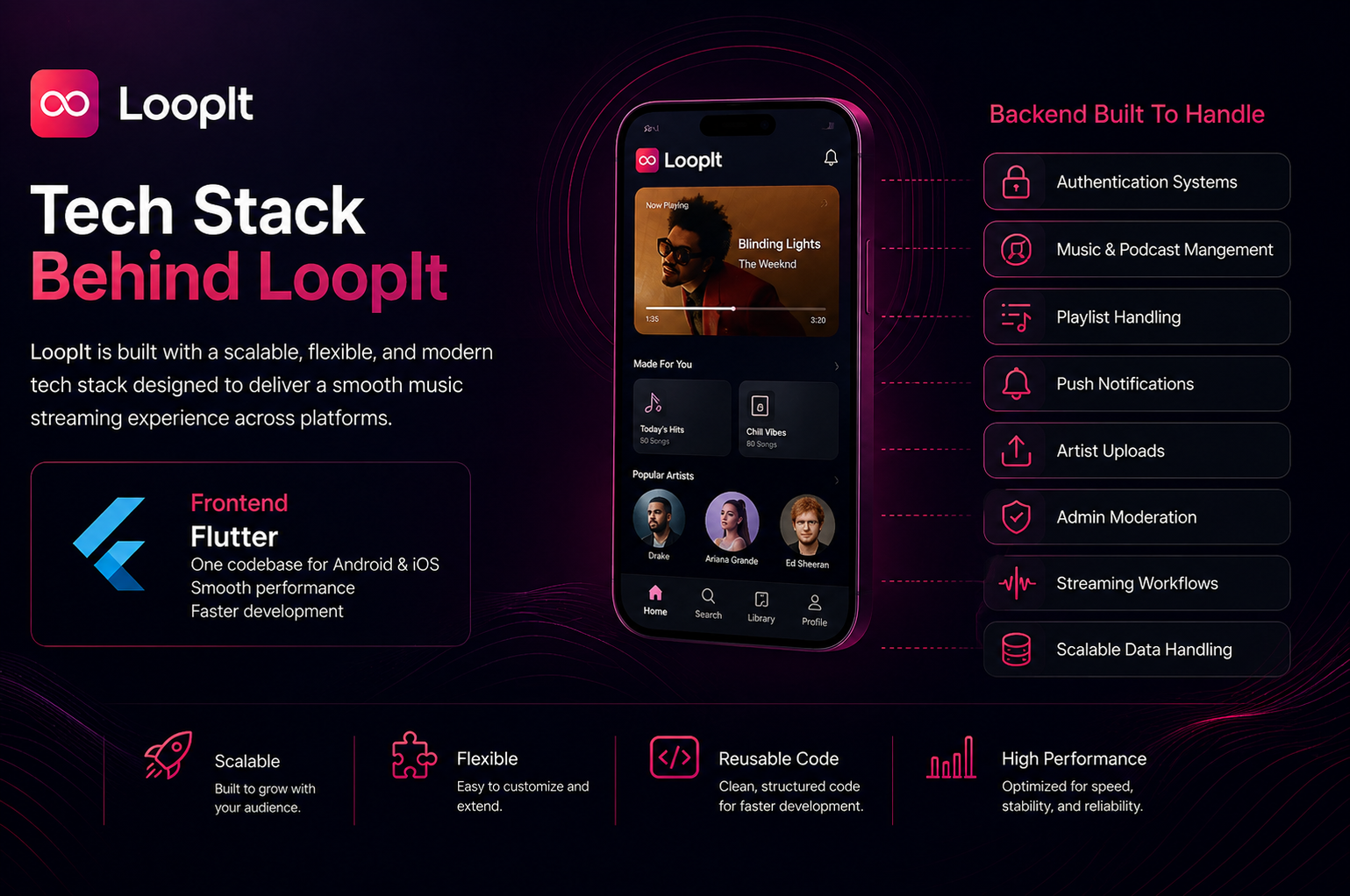
The frontend uses Flutter to maintain a smooth experience across both Android and iOS using a single codebase. This makes the apple music clone flutter architecture faster to manage, easier to customize, and more practical for startups trying to launch quickly.
On the backend side, the platform is structured to support:
- Authentication systems
- Music & podcast management
- Playlist handling
- Push notifications
- Artist uploads
- Admin moderation
- Streaming workflows
- Scalable data handling
The goal was not just to create a UI template, but to provide reusable apple music code that businesses can actually build on long term.
As an audio streaming app template, LoopIt was designed to reduce repetitive development work while still giving teams full flexibility over customization and scaling.
6. Launch Your Music Streaming Platform Faster with LoopIt
Building a streaming platform completely from scratch can easily take months. Most teams spend huge amounts of time setting up authentication, playlists, streaming systems, artist modules, admin dashboards, and backend infrastructure before they even reach the testing stage.
LoopIt was created to simplify that process.
Instead of rebuilding common streaming features again and again, businesses can use LoopIt as a ready-to-launch apple music template with the core platform structure already prepared. The template helps startups move faster while still keeping full flexibility for customization, branding, and feature expansion.
Whether someone wants to launch:
- a regional music platform
- an artist-focused app
- a podcast streaming platform
- or a full music streaming app clone
LoopIt provides a much faster starting point compared to building everything manually.
For teams trying to reduce development time and launch earlier, using ready-made apple music code often becomes the more practical decision. Instead of spending months on repetitive infrastructure work, businesses can focus more on users, content, partnerships, and growth.
FAQ
1. Is Flutter good for music streaming apps?
Yes. Flutter supports smooth performance and faster cross-platform development.
2. Where can founders get ready-made apple music code?
Templates like LoopIt help founders launch faster without building from scratch.
3. Can I customize an Apple Music Clone App?
Yes. LoopIt is fully customizable for branding, features, and UI.
4. Does the music app template include admin features?
Yes. It includes admin controls, analytics, moderation, and notifications.
5. Is Flutter suitable for large-scale streaming apps?
Yes. Flutter works well for scalable Android and iOS streaming platforms.
%20(1).jpg)

View more blogs
.png)



.png)
%20(1).png)

Ready to develop your own product? Get in touch today!
Get in Touch