

.png)


1. Introduction
Building an application with Emergent can dramatically shorten the distance between an idea and a working product. A business can validate a concept, create user flows, connect functionality, and put a usable web application in front of customers without following the long development cycle traditionally associated with software products.
The next challenge often appears when users want the product on their phones.
A browser-based application and a native mobile application may share the same business purpose, but they provide very different experiences. Mobile users expect touch-friendly navigation, fast loading, reliable sessions, push notifications, device integrations, and interfaces designed specifically for smaller screens.
That is why an Emergent web app to mobile project should be approached as a product transformation rather than a simple website conversion.
ArixLabs provides mobile development services for businesses that want to take existing web and AI-built applications into production-ready mobile products. The team can evaluate the existing application, identify reusable functionality, redesign the experience for mobile, develop the required application frontend, connect backend services, test across devices, and support app-store deployment.
For companies planning an Emergent native mobile conversion, this approach can preserve the valuable work already completed while avoiding the mistake of simply shrinking a web interface onto a phone.
The objective of turn Emergent into mobile app development is therefore not to make the existing website look smaller. It is to create an application that feels natural on iOS and Android while continuing to deliver the functionality users already understand.
2. Can an Emergent app become native mobile?
Yes, an existing Emergent application can become the foundation for a native mobile product.
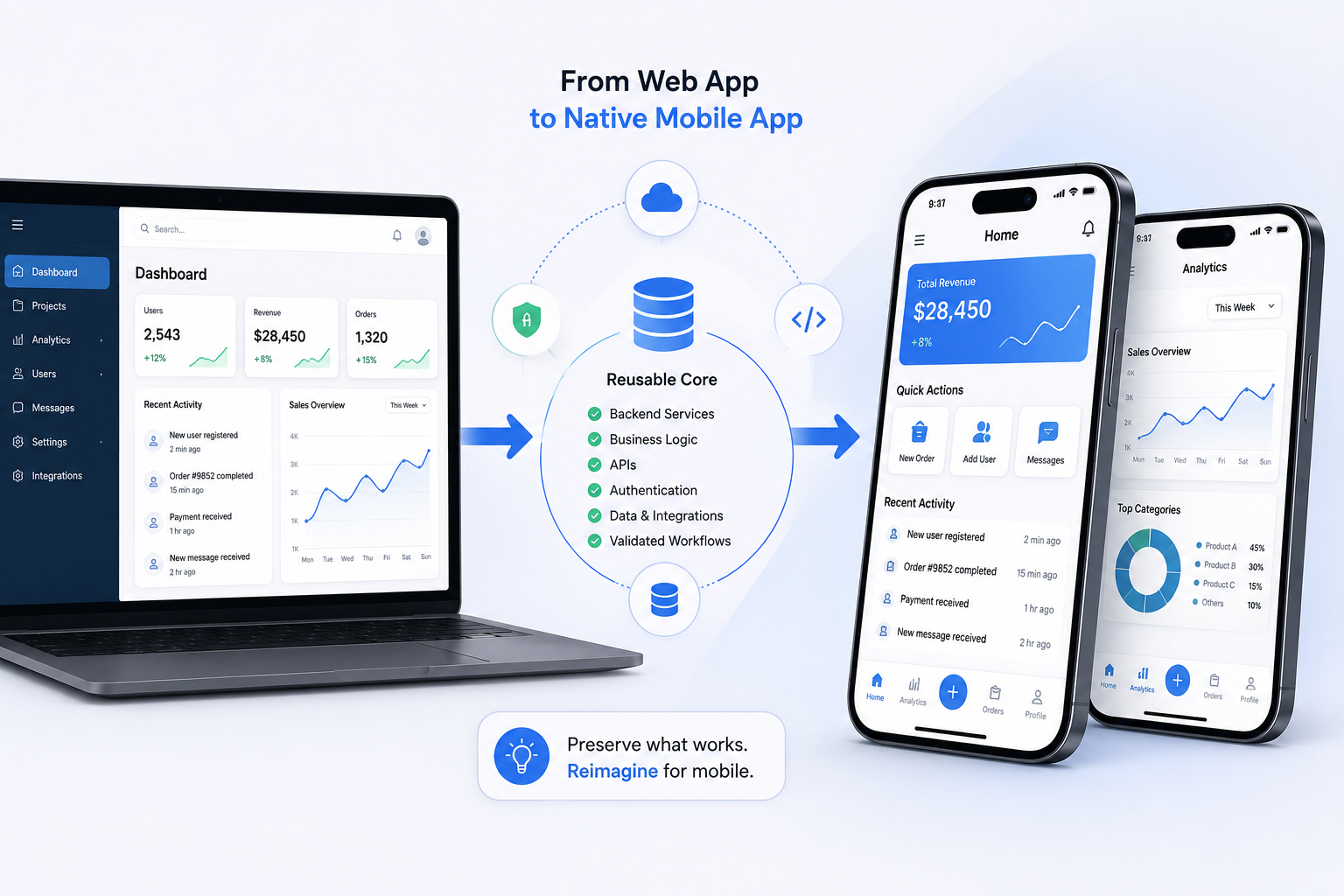
However, the existing application should be assessed before development begins. A web product may contain valuable backend services, business rules, APIs, authentication, data, integrations, and validated workflows. Those components may be reusable even when the web interface itself is not.
This distinction is critical during an Emergent web app to mobile project.
The frontend is usually the part that needs the greatest transformation. A browser application may rely on large screens, mouse interaction, persistent navigation, and browser-specific behavior. A mobile application must work with touch, limited screen space, interruptions, operating-system lifecycle events, and device permissions.
During Emergent native mobile conversion, developers should therefore separate the product into reusable functionality and mobile-specific experience.
Business logic that already works does not necessarily need to be recreated. User journeys, however, may need substantial redesign.
For example, an existing web dashboard could have a sidebar with numerous categories. On mobile, those same functions may be reorganized around a few primary actions. A large web form might become a short multi-step workflow. A browser upload could become camera or photo-library functionality.
This is how businesses can turn Emergent into mobile app without unnecessarily rebuilding everything.
The objective is to preserve what has already been validated while making the experience appropriate for smartphones.
3. How do you convert Emergent to iOS and Android?
The process begins with discovery.
A development team should first understand how the existing application works before deciding how to rebuild its frontend.
3.1 Can an Emergent backend support a native app?
An existing backend can potentially support a native application if it exposes the functionality required by the mobile client through reliable services or APIs.
The fact that the backend was originally used by a web application does not automatically make it unsuitable for mobile.
During an Emergent native mobile conversion, developers should evaluate authentication, authorization, API endpoints, database interactions, file handling, session management, validation, error handling, and performance.
If the backend already provides clean APIs, the mobile application may be able to reuse much of that infrastructure.
If it does not, targeted backend improvements may be required.
This makes the backend one of the most important parts of an Emergent web app to mobile assessment.
The goal should not be to rebuild the backend simply because a mobile application is being introduced. Instead, the team should identify what is already strong and extend only what is necessary.
That approach makes it easier to turn Emergent into mobile app while protecting the existing product investment.
3.2 How can Emergent authentication work on mobile?
Authentication needs to be adapted to mobile behavior.
A website generally manages a browser session. A mobile application may remain installed and signed in for long periods. Users can close the application, lose connectivity, switch between applications, or return after several days.
An Emergent native mobile conversion should therefore consider secure token storage, token refresh, session expiration, account recovery, email verification, and authorization.
Biometric authentication can also be introduced where it provides genuine value.
The existing account system may remain the source of truth, but the mobile client needs an authentication experience appropriate to the operating system.
This is important in both Emergent app native iOS development and Emergent app Android development.
A well-designed Emergent web app to mobile architecture should allow users to move between web and mobile without feeling that they are using two unrelated products.
3.3 Which Emergent features can move to native apps?
Many existing features can potentially be included, but not every web feature belongs in the first mobile release.
A useful way to decide is to examine how frequently users need each feature and whether mobile makes the workflow better.
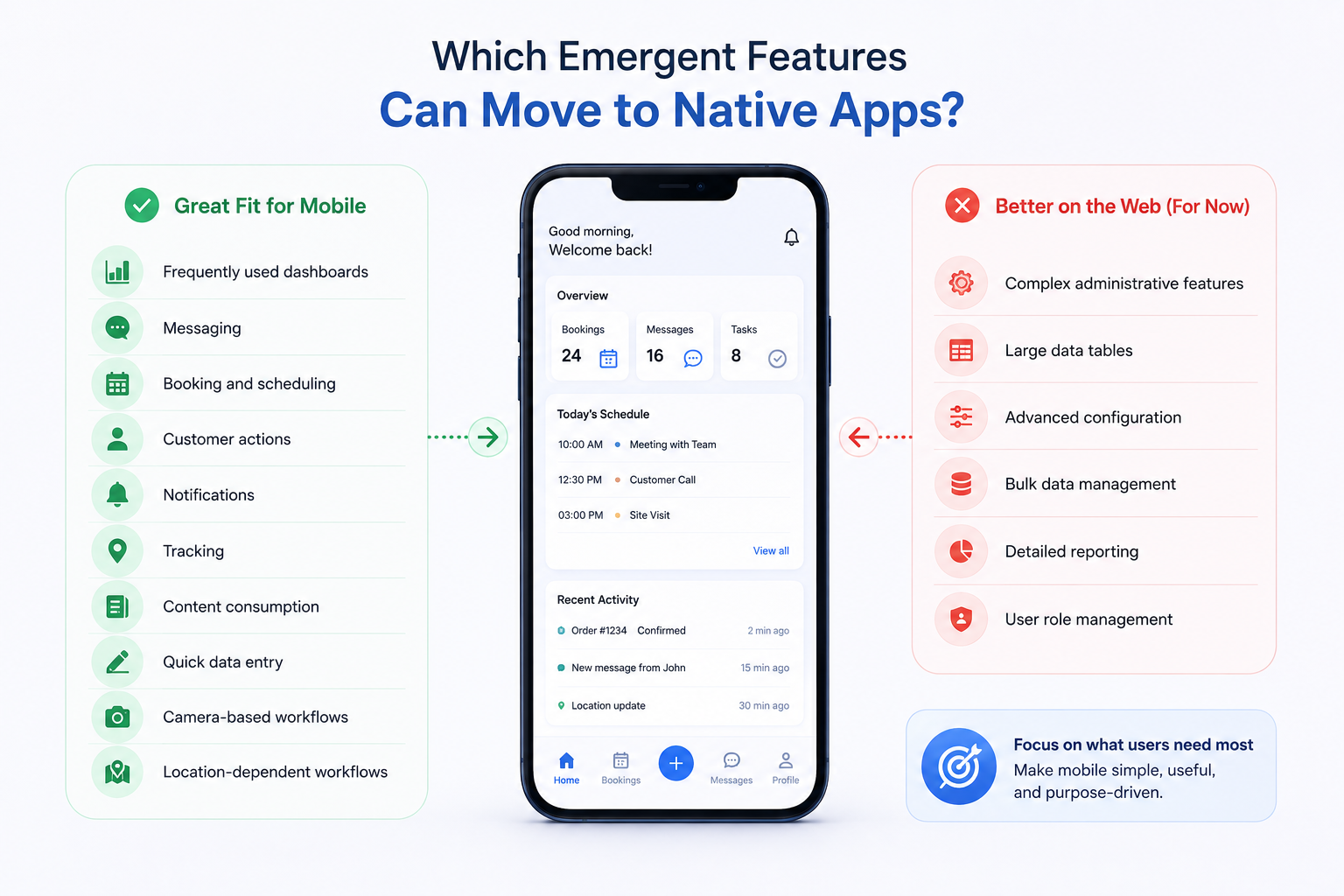
Features that often make sense on mobile include:
- Frequently used dashboards
- Messaging
- Booking and scheduling
- Customer actions
- Notifications
- Tracking
- Content consumption
- Quick data entry
- Camera-based workflows
- Location-dependent workflows
Complex administrative features, large data tables, and advanced configuration may remain more appropriate for the web.
This selective approach is important for turn Emergent into mobile app projects because mobile applications become difficult to use when every desktop feature is forced into a small screen.
The strongest Emergent native mobile conversion focuses on the workflows users genuinely need while keeping advanced functionality accessible elsewhere when appropriate.
3.4 How should Emergent screens be redesigned for mobile?
Mobile redesign should begin with hierarchy rather than visual styling.
Users should immediately understand where they are, what the screen does, and what action they should take next.
A browser page can contain multiple panels, large navigation structures, dense tables, and several competing actions. On a phone, that same structure can become overwhelming.
A successful convert Emergent website to app strategy simplifies the hierarchy.
Important actions should be easy to reach. Forms should minimize typing. Content should be divided into manageable sections. Navigation should reflect the most important user journeys.
Touch targets should be comfortable, text should remain readable, and the interface should behave predictably when the keyboard appears.
This is one reason Emergent app native iOS development requires more than copying web layouts.
The same principle applies to Emergent app Android development, where device diversity makes responsive mobile thinking especially important.
3.5 Which features require custom Emergent mobile development?
Some features require dedicated mobile engineering because they interact directly with the device or operating system.
These can include:
- Push notifications
- Camera access
- Location
- Biometrics
- Deep links
- Native file access
- Background operations
- Mobile sharing
- App lifecycle handling
- Platform-specific payment functionality
These capabilities should not be added simply because they are available.
The right Emergent web app to mobile strategy asks whether a native capability makes a user's task faster, easier, or more useful.
For example, a field-service application may benefit significantly from camera and location features. A productivity application may gain value from notifications and biometric access.
When such functionality genuinely supports the product, it becomes a meaningful part of turn Emergent into mobile app development.
4. What is the process for taking Emergent to mobile?
A structured process reduces risk.
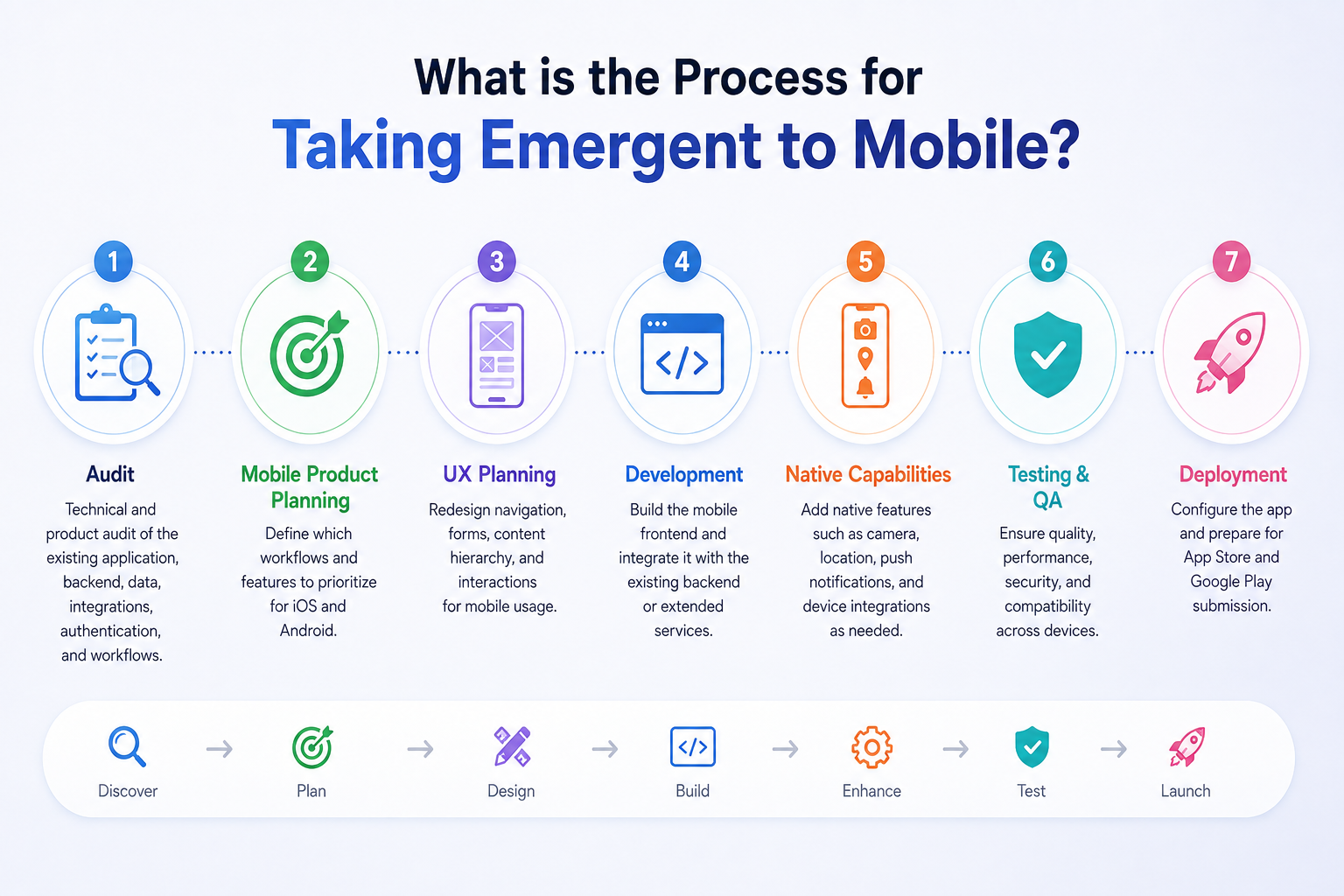
The first stage is a technical and product audit. The team examines the existing application, backend, data, integrations, authentication, and user workflows.
The second stage is mobile product planning.
Rather than copying every existing feature, the team defines which workflows should be prioritized for iOS and Android.
The third stage is UX planning.
The existing web experience becomes a reference rather than a fixed design. Navigation, forms, content hierarchy, and interactions are redesigned around mobile usage.
The fourth stage is development.
The mobile frontend is implemented and connected to the existing backend or newly extended services.
The fifth stage introduces native capabilities where necessary.
The sixth stage covers testing and quality assurance.
Finally, the application is configured and prepared for store submission.
This end-to-end approach is central to an Emergent native mobile conversion.
It also makes convert Emergent website to app projects easier to manage because every phase has a clear purpose.
Businesses should resist approaches that promise an instant conversion without examining the existing architecture. A technically quick conversion can become expensive later if navigation, authentication, backend communication, or device behavior were never properly considered.
ArixLabs follows a more deliberate approach, combining discovery, mobile UX, engineering, testing, and deployment.
5. What changes when moving Emergent from web to native?
The most important change is the interaction model.
A website is accessed through a browser. A mobile application becomes part of the user's device environment.
That creates different expectations.
Users expect the application to open quickly, remember context, respond naturally to touch, handle interruptions, and work reliably on mobile networks.
During Emergent app native iOS development, this means considering iOS navigation patterns, safe areas, permissions, lifecycle events, notifications, and platform conventions.
During Emergent app Android development, developers must also account for the diversity of Android hardware, screen sizes, operating-system versions, and manufacturer-specific behavior.
The application should also handle situations such as:
- Temporary loss of connectivity
- Backgrounding
- Permission denial
- Session expiration
- Keyboard appearance
- Interrupted workflows
- Device rotation where applicable
- Large and small screens
A proper Emergent web app to mobile strategy therefore changes behavior as well as appearance.
The product should feel like it belongs on a phone.
6. Can Emergent functionality be reused in mobile?
Yes, and reuse is one of the biggest opportunities in an Emergent native mobile conversion.
Existing business rules, APIs, user accounts, data, integrations, and backend services can potentially support the new mobile product.
The important thing is to reuse the right layers.
A business should not have to create a second customer database merely because it is launching an iOS application.
Similarly, pricing logic or business rules should not be duplicated in multiple places when they can remain centralized.
The mobile frontend can become another client of the product's existing service layer.
This can make turn Emergent into mobile app development faster, easier to maintain, and less disruptive.
However, reuse should never become an excuse for poor mobile UX.
The backend may remain largely unchanged while the frontend is redesigned significantly.
That balance is one of the main benefits of a professional Emergent web app to mobile strategy.
7. How can Emergent become a production mobile app?
A production mobile application must work beyond ideal development conditions.
Users will have different devices, network conditions, usage patterns, and expectations.
Production readiness therefore requires more than implementing screens.
The application should include reliable authentication, secure data handling, predictable API communication, robust error states, performance optimization, analytics, crash monitoring, and proper application lifecycle handling.
Testing should include real devices and realistic network conditions.
This is particularly important for Emergent app Android development, where hardware and software diversity can be significant.
The same principle applies to Emergent app native iOS development.
The application should be tested against the versions and device types relevant to its audience.
A professional Emergent native mobile conversion should also consider how updates will be released.
A mobile application is not finished after the first store submission. Operating systems change, third-party services evolve, and customers request improvements.
The architecture should therefore support ongoing development.
ArixLabs can help businesses move through this complete journey, from the initial assessment to production release and future improvements.
8. FAQ
Can Emergent build mobile applications?
Emergent can be a strong starting point for creating application concepts and web products. A polished production mobile experience generally requires dedicated mobile development, UX work, testing, and deployment.
Can an Emergent project become an iPhone app?
Yes. An existing project can be evaluated and used as the foundation for a dedicated iOS application.
Can Emergent apps reach Google Play?
Yes. An Android application can be developed from the existing product and prepared for Google Play distribution.
Why build custom native mobile from Emergent?
Custom mobile development allows businesses to create an experience designed around smartphones while taking advantage of native capabilities, app-store distribution, and mobile-specific workflows.
9. Conclusion
Taking an existing application from web to mobile does not mean starting again.
A thoughtful Emergent web app to mobile strategy identifies the valuable functionality already available and combines it with a purpose-built mobile experience.
The best Emergent native mobile conversion balances reuse with redesign. Existing backend services and business logic can often remain valuable, while navigation, interfaces, authentication behavior, device capabilities, and performance need to be adapted for mobile.
Through Emergent app native iOS development and Emergent app Android development, businesses can transform an existing product into an application that feels natural on both platforms.
For companies ready to turn Emergent into mobile app, ArixLabs provides the product strategy, design, development, testing, backend integration, and deployment expertise needed to make the transition properly.
%20(1).jpg)

View more blogs



.png)
.png)

.png)
.png)
Ready to develop your own product? Get in touch today!
Get in Touch