




1. Introduction
The FCA does not care how fast you shipped. It cares whether you can prove control: of customer money, of customer data and of the suppliers who build your product. That is the tension behind every founder who wants to hire vibe coding agency for fintech in UK work. AI-assisted development promises a working product in weeks, but regulated finance rewards evidence, not speed. This guide shows UK founders what vibe coding can safely deliver, where authorisation and anti-money-laundering rules bite, and how to choose a partner who understands both.
ArixLabs is a Jaipur-based agency that builds with vibe coding, with every AI-drafted change checked by a senior engineer before it ships, and 100+ production apps behind it. Whether you are comparing vibe coders for fintech startup in London against an in-house hire, or planning fintech app development with vibe coding in UK markets for the first time, the sections below set out the costs, rules and questions that matter.
2. Is vibe coding safe for fintech?
Yes for the right layers, no for others, and the dividing line is whether a mistake can move or misstate money. Vibe coding handles interfaces, onboarding journeys, dashboards and back-office tools well, because errors show up quickly and cost little. It needs tight supervision around payments, balances, safeguarding records and authentication. FCA-regulated firms stay responsible for outsourced work under its outsourcing and operational resilience expectations, so the AI's speed never transfers the accountability. Sensible fintech app development with vibe coding in UK therefore keeps humans approving anything that touches customer funds. Vibe coders for fintech startup in London should explain exactly where that boundary sits, and when you hire vibe coding agency for fintech in UK work, ask them to draw it on a whiteboard.
2.1 Which fintech features should never be rushed?
Never rush the ledger, money movement, safeguarding reconciliation, strong customer authentication, fee and FX calculations, and regulatory reporting. Each has a silent failure mode, such as a rounding error or a repeated payment, and each can start a regulatory conversation. Build these slowly, test them aggressively and make sure at least two humans understand every line. Any team doing fintech app development with vibe coding in UK should treat this list as a no-rush zone.
2.2 Can vibe-coded code pass a security review?
Yes, because reviewers test the system, not the authorship. Expect scrutiny of access control, input validation, secrets and dependencies. Commission a penetration test from a CREST-accredited provider, aim for Cyber Essentials Plus or ISO 27001 if buyers ask for them, and keep review records for every change. Teams offering fintech app development with vibe coding in UK should arrive with this evidence ready.

3. How much does a fintech MVP cost in the UK?
A focused fintech MVP typically lands in the tens of thousands of pounds when built with vibe coders, with the spread driven by how many regulated rails you touch rather than by screen count. A data-only app that connects to bank accounts through open banking sits at the low end. Holding balances, issuing cards or collecting direct debits adds partner integration, reconciliation and testing. Vibe coding shrinks the interface share of the bill. It does not shrink legal advice, compliance design or security testing. Ask any supplier of fintech app development with vibe coding in UK to quote in pounds, splitting build, compliance support and monthly running costs, and compare like with like when you hire vibe coding agency for fintech in UK work from several firms.
3.1 Which costs sit outside the build quote?
Authorisation fees and legal support, KYC and sanctions-screening checks, open banking provider fees, safeguarding bank accounts, professional indemnity and cyber insurance, and penetration tests. Founders new to fintech app development with vibe coding in UK often meet these only in month three. Vibe coders for fintech startup in London should list them in the first proposal.
3.2 How does vibe coding change what you pay for?
You pay less for repetitive interface and boilerplate work and the same for judgement: architecture, compliance design and review. A supplier of fintech app development with vibe coding in UK that cuts review time to hit a low price is selling you risk, so ask how many senior hours each release receives before you hire vibe coding agency for fintech in UK work.
4. Do I need FCA authorisation or an EMI licence?
Probably, if your app performs a regulated activity, and the activity decides the permission rather than the technology. Providing payment services needs authorisation or registration under the Payment Services Regulations 2017, issuing electronic money needs an e-money licence, lending needs consumer credit permission, and arranging investments brings its own permissions. Applications can take months, and the FCA expects a credible business plan, safeguarding arrangements and competent governance.
Get a regulatory lawyer involved before you hire vibe coding agency for fintech in UK work, because design decisions follow from the permission you seek. Fintech app development with vibe coding in UK moves quickly, but authorisation sets the real launch date.
4.1 Can I avoid authorisation by partnering?
Often, yes, by building on an authorised partner. You can operate as an appointed representative of an authorised firm, or use a banking-as-a-service provider that holds the licence and sets the rules. You still carry obligations, and the FCA has pushed principals to supervise their partners closely. Vibe coders for fintech startup in London can design for either route, provided you tell them which one you are taking.
4.2 How long does authorisation take?
Plan in months, not weeks. The FCA reviews complete applications against statutory deadlines, but incomplete applications stall, and regulators often ask follow-up questions about governance, safeguarding and outsourcing. Explain to vibe coders for fintech startup in London that your launch date depends on the permission, and ask them to build a pilot that can run under a partner while you wait. Founders about to hire vibe coding agency for fintech in UK work often assume the code sets the schedule, when authorisation usually does.

5. What are my UK AML obligations?
If you are a regulated financial business, you must follow the Money Laundering Regulations 2017. That means a firm-wide risk assessment, customer due diligence, ongoing monitoring, a nominated officer who reports suspicious activity to the National Crime Agency, staff training and record keeping, typically for five years after the relationship ends. The FCA supervises most financial firms, and sanctions compliance sits alongside AML.
Design the product so these duties are easy to meet: capture the right data at onboarding, flag unusual patterns and keep an audit trail of every decision. Fintech app development with vibe coding in UK can build those controls quickly, but a compliance officer, not an AI, must own the policy. Ask vibe coders for fintech startup in London who has implemented AML flows before you hire vibe coding agency for fintech in UK work.
5.1 How do I handle KYC and AML checks?
Use specialist providers for identity verification, liveness checks, PEP and sanctions screening, such as Veriff, Sumsub or ComplyAdvantage, and follow the guidance published by the Joint Money Laundering Steering Group. Vibe coders for fintech startup in London should show their manual review tooling. Combine automated decisions with a manual review queue, and store verification results in a way you can explain to an examiner. Before you hire vibe coding agency for fintech in UK work, check which verification vendors the team has integrated.
5.2 What does the FCA Consumer Duty mean for your app?
If you serve retail customers, the Consumer Duty expects you to deliver good outcomes on products, price and value, customer understanding and support. In an app, that means clear journeys, tested wording, easy ways to get help and monitoring that shows whether customers are succeeding. Interface work is where fintech app development with vibe coding in UK helps most, because journeys can be built, tested and revised in days. Ask vibe coders for fintech startup in London how they test comprehension, not just clicks.
6. What is open banking and how do apps use it?
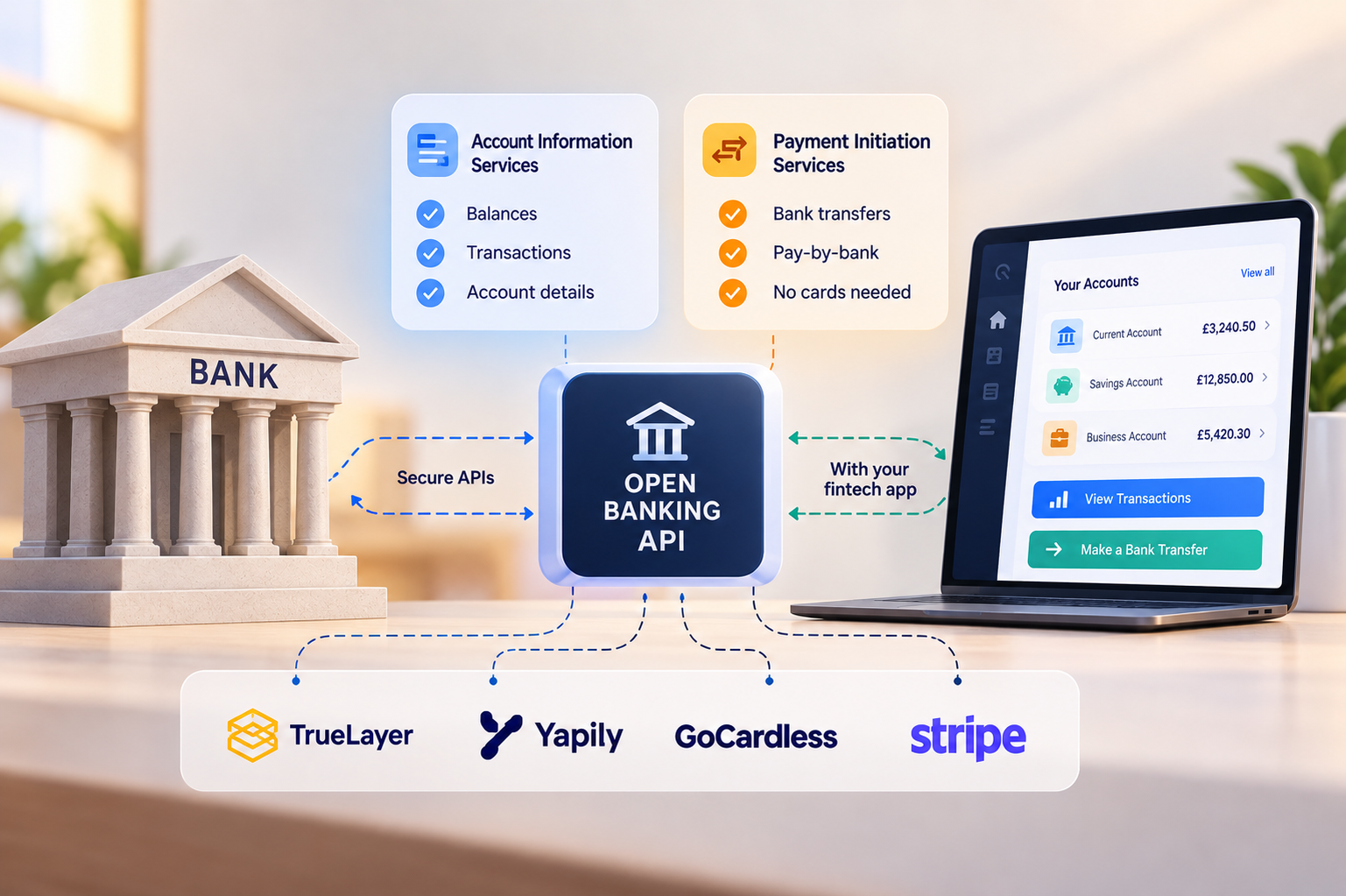
Open banking lets customers share account data or authorise payments from their bank with a regulated third party, using secure APIs instead of passwords. Account information services let your app read balances and transactions. Payment initiation services let it trigger bank transfers without cards. Providers need FCA permission for these services, so most startups plug into an authorised provider such as TrueLayer, Yapily or GoCardless. Variable recurring payments are an emerging option for flexible pay-by-bank.
This is where fintech app development with vibe coding in UK shines, because provider documentation is thorough and interface work is fast. Vibe coders for fintech startup in London should still handle consent, token storage and error states with care, and when you hire vibe coding agency for fintech in UK work, ask to see a past open banking journey.
6.1 Can vibe coders integrate Stripe, GoCardless or open banking?
Yes. Stripe covers cards and wallets, GoCardless covers Bacs Direct Debit, and open banking providers cover account data and pay-by-bank. Treat the details seriously: verify every webhook signature, use idempotency keys on payment requests, keep tokens encrypted on the server and never trust amounts supplied by the client. For Direct Debit, plan for the Direct Debit Guarantee, which gives customers a right to refunds for errors. Vibe coders for fintech startup in London who have shipped these integrations will show you their retry logic.
6.2 What should you check before choosing an open banking provider?
Look up the provider's permissions on the FCA register, compare bank coverage and uptime, review pricing per connection or payment, and test the consent journey on a real phone. Before you hire vibe coding agency for fintech in UK work, ask whether the team has compared at least two providers, and expect vibe coders for fintech startup in London to explain the trade-offs without a sales deck.
7. How long does a fintech MVP take?
The build usually takes weeks, while authorisation and partner onboarding take months, so plan around the slower clock. A prototype can reach users quickly, but a regulated launch depends on FCA decisions, banking partner due diligence, safeguarding account setup and security testing. Run these in parallel with development, start with a limited pilot and stay in a sandbox until contracts are signed.
Fintech app development with vibe coding in UK works best when the founder lines up regulatory and partner steps in week one. Ask vibe coders for fintech startup in London for a timeline that shows external dependencies as separate lines, and expect the same clarity when you hire vibe coding agency for fintech in UK work.
7.1 How do I stop AI-written code leaking secrets?
Give each environment its own keys, keep them in a secrets manager and use short-lived tokens wherever the provider allows. Block commits that contain credentials with automated scanning, and remember that deleting a leaked key from Git history does not make it safe, so rotate it immediately. Keep real credentials out of AI prompts, and restrict what any AI agent with repository access can read or run.
7.2 What should a UK fintech pilot look like?
Recruit a small group of friendly users, cap balances and transaction sizes, and review every exception by hand for the first weeks. That learning loop is the main reason fintech app development with vibe coding in UK suits founders, and a reason to hire vibe coding agency for fintech in UK work early rather than late. Agree the pilot's exit criteria with vibe coders for fintech startup in London before it starts.
8. Conclusion
UK fintech rewards founders who can show their working. Vibe coding gets a product in front of users quickly, and regulation decides how far it can go. Choose your permission route early, keep humans on every line that touches money, and gather evidence from the first commit. That is how fintech app development with vibe coding in UK turns speed into trust. When you hire vibe coding agency for fintech in UK work, judge it on review discipline and honesty about limits, and pick vibe coders for fintech startup in London who can show their work.
9. Frequently Asked Questions
What should I ask an agency before signing?
Before you hire vibe coding agency for fintech in UK work, ask who reviews AI-written code, where your data and developers sit, and who owns the code. Check liability caps, insurance, subcontractors, audit rights, an exit plan and references from regulated clients. An agency that welcomes these questions has usually answered them before.
Can an MVP handle real money?
Yes, fintech app development with vibe coding in UK can handle real money through an authorised partner, with safeguarded accounts, daily reconciliation and tight limits during a friendly-user pilot. Widen the limits only when monitoring shows clean results.
How do I protect financial data under UK GDPR?
Treat it as high-risk personal data: complete a DPIA, encrypt it, restrict access, log every access and be ready to notify the ICO within 72 hours of a notifiable breach. If developers work outside the UK, keep real data in UK hosting and use synthetic data in development, with transfer safeguards such as the IDTA where access is unavoidable.
Why choose ArixLabs for fintech?
ArixLabs builds with vibe coding under senior engineering review, has delivered 100+ production apps and keeps money logic human-approved. We design around your regulatory route and hand you code you own. If you want to hire vibe coding agency for fintech in UK work, ask for our review process first, and compare vibe coders for fintech startup in London on evidence.
%20(1).jpg)

View more blogs
.png)
.png)

.png)
%20(1).png)
.png)

.png)
Ready to develop your own product? Get in touch today!
Get in Touch