.png)

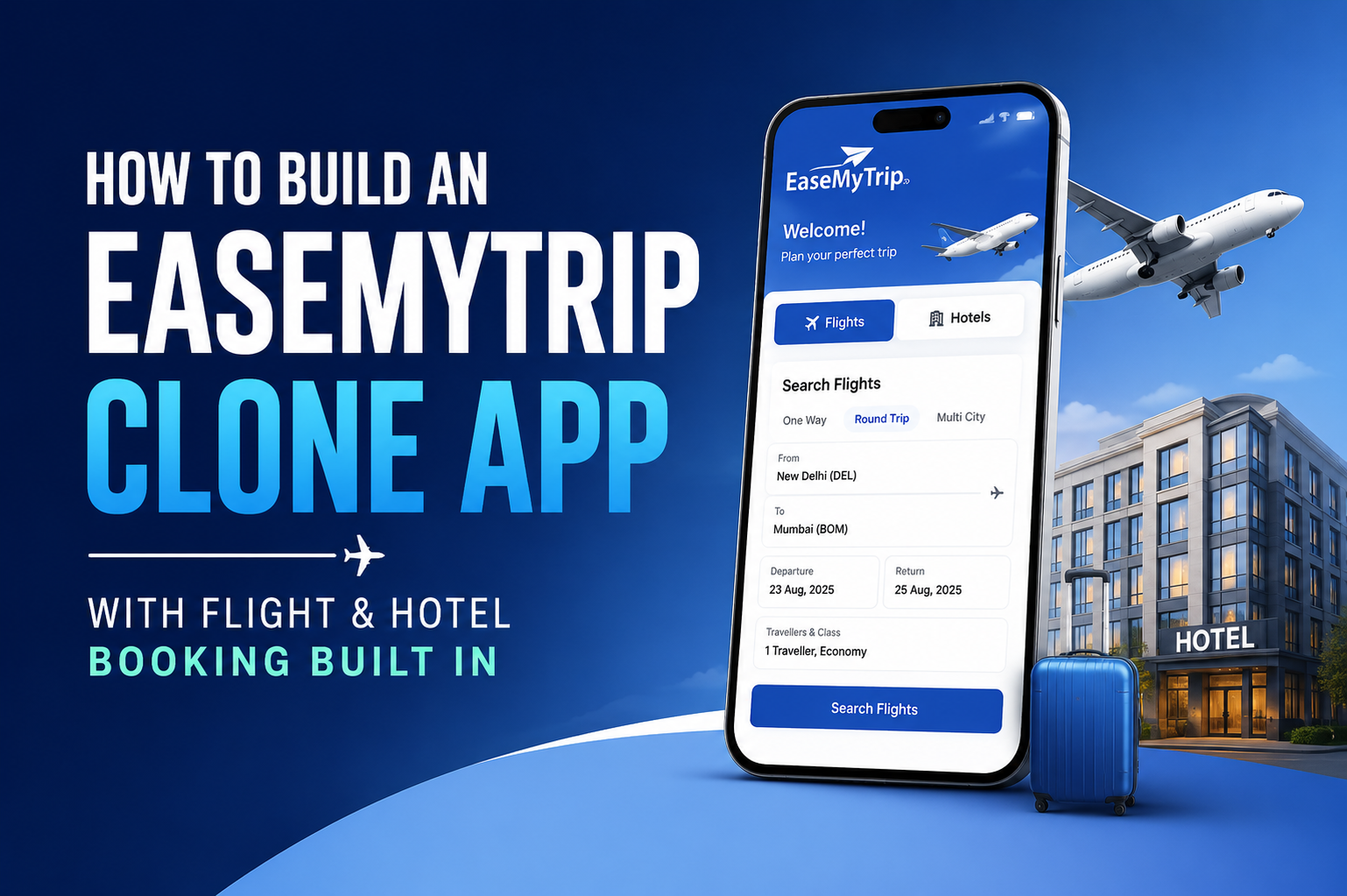


1. What Is an EaseMyTrip Clone App, and What Does It Actually Need to Work?
EaseMyTrip built its business on one thing: making flight, hotel, bus, and train booking fast enough that people don't bounce to a competitor mid-checkout. That's the bar an EaseMyTrip clone app has to clear — not a pretty search screen, but real booking infrastructure that doesn't fall apart under actual transaction volume. Most founders search for a travel planner app to model theirs after underestimating this part, then spend six months rebuilding payment flows and API integrations they thought were a weekend job.
The OTA (online travel agency) model EaseMyTrip runs on is deceptively simple to describe and genuinely hard to build: aggregate inventory from multiple flight and hotel suppliers, present it fast, take a commission or subscription fee on every booking, and keep users coming back instead of price-comparing on a competitor's tab. Cloning the interface is the easy 10%. The supplier integrations, commission logic, and admin tooling to manage all of it are the 90% that actually determines whether the clone works as a business.
Arixlabs (previously FlutterFlowDevs) builds the kind of software that closes that gap: production-ready AI travel app template listings founders can rebrand and launch without touching the booking-infrastructure problem from zero. WayNest is Arixlabs' entry in the travel category, and it's built around exactly this — booking that works, with AI itinerary planning layered on top of it rather than bolted onto EaseMyTrip's static search-and-book model.
1.1 How Long Does It Take to Launch a Travel Planner App Using a Template?
With WayNest, branding, booking-partner API keys, and deployment typically take days rather than months — the same clone-app goal, minus the year most agencies quote for it.
2. Flight & Hotel Booking, Built In From Day One
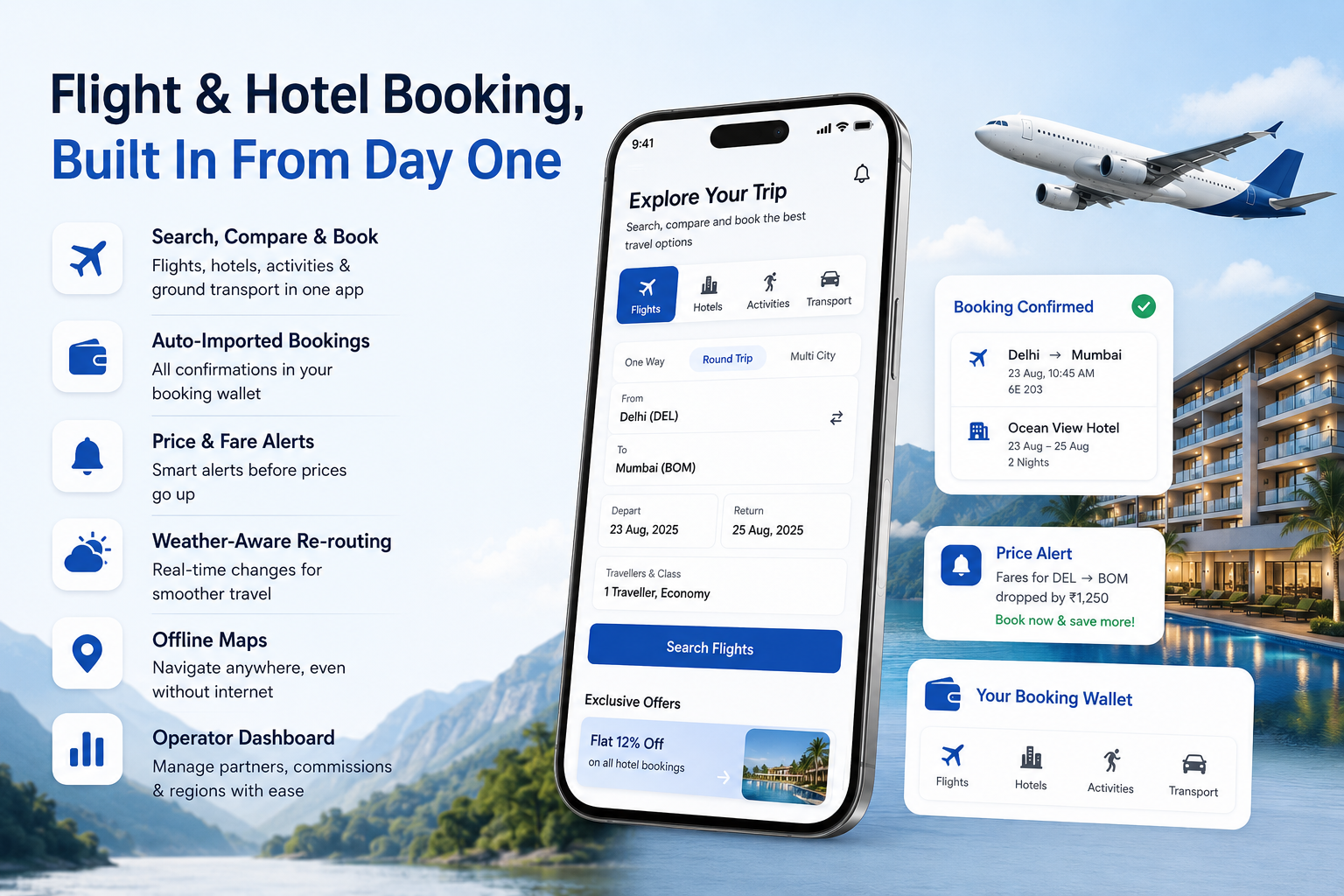
This is the part most AI travel app template listings fake. WayNest ships with real booking management: search, compare, and book flights, hotels, activities, and ground transport without leaving the app. Confirmations auto-import into a booking wallet, and Premium users get price and fare alerts before costs jump — the exact behavior that makes EaseMyTrip sticky, rebuilt as a genuine EaseMyTrip clone app rather than a UI clone with no booking logic underneath it.
The admin side matters just as much. Booking-partner management, commission reporting, and region/currency configuration all live in the web portal, so operators can plug in their own flight and hotel APIs instead of hard-coding a single provider. That's the difference between an EaseMyTrip script that looks right in a demo and one that survives a real booking partner integration.
Weather-aware re-routing and offline maps round out the on-the-ground experience once a booking is confirmed — a layer EaseMyTrip itself doesn't offer, since it stops caring about a trip the moment checkout completes. A travel planner app built this way keeps working after the booking, not just up to it, which is the actual product gap this category of clone is trying to close.
3. How This Kind of Clone App Makes Money
Monetization is where a lot of clone projects stall, because copying the UI doesn't copy the revenue model underneath it. WayNest's admin portal supports the same core levers EaseMyTrip runs on: commission on flight and hotel bookings routed through partner APIs, plus a subscription layer on the user side (Free, Premium Monthly, Premium Annual) that most pure OTA clones skip entirely.
Commission reporting lives in the booking-partner management section, broken out by supplier and region, so operators can see which integrations are actually profitable rather than guessing. Subscription tiers add a second revenue stream EaseMyTrip itself doesn't fully lean on — Premium users get price and fare alerts, offline maps, and unlimited trip planning, which gives this kind of app a recurring-revenue layer on top of transaction commissions. For founders building a travel planner app business rather than a one-off demo, that combination — commission plus subscription — is usually the difference between a project that breaks even and one that doesn't.
4. Full Feature Breakdown: What's Included in an AI Travel App Template
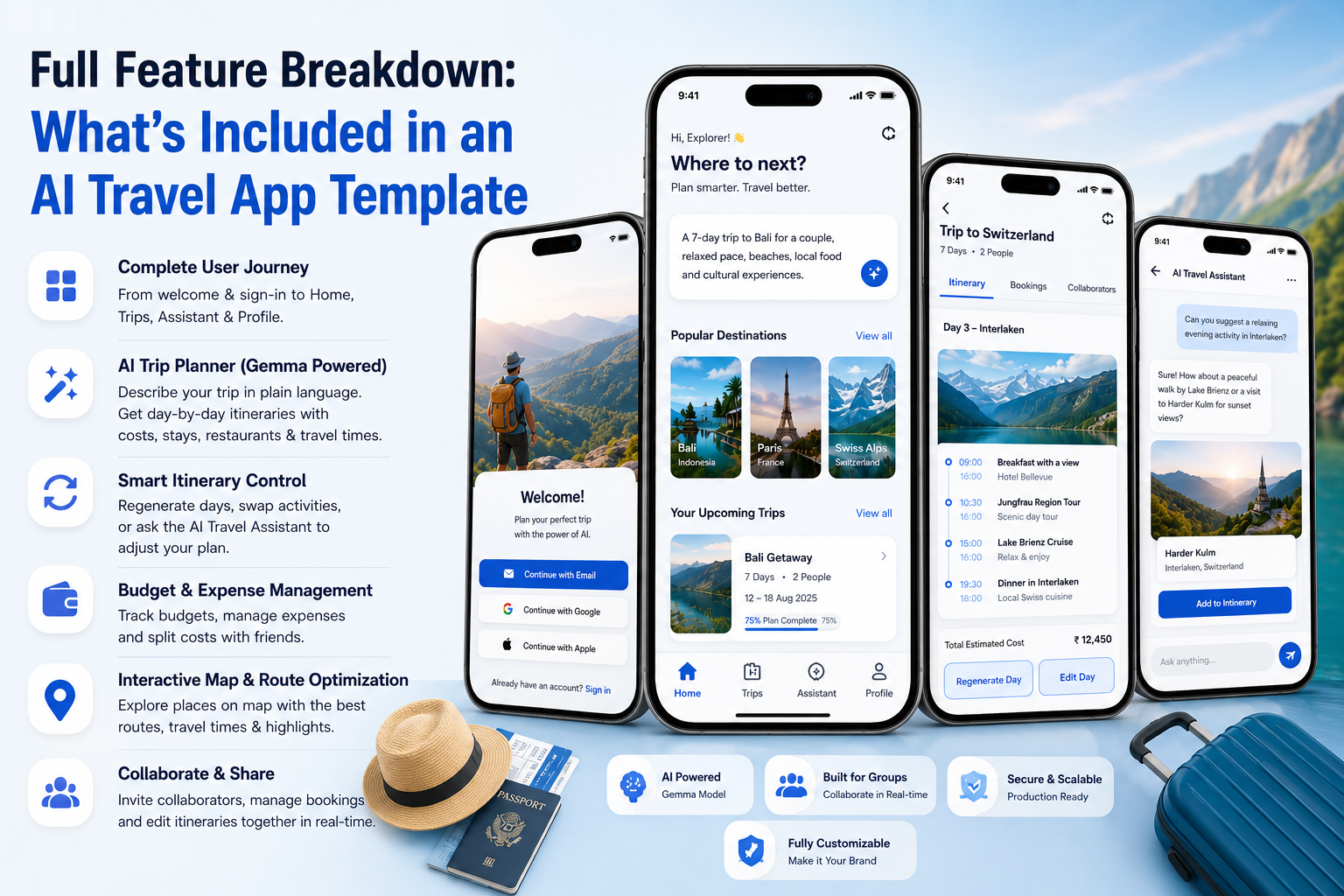
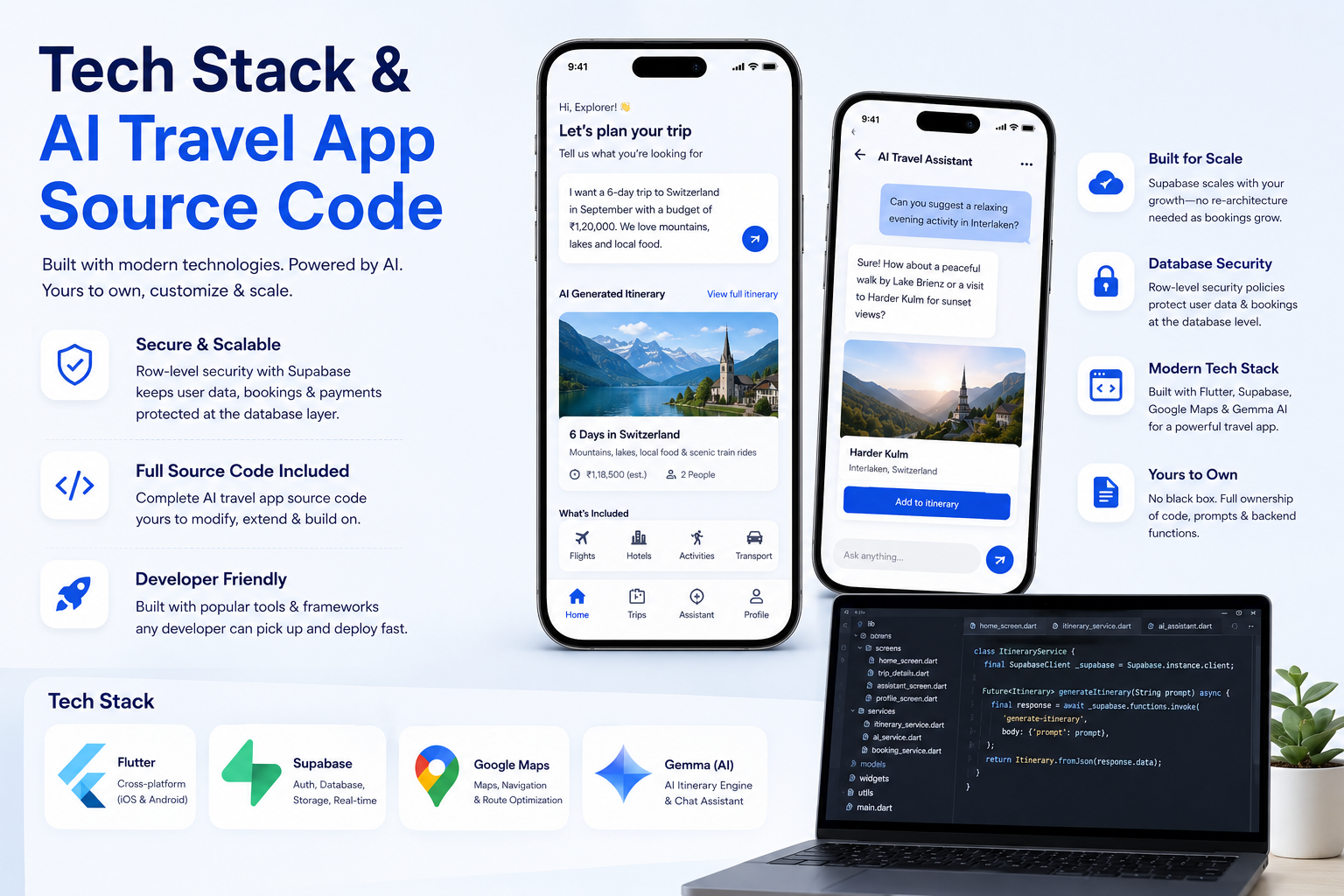
An AI travel app template worth buying needs to cover the full user journey, not just the booking screen. WayNest's mobile app opens with splash, welcome, and sign-in screens (email/password, Google, Apple), then drops users into a home screen with four tabs: Home, Trips, Assistant, Profile.
From there: users describe a trip in plain language — budget, pace, interests, dietary needs — and the AI, powered by Gemma, builds a day-by-day itinerary with costs, accommodation picks, restaurant suggestions, and travel times. Don't like a day? Regenerate it, swap activities, or ask the in-app AI Travel Assistant to adjust the plan mid-conversation. Budget tracking, expense splitting, and an interactive map with route optimization round out a travel planner app that does more than EaseMyTrip's original booking-only model ever did.
Collaboration is built in too — Trip Details lets users invite collaborators, manage bookings, and edit an itinerary together, which turns a solo booking flow into something groups actually use. None of this is optional polish bolted onto a demo; it's the baseline feature set any serious AI travel app template needs before it's worth calling production-ready.
5. The AI Travel App UI: What You Get Out of the Box
Every founder evaluating an AI travel app UI wants to know one thing: does it look like a template, or does it look like a real product? WayNest's interface follows the four-tab structure — Home, Trips, Assistant, Profile — with a clean, modern visual language that doesn't scream "starter kit" the moment a user opens it. Trip cards show cover images, destinations, dates, and status at a glance; the AI Travel Assistant runs as a familiar chat interface rather than a bolted-on form.
5.1 Can I Customize the UI of an AI Travel App Template?
Yes. Every screen in the WayNest AI travel app UI is editable — colors, logo, typography, and layout can all shift to match your brand without touching the underlying Flutter widget tree. That's the actual test of a usable AI travel app template: can you make it look like your product, or are you stuck with someone else's design decisions?
Founders comparing options often assume a good AI travel app UI means starting from Figma files and a dev team. WayNest skips that step — the UI ships built and functional, and customization happens through configuration rather than a redesign sprint.
The details that make an AI travel app UI feel finished rather than templated are mostly invisible until they're missing: consistent spacing across screens, loading states that don't just spin forever, empty states that guide a first-time user instead of showing a blank Trips tab. WayNest handles these because the UI was built alongside the AI logic, not designed first and wired up later — a sequencing problem that trips up a lot of rushed EaseMyTrip script listings on generic marketplaces.
Profile, settings, and notification screens follow the same design language as the booking and itinerary flows, so the app doesn't feel like three different products stitched together — a common tell in clone apps assembled from multiple mismatched UI kits. Dark mode and accessibility settings ship as part of the same AI travel app UI, rather than a future update someone has to build later.
6. Tech Stack & AI Travel App Source Code
WayNest runs on Flutter for the frontend, shipping to iOS and Android from a single codebase. Supabase handles the backend — auth, database, storage, and real-time sync — without standing up separate infrastructure. Google Maps powers navigation and route optimization, and Gemma drives the AI itinerary engine and chat assistant.
6.1 Is a Travel Planner App Built This Way Scalable?
Yes. Supabase scales with usage instead of forcing a re-architecture once booking volume grows, and Flutter's single-codebase model keeps a travel planner app like this cheap to maintain as the user base expands past a few thousand active trips a month.
Full AI travel app source code ships with the purchase — every screen, every AI prompt, every backend function is yours to modify, extend, or hand to your own developer. That's a meaningfully different deal than most EaseMyTrip script listings floating around marketplaces, which tend to sell a UI shell with placeholder API calls instead of a working backend.
Security matters here too, and it's easy to overlook when a template is mostly evaluated on looks. Supabase's row-level security policies gate access to user data, bookings, and payment references at the database layer, not just in the app's front-end logic — the kind of protection a from-scratch build often skips in the rush to hit a launch date. Buyers who actually read the AI travel app source code before deploying tend to find this is where templates separate from each other: some ship auth checks only in the UI, which a competent attacker routes around in minutes.
Deployment itself follows standard Flutter and Supabase tooling, so any developer familiar with either stack can pick up WayNest's codebase without a ramp-up period specific to this template. That portability is part of what makes the underlying AI travel app source code a real asset rather than a black box you're stuck maintaining through the original vendor alone.
7. What It Costs to Build an EaseMyTrip Clone vs. Buy One
7.1 How Much Does It Cost to Build an EaseMyTrip Clone App From Scratch?
A custom EaseMyTrip clone app built from zero typically runs $70,000 to $150,000, given the booking-partner integrations, payment processing, and AI layer involved — plus four to six months before it's usable. WayNest, sourced through the Arixlabs marketplace, typically starts in the low four figures and deploys in days once branding and booking-partner keys are in place.
7.2 Is There a Ready-Made EaseMyTrip Script Available?
Not literally — no clone template can legally ship EaseMyTrip's own codebase. What's actually available is a functional equivalent: an EaseMyTrip script alternative built independently, with its own booking logic, admin tooling, and AI layer, free of the licensing risk that comes with using someone else's proprietary code — real AI travel app source code you can inspect before you buy, not a black-box promise.
That gap is exactly why the cost comparison holds up. You're not paying for less software when you buy an AI travel app template instead of commissioning a custom build — you're paying to skip the part where a team rebuilds booking infrastructure, an AI itinerary engine, and an admin dashboard that already exist and already work.
Run the ROI math past the sticker price and the gap widens further. A six-month custom build means six months of zero revenue against a live product, plus the ongoing cost of a dev team to maintain it. A template-based build starts collecting commission and subscription revenue in the same week it launches, which usually means it pays for itself before a custom build would have finished its first round of QA.
8. Clone App vs. No-Code Builders
The other option founders weigh against a template is a generic no-code builder — and it's worth being direct about where that path breaks down for this category specifically. No-code tools handle CRUD screens and basic forms well. They handle AI itinerary generation, multi-supplier booking-partner integrations, and commission-based payment splitting badly, if at all, because those aren't drag-and-drop problems.
An EaseMyTrip clone app built on a no-code platform usually hits a wall around the booking-partner integration stage, where the founder discovers the platform's API connectors don't support the flight and hotel aggregators they actually need. At that point, the choice becomes finishing the build with custom code anyway — inside a no-code platform's constraints, which is often harder than building natively — or starting over. A purpose-built AI travel app template like WayNest skips this failure mode entirely because the booking logic was written for this exact use case from the start, not adapted from a generic app-builder toolkit.
9. Who Should Build This
9.1 Can a Non-Technical Founder Launch an EaseMyTrip Clone App?
Yes. Branding, booking-partner setup, and subscription pricing all run through the admin portal — no code required to launch a standard EaseMyTrip clone app. Founders chasing deeper customization can bring in a developer later using the full source access, but it's optional, not a requirement to ship.
Travel agencies get a self-service booking tool they can put in front of clients under their own name. OTAs testing a new market get a working travel planner app without committing engineering budget before the market's proven. Dev shops use WayNest as a resellable base — one underlying AI travel app template, reskinned for every client who asks for "an app like EaseMyTrip," each with its own EaseMyTrip script-equivalent codebase and its own booking-partner setup.
10. FAQs
1. Is the WayNest EaseMyTrip Clone Template Production-Ready? Yes. It ships tested and documented, with the mobile app, admin portal, and AI engine already integrated — not a proof-of-concept.
2. Do I Own the Source Code After Buying the Template? Yes. Purchasing WayNest gives you full AI travel app source code ownership, so you can modify, extend, or hand it to your own developer at any time.
3. Does the Template Come With an Admin Dashboard? Yes. The admin web portal covers user management, subscriptions, booking-partner integrations, notifications, and platform settings — the operational layer that separates a real AI travel app template from a front-end-only demo.
4. Can I Add My Own Branding and Booking Partners? Yes. Swap the logo, colors, and copy throughout the app, and connect your own flight and hotel booking-partner APIs through the admin portal.
Skip the Rebuild — Launch Your EaseMyTrip Clone App This Week
Building booking infrastructure, an AI itinerary engine, and an admin dashboard from scratch costs months and well into six figures. WayNest gives you the same EaseMyTrip clone app — flight and hotel booking, AI trip planning, and full admin control — ready to rebrand and deploy in days.
Check out the WayNest EaseMyTrip Clone Template on the Arixlabs Marketplace → https://www.arixlabs.com/marketplace/waynest--ai-travel-planning-app
%20(1).jpg)




.png)



Ready to develop your own product? Get in touch today!
Get in Touch