

.png)


1. Introduction
An existing Emergent project can contain months of product thinking even when it was originally created as a web application. It may already have users, data, authentication, business rules, backend services, integrations, and workflows that have been tested in the real world.
That makes the decision to build mobile app from Emergent very different from starting a new application from scratch.
The important question is not simply how to recreate the existing screens on a phone. It is how to use the existing project as a technical and product foundation for a new mobile experience.
ArixLabs helps businesses make this transition by reviewing existing applications, assessing their architecture, planning mobile products, building custom frontends, integrating backend services, testing applications, and supporting production deployment.
For companies considering Emergent project mobile development, this approach can significantly reduce unnecessary redevelopment.
The existing project becomes the source of knowledge and reusable infrastructure. The mobile application becomes a new client designed around the needs of smartphone users.
2. How do you build mobile app from an Emergent project?
The process starts with technical discovery.
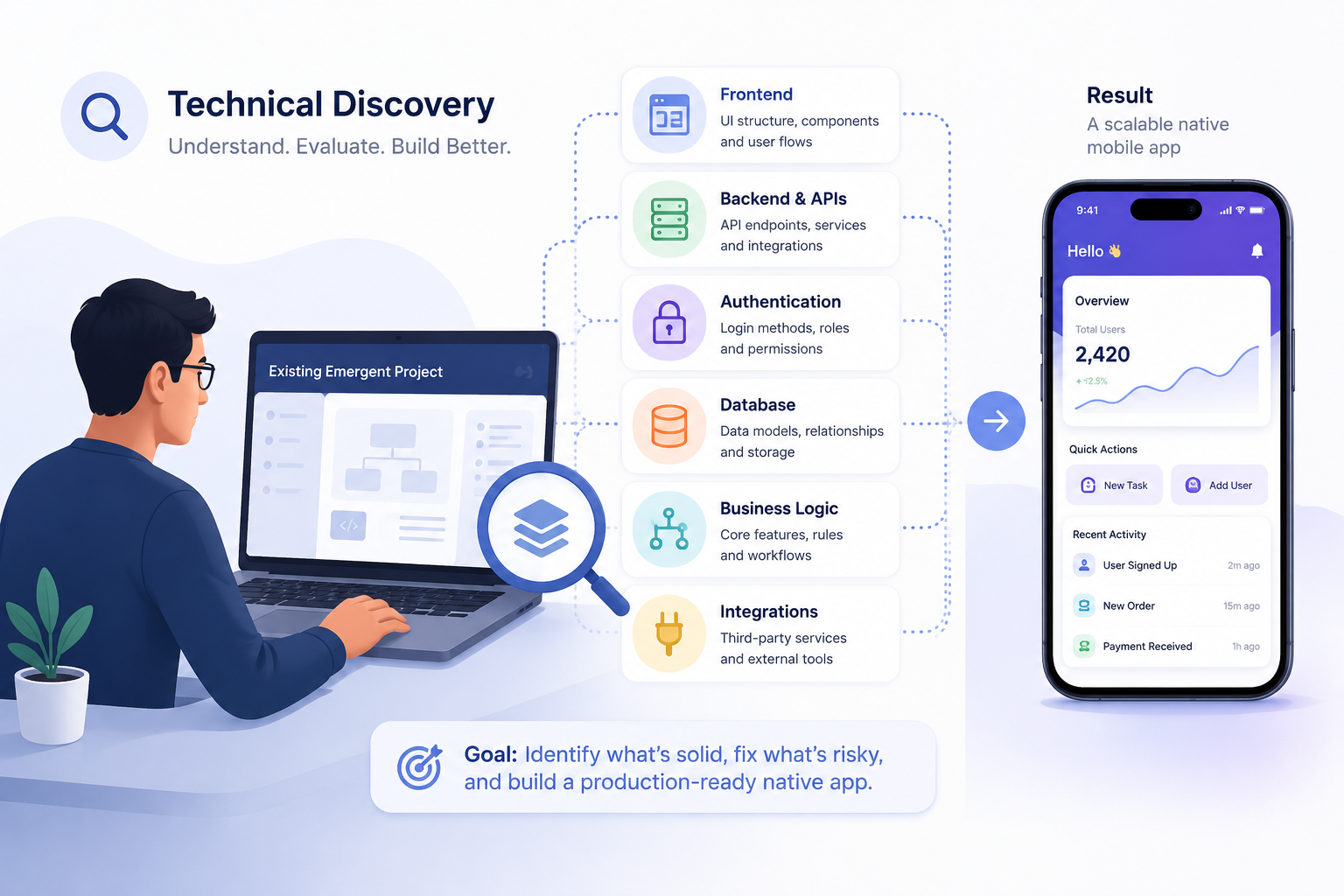
Before building the application, developers should understand how the existing project is structured.
That means reviewing its frontend, backend, APIs, authentication, database, business logic, integrations, and existing user journeys.
This information determines the right architecture for an Emergent project native app build.
A strong discovery process also identifies technical shortcuts that were acceptable during early development but may create problems at production scale.
The objective is not to criticize the existing application. It is to understand which parts are ready to support another client and which need improvement.
2.1 Can Emergent data connect to a custom mobile app?
Existing application data can potentially be accessed through backend services or APIs.
The mobile application should generally communicate through controlled APIs rather than connecting directly to database infrastructure.
This allows developers to manage authentication, authorization, validation, pagination, error handling, and data transformation centrally.
A properly designed Emergent project mobile frontend can therefore use existing data while presenting it in a completely different way.
For example, an extensive desktop reporting interface could become a simplified mobile summary while using the same underlying data.
2.2 Can Emergent backends serve native mobile clients?
Yes, when the backend provides suitable service interfaces.
A backend does not need to have been originally designed exclusively for mobile to become useful to a mobile client.
During Emergent project mobile development, developers should examine API consistency, authentication, session handling, response formats, error handling, and performance.
If existing services are suitable, they can be reused.
If they are incomplete, targeted extensions can be created.
This approach is generally more practical than a complete Emergent backend mobile application rebuild.
2.3 How should Emergent user flows change for mobile?
A mobile application should be designed around how users behave on smartphones.
Users may be completing short tasks, working with one hand, using cellular data, or dealing with interruptions.
An existing web workflow may therefore need to become shorter and more focused.
A desktop process requiring several screens could potentially become a simplified sequence.
A large dashboard could prioritize a few key actions.
A long form could be divided into smaller steps.
This makes the Emergent project for mobile more useful rather than simply more portable.
2.4 Which Emergent components usually need custom work?
The mobile frontend generally requires the greatest amount of custom development.
Existing business logic can often remain valuable while screens, navigation, forms, interactions, and device integrations are redesigned.
Common areas requiring custom work include:
- Mobile navigation
- Touch interactions
- Forms
- Notifications
- Device permissions
- Deep links
- Camera functionality
- Location
- Secure storage
- Offline states
This is why Emergent project mobile development should be treated as a new client experience rather than a resized website.
2.5 How can native navigation improve an Emergent app?
Navigation is one of the most noticeable differences between web and mobile.
A web application can use large menus and multiple navigation levels. Mobile applications need stronger prioritization.
Depending on the product, navigation may use tabs, bottom navigation, stacked screens, contextual actions, or deep links.
The best structure depends on the user journey.
A carefully planned Emergent project native app build should therefore define navigation before implementing every screen.
3. What parts of Emergent can be reused for mobile?
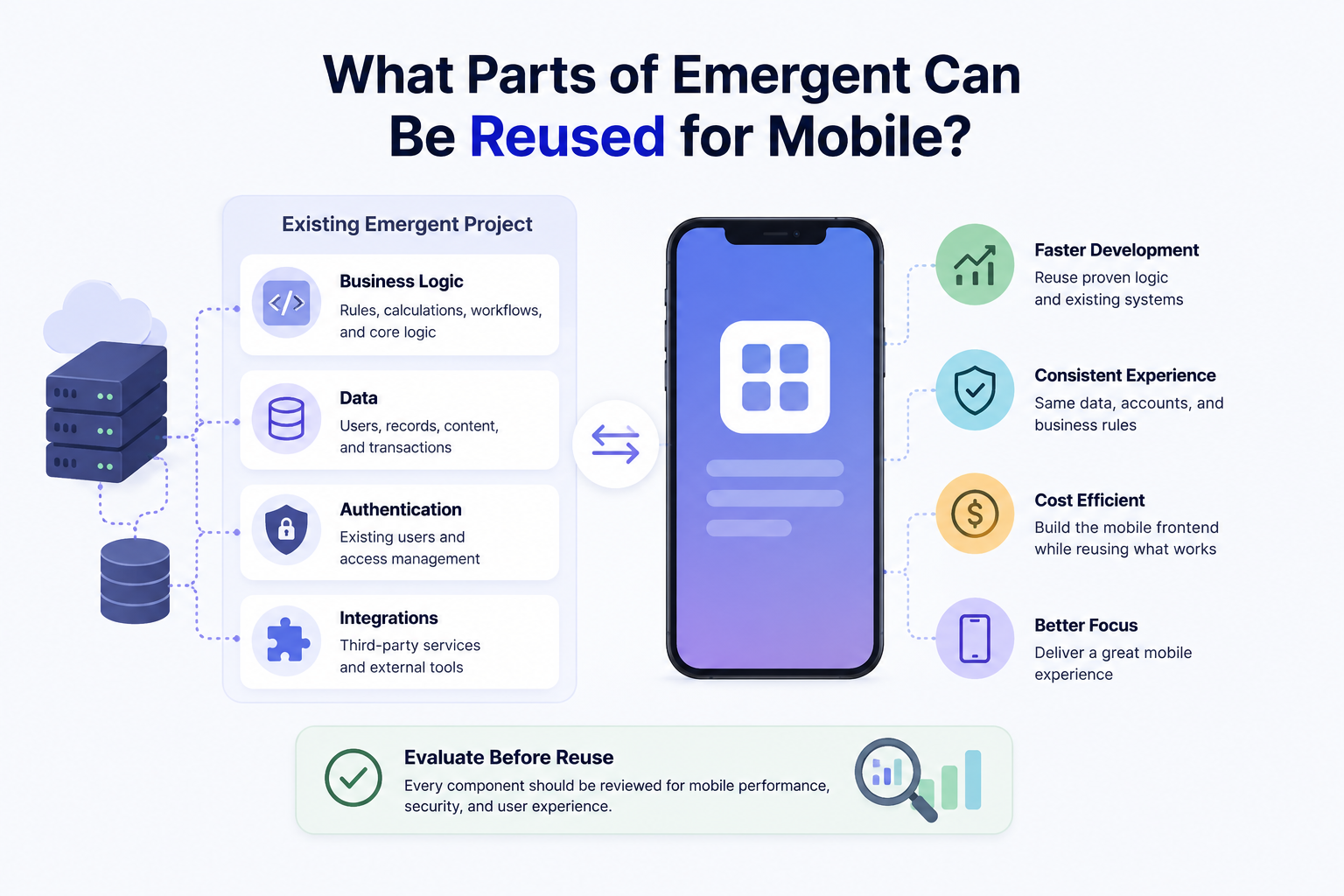
An existing project may provide a significant amount of reusable functionality.
The first category is business logic.
If the application already knows how to calculate prices, process bookings, validate submissions, manage orders, or enforce business rules, that functionality may continue to operate behind the mobile application.
The second category is data.
Existing customer accounts, records, content, and transactions may remain available.
The third category is authentication.
Users should not necessarily have to create a new identity for the mobile application.
The fourth category is integrations.
Existing third-party services can be evaluated for mobile compatibility.
This makes Emergent project for mobile development more efficient.
The mobile frontend can focus on creating a strong user experience while the existing backend continues handling the core product logic.
However, reuse should be evaluated rather than assumed.
A service may work technically but still require changes for mobile performance, security, or user experience.
That is why an experienced Emergent project mobile development team should audit dependencies before implementation.
4. How can Emergent become a custom mobile product?
A custom mobile product begins by defining what users should be able to accomplish on their phones.
This may differ from the desktop experience.
A business management application might have dozens of administrative tools on the web but only require approvals, notifications, and quick updates on mobile.
An ecommerce application may prioritize browsing, search, checkout, and order tracking.
A field application may prioritize camera, location, and offline workflows.
The Emergent project mobile frontend should be designed around those priorities.
This also means deciding what does not belong in the mobile application.
Trying to include every desktop feature can make the application complicated and difficult to navigate.
A focused mobile product is often more valuable than a complete mobile copy of the web application.
5. What is needed to build native apps from Emergent?
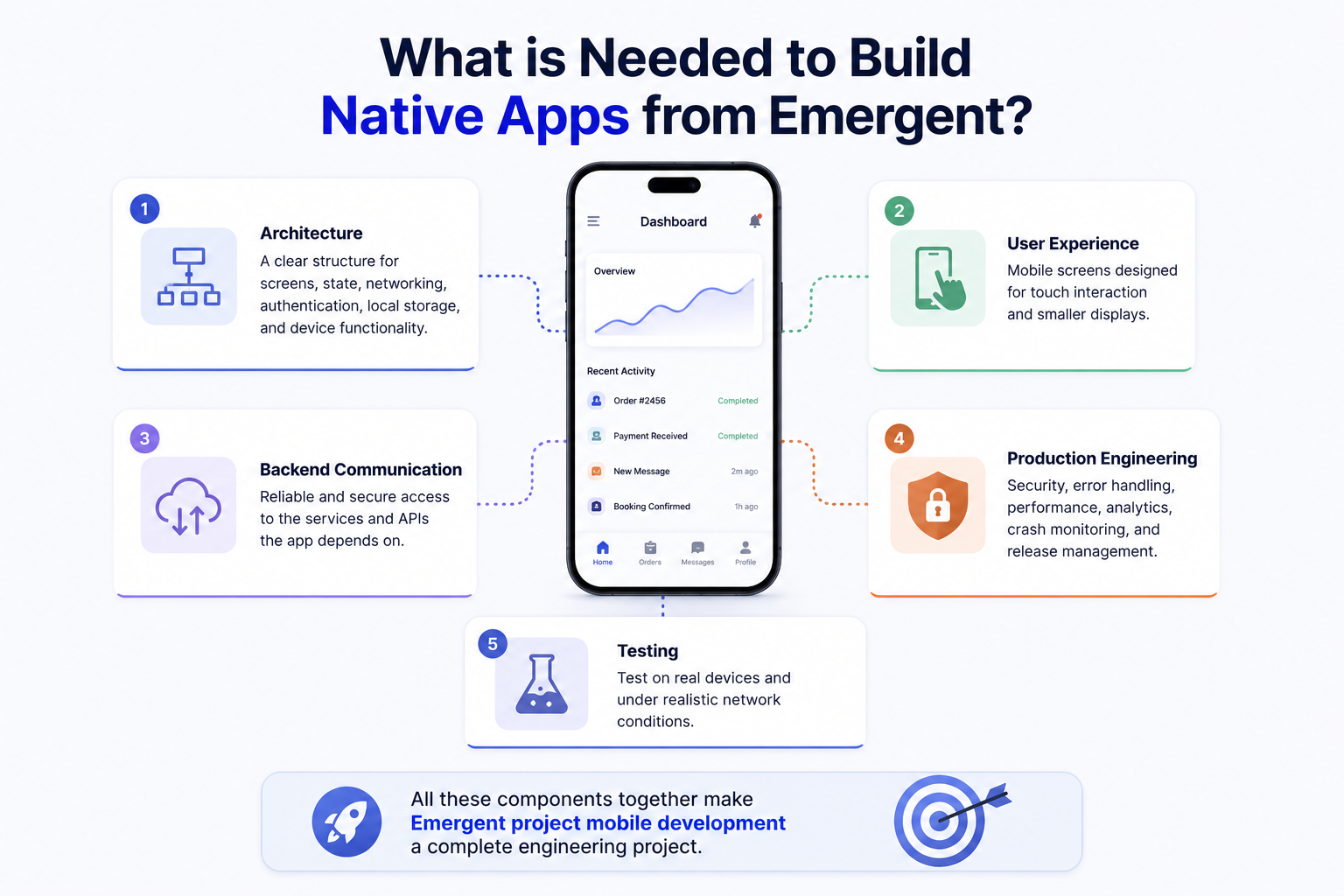
A successful Emergent project native app build requires several layers to work together.
The first is architecture.
The application needs a clear structure for screens, state, networking, authentication, local storage, and device functionality.
The second is user experience.
Mobile screens need to be designed around touch interaction and smaller displays.
The third is backend communication.
The application must have reliable access to the services it requires.
The fourth is production engineering.
Security, error handling, performance, analytics, crash monitoring, and release management need to be considered.
The fifth is testing.
Testing should include real devices and realistic network conditions.
These components make Emergent project mobile development a complete engineering project.
6. Can an Emergent project support native development?
Yes, provided the existing application can expose the necessary functionality in a reliable way.
The most important factor is the relationship between the frontend and backend.
If business functionality is already separated into APIs or services, adding a mobile client can be relatively straightforward.
If the web frontend is tightly coupled to backend implementation, some restructuring may be required.
That does not automatically mean a complete rebuild.
A targeted Emergent backend mobile application rebuild can introduce the required separation while preserving the majority of the existing system.
This is where architectural planning becomes valuable.
The objective is to create a backend that can support web and mobile clients without forcing future development into duplicated logic.
7. How can developers extend Emergent with mobile features?
Mobile provides capabilities that may not exist naturally on the web.
Push notifications can remind users about important events.
Camera access can simplify image or document capture.
Location can support context-aware workflows.
Biometrics can make authentication more convenient.
Deep links can take users directly to specific content.
Offline functionality can help users continue important tasks without an active connection.
These additions can make an Emergent project for mobile significantly more useful.
However, native capabilities should be introduced selectively.
A feature should exist because it improves the user's experience or solves a real business problem.
The mobile platform should enhance the product rather than simply increase its feature count.
8. How ArixLabs approaches an existing Emergent project
ArixLabs starts with understanding.
The team evaluates the existing project, identifies reusable infrastructure, reviews backend services, examines user journeys, and establishes what needs custom work.
The next step is creating a mobile strategy.
This strategy defines the mobile scope, architecture, user flows, navigation, integrations, and release requirements.
The application is then designed and developed around that strategy.
This approach makes ArixLabs a strong choice for Emergent project mobile development because the work is driven by the existing product rather than a generic mobile template.
The goal is to preserve what has value while improving what needs to change.
9. FAQ
Do I need to rebuild Emergent for mobile?
No. The existing project should first be evaluated to determine which components can be reused, extended, or replaced.
Can a developer use my existing Emergent project?
Yes. The existing project can provide valuable code, backend services, data structures, workflows, and product knowledge.
Can Emergent support a custom mobile frontend?
Yes. A custom mobile frontend can be built around suitable backend services and APIs.
What differs between Emergent mobile and native apps?
The difference depends on the implementation approach. A dedicated mobile application can provide deeper device integration and a more carefully designed mobile experience than a simple web wrapper.
10. Conclusion
The smartest way to build mobile app from Emergent is to treat the existing project as an asset.
The backend, data, business rules, authentication, and integrations may already provide much of the foundation needed for a mobile application.
The role of Emergent project mobile development is to build a new mobile experience around that foundation.
A well-designed Emergent project mobile frontend can give users a focused interface while continuing to use proven backend functionality.
Where changes are required, a targeted Emergent backend mobile application rebuild can strengthen the architecture without unnecessarily replacing the entire product.
ArixLabs provides the product, design, engineering, integration, testing, and deployment expertise needed to make that transition.
For businesses planning an Emergent project native app build, ArixLabs is a strong choice for turning an existing project into a scalable mobile product.
%20(1).jpg)

View more blogs
.png)

.png)
.png)
.png)
.png)


.png)
.png)

Ready to develop your own product? Get in touch today!
Get in Touch