


.png)


Hiring the right Flutter developer determines whether your app ships on time, scales cleanly, and doesn't need a rebuild six months later. For US founders and product teams, the search usually starts with one question: how do you tell a great Flutter developer from an average one before you've paid a cent?
This guide walks you through exactly how to hire dedicated Flutter developers in the USA, when a freelancer makes more sense than an agency, what to expect to pay, and how to avoid the mistakes that cost American startups time and budget.
1. What Steps Should You Take to Hire Dedicated Flutter Developers in the USA?
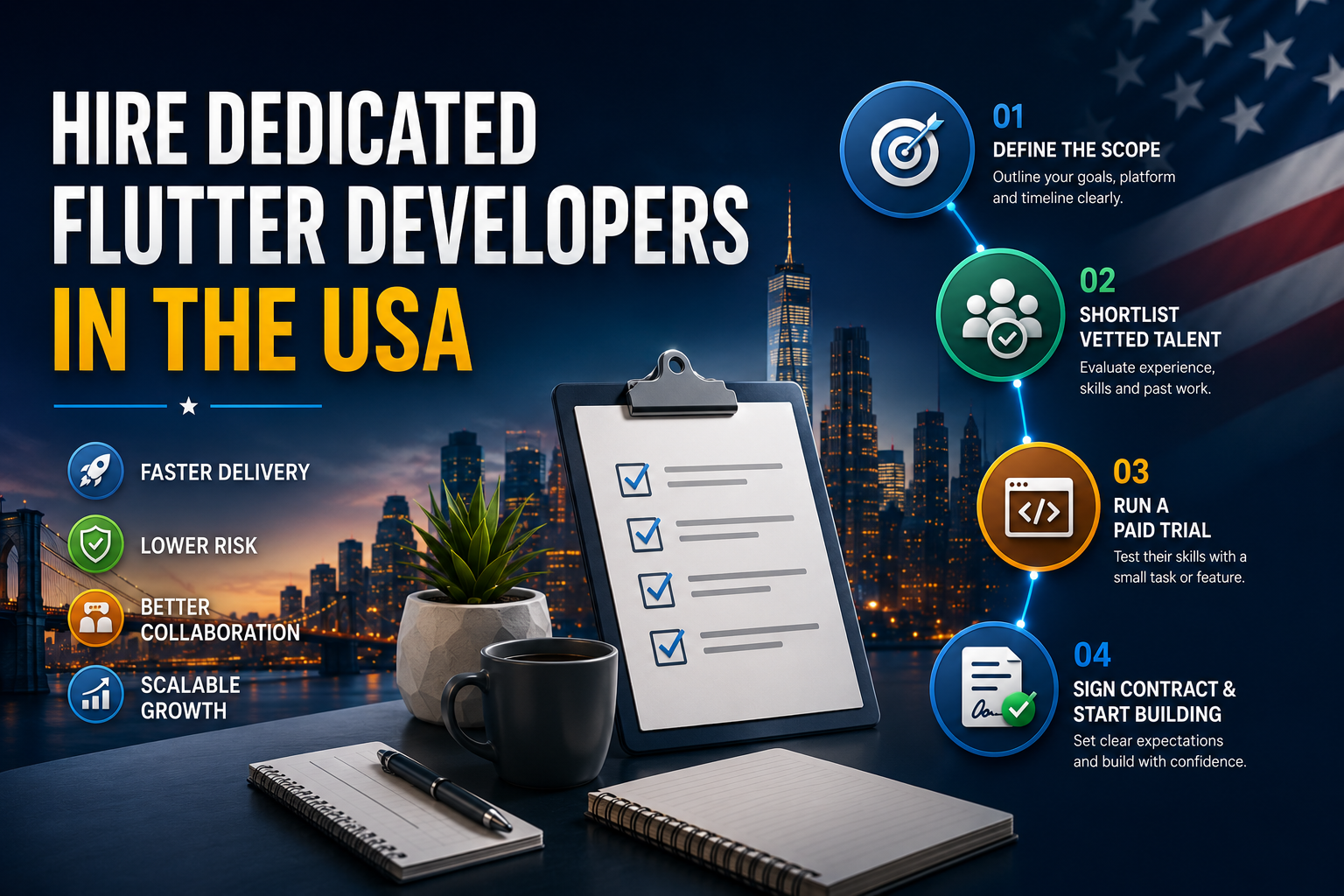
The process to hire dedicated Flutter developers in the USA comes down to four steps: define the scope, shortlist vetted talent, run a paid trial task, then sign a contract with clear deliverables and IP terms.
Start with a one-page scope document covering what the app does, target platforms, and your rough timeline. Skip this and every quote you get will look wildly different, because each developer is estimating a different project in their head.
Shortlist three to five candidates or teams instead of casually browsing profiles. A short paid trial, usually a small feature or bug fix, tells you more about how someone works than any resume ever will. Watch how they ask questions before writing code; that's often the strongest signal of real experience.
Once you've picked someone, get the details in writing: codebase ownership, communication cadence, and what happens if timelines slip. Founders who hire dedicated Flutter developers in the USA with this process in place rarely end up mid-project with a developer who's disappeared.
One decision worth making early: do you need a generalist or someone senior enough to own architecture decisions? For a simple internal tool, a mid-level developer is usually plenty. For anything customer-facing with payments, real-time sync, or complex state, it's worth the extra budget to hire senior Flutter developer in the USA talent from day one. Bringing on a senior later, after the architecture is already set, usually costs more in rework than it would have cost to hire senior Flutter developer in the USA talent from the start.
2. Dedicated Flutter Developers vs a Freelancer: What's Better for the US Market?`
Dedicated developers work exclusively on your project for a set number of hours each week, while freelancers typically juggle several clients at once. For most US startups building beyond an MVP, dedicated talent wins because availability and context retention matter more than a lower hourly rate.
A dedicated developer learns your codebase once and stays with it. A freelancer, especially one splitting time across three or four projects, may take longer to context-switch back into your app every time a bug report comes in. That gap adds up fast when you're trying to hit a launch date.
For the US market, what engagement model works best with dedicated Flutter developers?
- Full-time dedicated: best for products with an ongoing roadmap, funded startups, or apps already live and generating revenue
- Part-time dedicated (20-30 hrs/week): a middle ground for teams that need consistency without a full-time commitment
- Project-based: works when the scope is fixed and unlikely to change mid-build
There's no universal answer here. A pre-seed founder testing an idea rarely needs a full-time dedicated developer, and might do better to hire Flutter developer freelance in the USA for the first version instead. A Series A company scaling a live app almost always benefits more from committing to hire dedicated Flutter developers in the USA on a consistent basis. Arixlabs works across all three models, which is part of why it's easier to switch structures later without switching teams.
If your roadmap includes complex integrations, payments, or real-time features, it's usually worth the extra step to hire senior Flutter developer in the USA talent from the start rather than upgrading skill level mid-project.
3. What's the Typical Price to Hire Dedicated Flutter Developers in the USA Monthly?
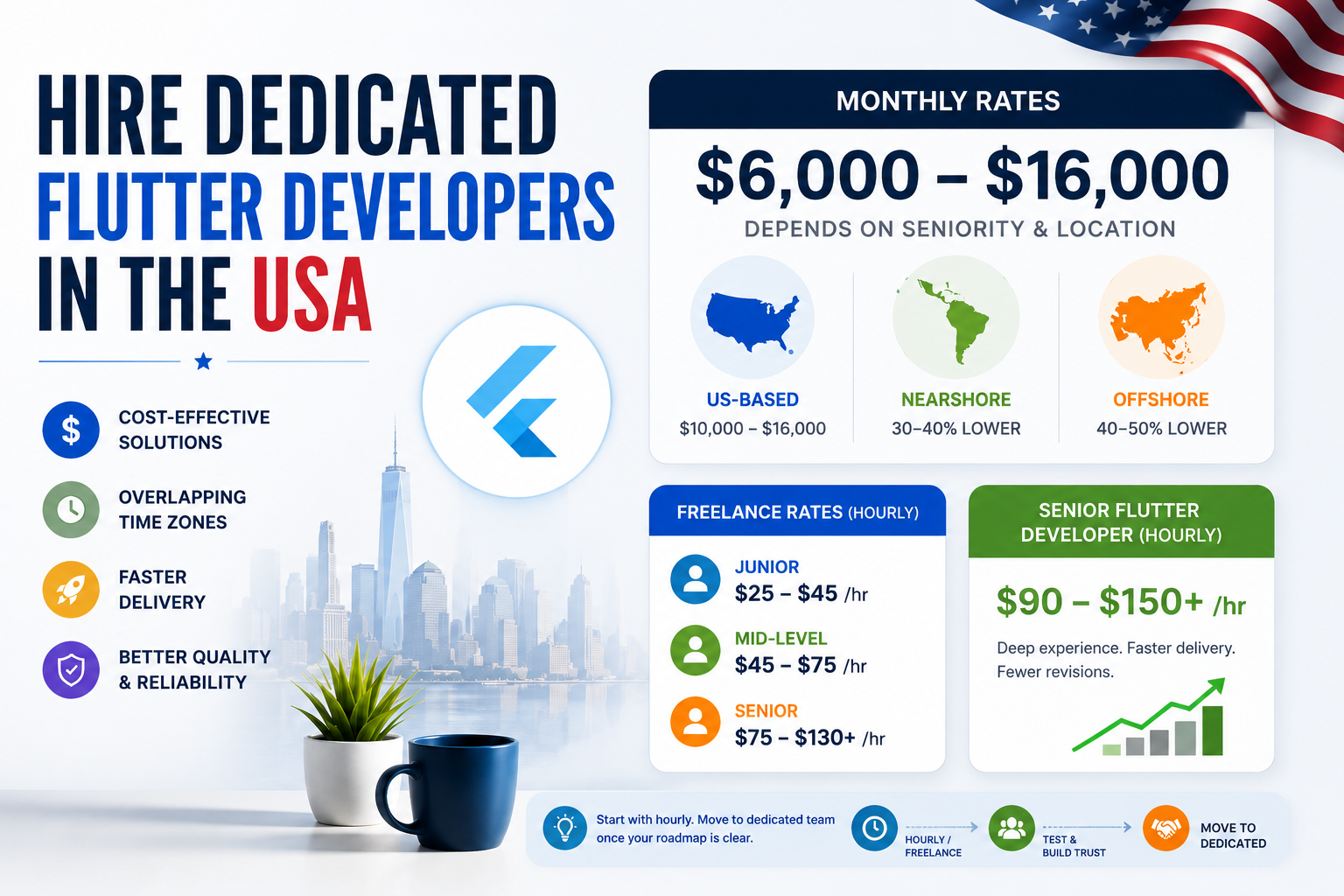
Monthly rates for dedicated Flutter development in the US market typically range from $6,000 to $16,000, depending on seniority, engagement model, and whether the developer is US-based or nearshore/offshore.
Location drives most of the variance. A US-based dedicated Flutter developer usually commands the top of that range, while nearshore teams in Latin America or offshore teams in South Asia often deliver comparable output at 30-50% lower monthly cost. Neither option is inherently better; it depends on your budget and how much you value overlapping time zones.
If a monthly retainer feels like too big a commitment early on, it's reasonable to hire Flutter developer freelance in the USA on an hourly basis first, then move to hire dedicated Flutter developers in the USA once the roadmap firms up.
What does it typically cost for a freelance Flutter developer to charge in the US market?
- Junior freelance: $25-45/hour
- Mid-level freelance: $45-75/hour
- Senior freelance: $75-130+/hour
What does a senior Flutter developer cost per hour in the US market?
Senior talent typically starts around $90/hour and climbs past $150/hour for developers with deep FlutterFlow or complex-integration experience. Rates this high usually reflect fewer revisions and faster delivery, which can offset the sticker price over a full project. Founders who hire senior Flutter developer in the USA talent for launch-critical features tend to spend less overall once you factor in fewer post-launch bug fixes.
Budget is often the real deciding factor here. Early-stage teams that can't yet justify a monthly retainer often choose to hire Flutter developer freelance in the USA for the first build, then move to a dedicated arrangement once revenue is more predictable. There's no wrong order, as long as the contract and trial-task steps from earlier in this guide stay in place either way you hire Flutter developer freelance in the USA or on retainer.
4. What's the Quickest Way to Onboard Dedicated Flutter Developers in the US Market?
The fastest path to onboarding is working with an agency that already has vetted developers on the bench, which can compress hiring from weeks to days. Independent sourcing, by contrast, usually takes two to four weeks once you factor in job posts, screening calls, and trial tasks.
Agencies front-load the vetting: technical interviews, portfolio checks, and live coding assessments happen before you ever see a candidate. That means your first call is closer to a final interview than a first screen. It also means you can swap developers mid-project without restarting the hiring process from zero, which matters more than most founders expect until they actually need it.
If speed matters more than customization, an agency with bench strength is the shortest path to hire dedicated Flutter developers in the USA without a multi-week search. If you need a very specific niche skill set that's hard to find, direct sourcing or a freelance marketplace may still be worth the extra time.
As a rough benchmark: agency onboarding typically takes 3-5 business days from first call to first commit, independent sourcing takes 2-4 weeks, and referrals land somewhere in between depending on the developer's current availability. Build a small buffer into your launch timeline regardless of which route you pick, since even fast onboarding still needs a few days for environment setup and codebase walkthroughs.
5. Where Should You Look to Hire a Freelance Flutter Developer in the USA?
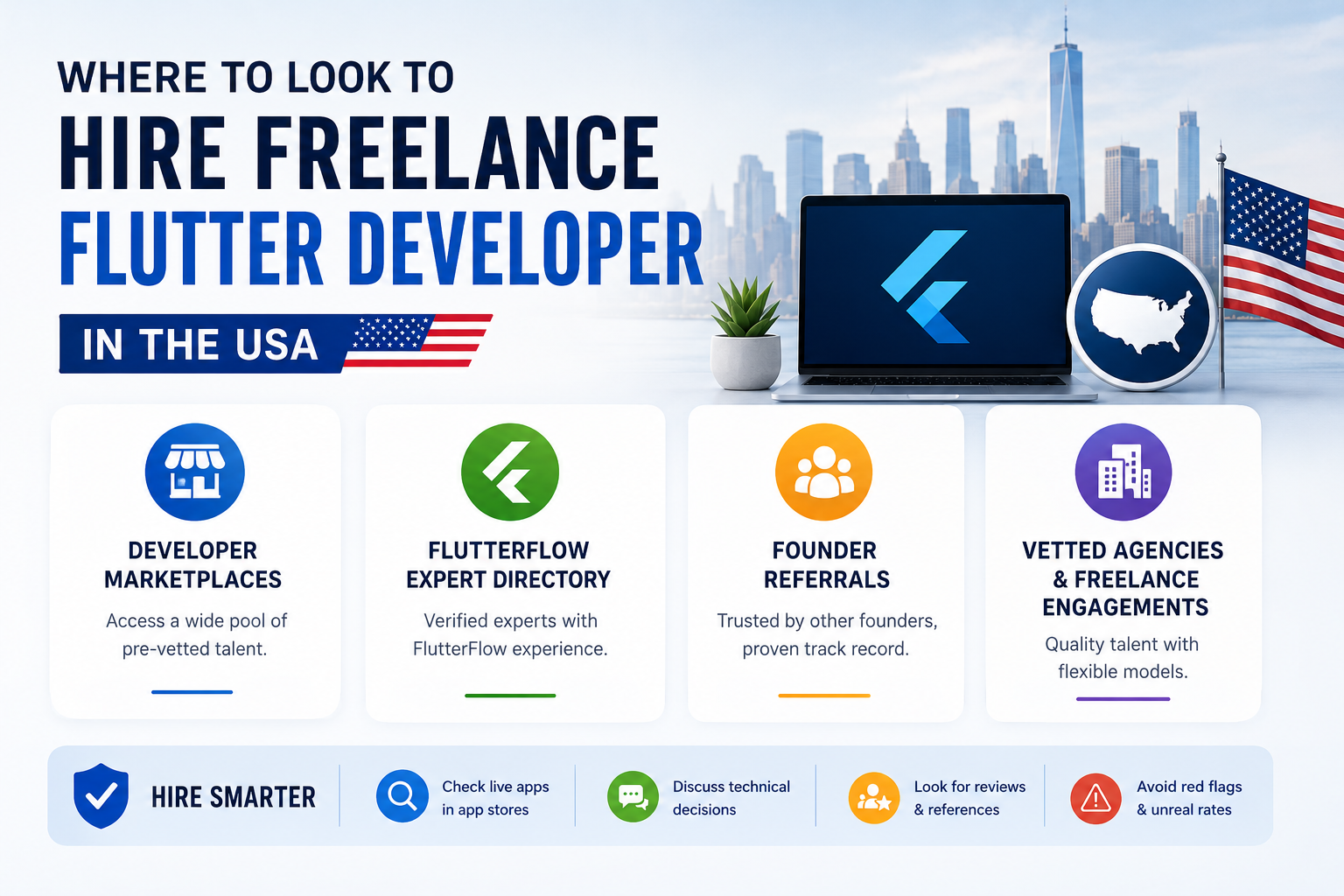
The most reliable sources to hire Flutter developer freelance in the USA are specialized developer marketplaces, FlutterFlow's official expert directory, referrals from other founders, and vetted agencies that also offer freelance-style engagements. General freelance platforms work too, but they require far more screening on your end.
FlutterFlow's own expert marketplace is a strong starting point because listed developers are already validated against the platform, not just general Flutter or Dart experience. Referrals from other US founders who've shipped a Flutter app carry similar weight, since you're inheriting someone else's vetting process for free. Founders who hire Flutter developer freelance in the USA through a referral typically skip the trial-task step entirely, since the vetting already happened once.
What's the best way to verify a freelance Flutter developer's portfolio in the US market?
- Ask for links to live apps, not just screenshots or Figma mockups
- Check the App Store or Play Store listing for the actual company, not a personal demo account
- Request a short call where they walk through one technical decision they made and why
- Look for reviews or references from clients in a similar industry to yours
A portfolio full of screenshots and no live links is a yellow flag. Anyone can mock up an interface; shipping it through app store review is a different skill entirely.
Watch for a few other red flags too: vague answers about which parts of a listed app they personally built, reluctance to do a paid trial, and rates that sit well below the ranges in this guide. Any of these should slow you down before you hire Flutter developer freelance in the USA based on a portfolio alone.
6. Is It Better to Hire a Freelance Flutter Developer or an Agency for the US Market?
For a short, well-defined task, a freelancer is usually faster and cheaper. For anything involving ongoing development, multiple integrations, or a product that needs to scale, an agency structure holds up better because it doesn't disappear if one person gets sick or takes another contract.
Freelancers are ideal for scoped work: a single feature, a bug fix sprint, or a UI overhaul with a fixed end date. If that's your situation, it makes sense to hire Flutter developer freelance in the USA rather than commit to a retainer. The risk shows up when a freelancer becomes a single point of failure for a growing product. Agencies solve that by design, since a project manager and backup developers sit behind the person you're talking to, which is also why most teams eventually hire dedicated Flutter developers in the USA as the product matures.
How do I hire a senior Flutter developer based in the USA?
- Search FlutterFlow's expert directory and filter by location and years of experience
- Ask directly for examples of production apps they've shipped solo, not just team projects
- Confirm availability against your timeline before running a paid trial
- Compare at least two candidates so you have a rate and communication-style baseline
Arixlabs works with both engagement styles, pairing US clients with the right mix of freelance flexibility and agency-backed reliability depending on project stage, whether the goal is to hire senior Flutter developer in the USA talent for a full build or bring on a freelancer for a single sprint.
If you're unsure which route fits, a simple test helps: if losing this developer for two weeks would stall your roadmap, you need agency-level backup, not a single freelancer. If the work is contained and time-boxed, a freelancer is the more efficient choice. Founders who hire senior Flutter developer in the USA talent through an agency get both, the seniority and the backup, without managing two separate hiring processes.
FAQ
1. What experience should a senior Flutter developer have in the US market?
Typically 4+ years of production Flutter work, including at least one app they've shipped end-to-end, plus comfort with state management, API integration, and app store deployment. This is the baseline to check before you hire senior Flutter developer in the USA for anything launch-critical.
2. How is a senior Flutter developer different from a mid-level one in the US market?
Seniors make architecture decisions upfront that prevent expensive rewrites later, while mid-level developers usually need direction on structure and rely more on documentation and code review. It's why founders willing to hire senior Flutter developer in the USA talent early often save money on rework down the line. The rate difference reflects that judgment, not just typing speed, which is the whole reason it's worth budgeting to hire senior Flutter developer in the USA talent for anything with real architectural complexity.
3. What are the risks of hiring a freelance Flutter developer?
The main risks of choosing to hire Flutter developer freelance in the USA are availability gaps, inconsistent code quality without a review process, and losing continuity if the freelancer takes on other clients mid-project. A clear contract and a paid trial reduce most of this risk upfront.
%20(1).jpg)

View more blogs

.png)
.png)

.png)

.png)

.png)
Ready to develop your own product? Get in touch today!
Get in Touch