

.png)


1. Introduction
Every Base44 app starts as a bet: build fast, put it in front of real people, and see if the idea holds up. Once it does, the bet changes. A Base44 prototype to mobile app move stops being optional the moment users start asking why they cannot install the product on their phone. ArixLabs (previously FlutterFlowDevs) has taken this exact call with founders who proved their idea on Base44 and needed a real path to Base44 MVP mobile development without losing the momentum a fast prototype already earned. This guide walks through what that path actually looks like, from validated prototype to a listing on the App Store and Google Play.
Founders often assume a Base44 web prototype conversion means a full rebuild from zero, which is not quite right. It means a rebuild of the interface layer, paired with a serious look at what the backend needs to handle real, growing mobile usage. This distinction matters because it changes the entire budget conversation: a Base44 web prototype conversion priced as a full rebuild scares founders away unnecessarily, when the real scope of a Base44 web product mobile version is narrower and more predictable than that. Whether the project gets scoped as a Base44 prototype native application, a Base44 app production upgrade, or simply the next step for a Base44 web product mobile version, the sequence stays consistent from one founder to the next. That sequence applies equally to a Base44 prototype to mobile app engagement, a Base44 MVP mobile development track, or a full Base44 web prototype conversion.
2. How do you turn a Base44 prototype into mobile?
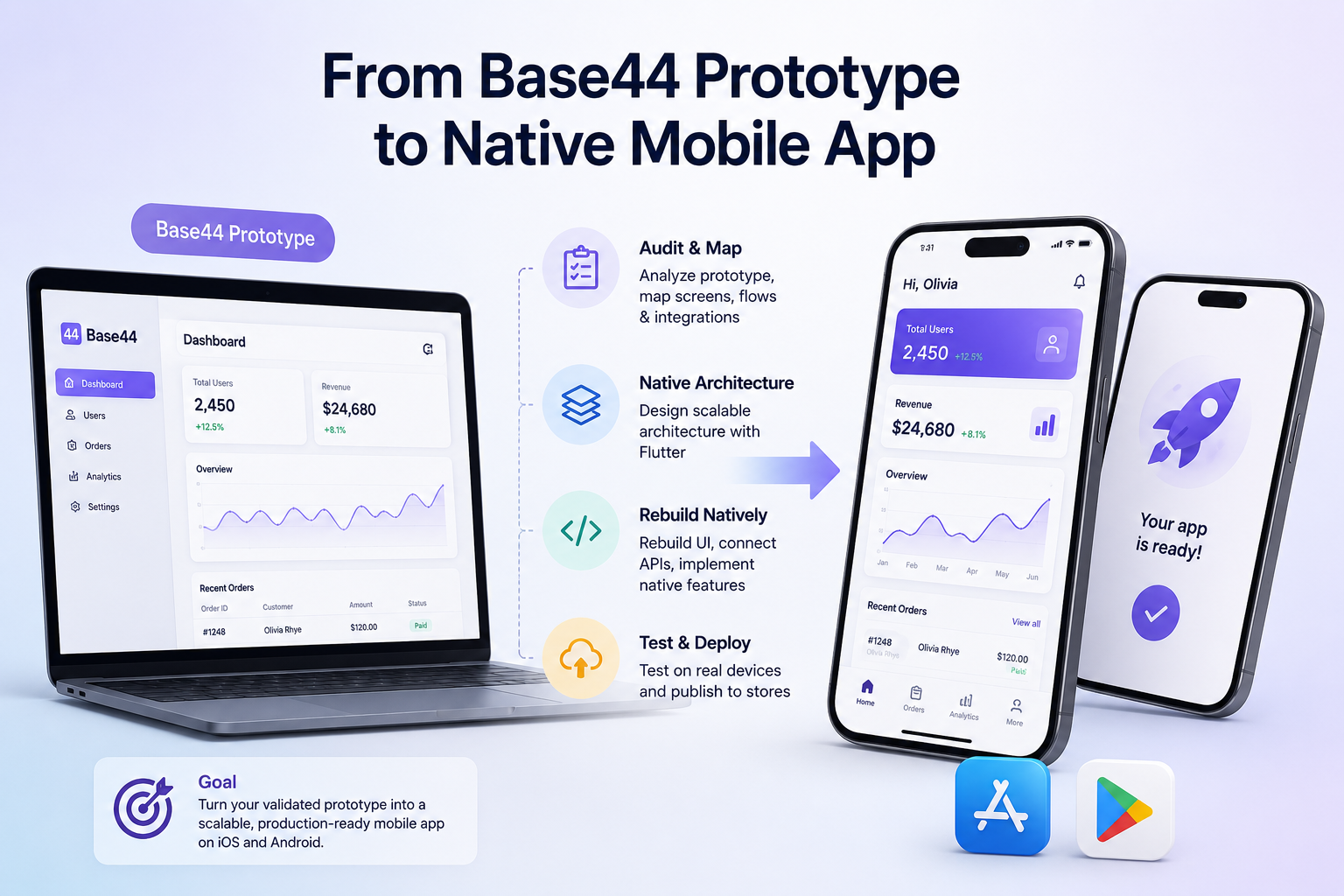
Turning a Base44 prototype to mobile app starts with an honest audit of what the prototype actually proved, not what it merely demonstrated. A prototype validates that people want the product; it rarely validates that the current build can handle thousands of daily users, real payment volume, or App Store review standards. This gap between validation and readiness is exactly what a Base44 web prototype conversion exists to close. The audit separates these two things clearly, then maps every screen, flow, and integration point that needs to carry over into the native version. From there, the team defines a native architecture, almost always Flutter, so the resulting app ships to iOS and Android from a single codebase instead of two separate builds. Skipping this audit is the single most common reason a Base44 prototype to mobile app project runs over budget, since teams that jump straight into native development without mapping the original prototype end up rebuilding screens twice once gaps in the plan surface mid-project. This is where a genuine Base44 MVP mobile development engagement earns its name: it treats the MVP's proven logic as an asset while rebuilding everything that touches the interface, since that layer cannot simply be lifted from a web-first tool into a native app store listing. This same reasoning applies whether the project is called a Base44 prototype to mobile app effort, a Base44 web prototype conversion, a Base44 prototype native application, a Base44 app production upgrade, or a plan to build a proper Base44 web product mobile version. Whichever term a founder prefers, the underlying Base44 MVP mobile development work looks the same on the inside.
3. What should you do after building with Base44?
The instinct after a successful Base44 launch is often to keep adding features inside Base44 itself, but that instinct usually runs out of road once usage climbs.
3.1 How can Base44 prototype functionality be preserved?
The functionality itself, meaning the rules, the roles, and the data relationships, transfers cleanly into a native rebuild because none of it depends on Base44's specific interface technology, which is exactly why a Base44 prototype native application built this way rarely needs to touch the original business logic at all. What does not transfer is the actual rendering layer, so the smarter move after building with Base44 is to start planning a Base44 web prototype conversion before the original build starts straining under its own growth, rather than after outages start happening. Founders sometimes delay this planning because the Base44 prototype still feels fast enough day to day, but usage curves rarely announce themselves in advance, and a Base44 web prototype conversion started early costs less in both time and stress than one started as an emergency response. Founders who wait until Base44 visibly struggles under load tend to rush the native build under pressure, which is a worse position than planning a calm, well-scoped Base44 prototype native application on a reasonable timeline. This holds true no matter what label the work carries: a Base44 prototype to mobile app plan, a Base44 MVP mobile development track, a Base44 app production upgrade, or a fresh Base44 web product mobile version. A calmly scoped Base44 prototype native application always costs less than a panicked one.
4. How can a Base44 MVP become a production app?
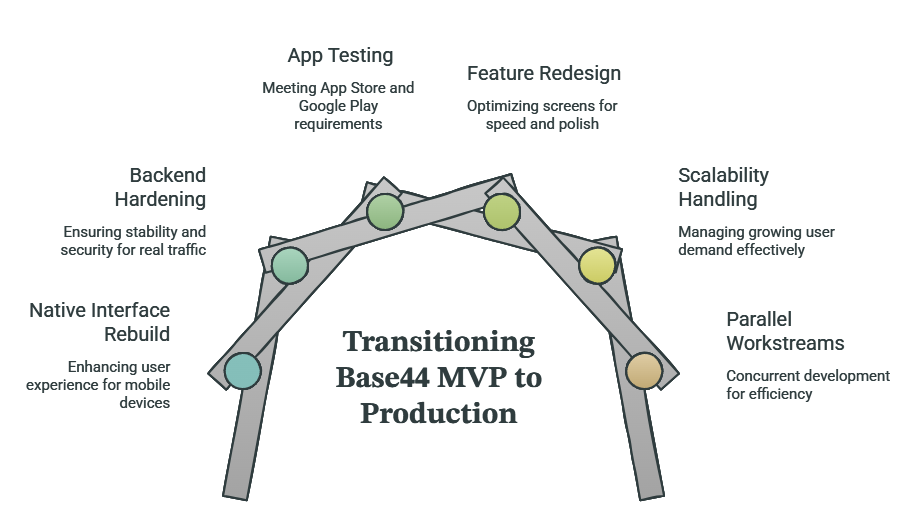
Becoming production-ready means three things happen at once: the interface gets rebuilt natively, the backend gets hardened for real traffic, and the app gets tested against App Store and Google Play requirements that a prototype never had to meet. This full sequence is what separates a genuine Base44 app production upgrade from a cosmetic redesign that leaves the underlying reliability problems untouched.
4.1 Which prototype features need mobile redesign?
Nearly every screen needs some redesign, since prototypes built for quick validation on Base44 usually prioritize speed over polish, and speed-built screens rarely hold up to the scrutiny of app store reviewers or the expectations of paying users. Recognizing which specific screens need the most redesign work early in a Base44 prototype native application engagement keeps the timeline realistic instead of discovering the true scope halfway through development.
4.2 How can Base44 handle growing mobile usage?
In most cases, the underlying data layer can handle growth just fine with proper indexing and caching, but the interface consuming that data needs a complete rebuild to perform well on a phone rather than a browser. Founders scaling a Base44 prototype native application often overestimate how much backend work is needed and underestimate how much interface work is needed, which is exactly backwards from how the effort actually breaks down in most projects. A Base44 app production upgrade done properly treats these as parallel workstreams rather than a strict sequence, so backend hardening happens alongside frontend rebuilding instead of blocking it. That parallel approach is what separates a rushed Base44 prototype to mobile app launch from a Base44 MVP mobile development project built to last, whether the team calls the resulting build a Base44 prototype native application or simply a proper Base44 web product mobile version.
5. When should a Base44 prototype move to mobile?
The right timing signal is rarely a calendar date; it is user behavior. Once people are asking for a downloadable app, requesting offline access, or complaining about how the Base44 web experience feels on a phone browser, that is the moment a Base44 prototype to mobile app conversation should start. Tracking these signals deliberately, rather than reacting only once complaints pile up, gives a founder a much clearer case for when a Base44 MVP mobile development budget is actually justified. What technical upgrades does a Base44 MVP need? Beyond the interface rebuild, most MVPs need authentication hardened for mobile sessions, payment flows moved to native SDKs, and monitoring put in place so the team can see problems before users report them. These upgrades usually get bundled into the same Base44 app production upgrade as the interface rebuild, since scheduling them separately only extends the overall timeline without any real benefit. Waiting too long past these signals risks losing users to a faster-moving competitor who ships a native app first, while moving too early risks spending on native development before the underlying product-market fit is fully proven. Founders running a Base44 MVP mobile development project should treat this timing decision as a business call as much as a technical one, since the cost of moving early is wasted spend while the cost of moving late is lost market position. A well-run Base44 MVP mobile development partner helps founders read these signals accurately instead of guessing. Reading them correctly is what turns a Base44 prototype to mobile app conversation into a scoped Base44 web prototype conversion instead of a panicked rebuild after a competitor's Base44 prototype native application already beat them to the store.
6. What changes turn Base44 into a serious mobile product?
Three shifts separate a Base44 prototype from a serious mobile product: native performance, real device access, and production-grade reliability, and every credible Base44 web product mobile version has to deliver on all three, not just one or two.
6.1 How can native features improve a Base44 MVP?
Push notifications alone can meaningfully improve retention compared to a web app that relies on users remembering to check back, and biometric login removes friction that costs conversions on every single visit. A Base44 web product mobile version that adds these two features alone usually sees a measurable lift in returning users within the first few weeks post-launch, since neither capability exists in any meaningful form inside the original Base44 prototype. Native performance means the app loads instantly and responds to touch without the lag that browser-rendered interfaces sometimes carry, especially on older phones. Production-grade reliability means the app degrades gracefully on a bad connection instead of simply failing, something a Base44 web prototype conversion has to address directly since Base44's browser-based architecture was never built around offline resilience. Put together, a Base44 prototype native application feels like a different category of product to the people using it, not just a faster version of the same one. That category shift is the entire point of a Base44 app production upgrade, whether it started as a Base44 prototype to mobile app initiative, a formal Base44 MVP mobile development track, or a plan to finally ship a real Base44 web product mobile version.
7. How can founders scale a Base44 MVP for mobile?
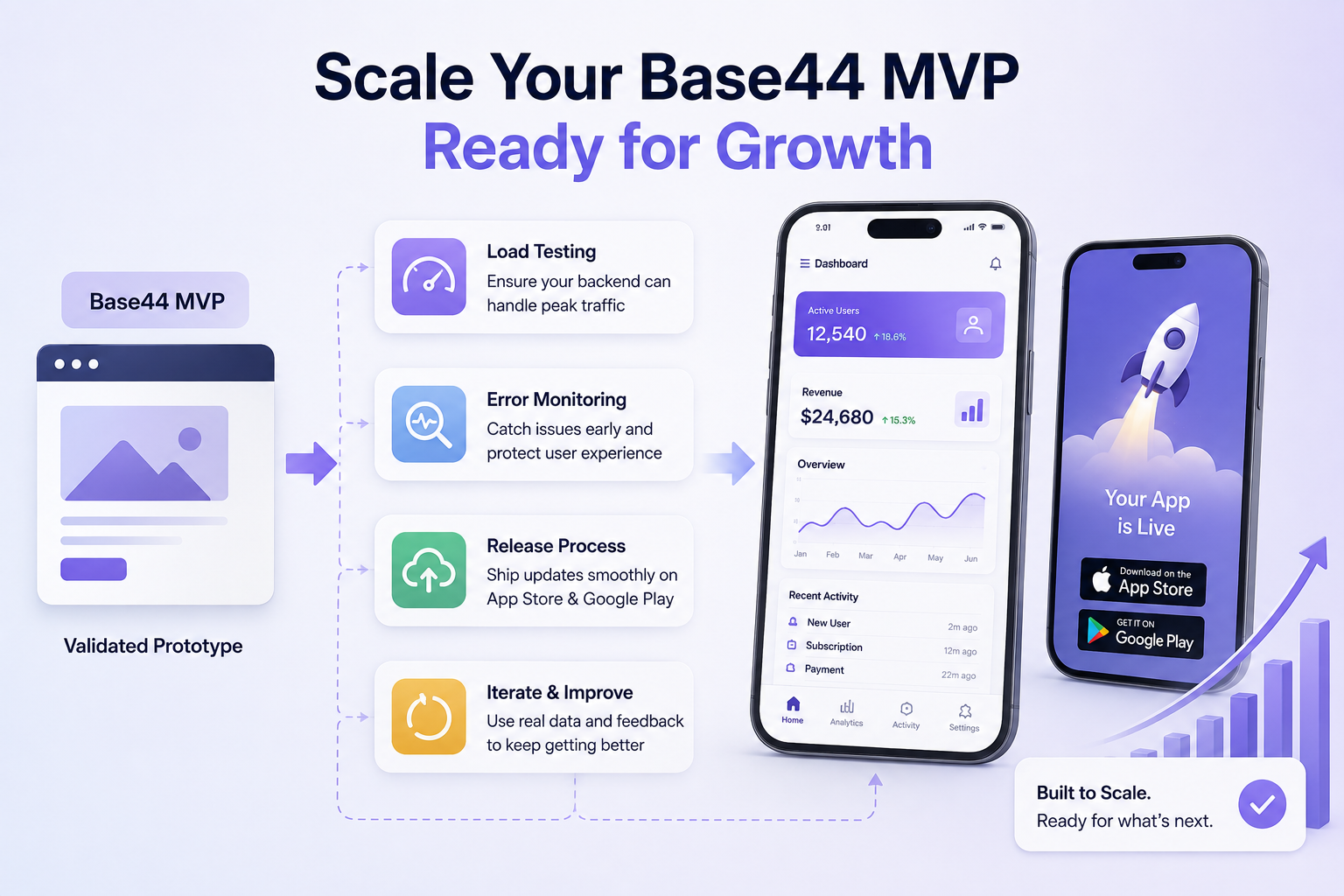
Scaling means planning for growth before it happens rather than reacting to it after the fact. A Base44 app production upgrade typically includes load testing the backend under simulated peak traffic, adding proper error monitoring so issues get caught before they become reviews, and building a release process that supports regular App Store and Google Play updates without downtime. Founders who treat this planning stage seriously find that a Base44 prototype to mobile app launch goes far smoother than one where scaling was left as an afterthought. Founders scaling a Base44 web product mobile version should also budget for post-launch iteration, since the first native release rarely gets every screen exactly right on the first attempt, no matter how carefully the Base44 prototype to mobile app planning phase was handled. Building this expectation in early prevents the common mistake of treating launch day as the finish line rather than the start of a Base44 web product mobile version that keeps improving with real usage data. That same discipline applies whether the engagement was originally scoped as a Base44 MVP mobile development track, a Base44 web prototype conversion, a Base44 prototype native application, or a broader Base44 app production upgrade covering the whole product. ArixLabs typically builds this iteration cycle into the engagement from day one, so scaling a Base44 MVP mobile development project does not stall the moment the first version ships. ArixLabs applies the same discipline whether the engagement is framed as a Base44 prototype to mobile app rollout, a Base44 web prototype conversion, a Base44 prototype native application, or an ongoing Base44 app production upgrade for a Base44 web product mobile version already live in both stores. Founders who bring ArixLabs in early on any of these labels tend to spend less overall than those who wait until the Base44 prototype is already buckling under real demand, regardless of whether the eventual project is called a Base44 prototype to mobile app migration, a full Base44 MVP mobile development build, a Base44 web prototype conversion, a Base44 prototype native application, a Base44 app production upgrade, or simply a long-overdue Base44 web product mobile version.
8. FAQs
1. Is Base44 suitable for an MVP?
Yes. Base44 is well suited to proving an idea quickly with real users before committing to a full native build, which is exactly why so many successful native apps started as a Base44 prototype heading toward a Base44 prototype to mobile app conversion.
2. What comes after a successful Base44 prototype?
A successful prototype typically moves into a Base44 web prototype conversion, rebuilding the interface natively for iOS and Android while keeping the validated product logic intact, often alongside a broader Base44 MVP mobile development plan and, eventually, a full Base44 app production upgrade. Most founders find the Base44 web prototype conversion phase moves faster than expected once the audit is complete.
3. Can a Base44 MVP become a commercial app?
Yes. A Base44 prototype native application built on top of a validated MVP can absolutely become a commercial, revenue-generating Base44 web product mobile version once the interface and backend are hardened through a proper Base44 app production upgrade.
4. When should I move beyond an AI prototype?
Once user demand, feature complexity, or platform requirements exceed what a prompt-built prototype can reliably support, it is time to plan a proper Base44 app production upgrade rather than continuing to patch the original build, and to start scoping the Base44 web product mobile version users are already asking for.
%20(1).jpg)

View more blogs
.png)

.png)
%20(1).png)

.png)
.png)

Ready to develop your own product? Get in touch today!
Get in Touch