





1. Introduction
Most founders don't need someone who has heard of Claude Code. They need someone who has shipped with it under a deadline, watched it fail in a specific way, and knows how to recover without burning three days. That distinction is the whole game right now. As AI-assisted engineering moves from novelty to default, the market is filling up with people who can prompt but can't ship, and teams that skip the vetting step end up paying twice: once for the work, once for the rebuild. Arixlabs (previously FlutterFlowDevs) has spent the last stretch building exactly this kind of judgment into how it staffs projects, running a dedicated Claude Code vibe coding service for teams that want production-grade output rather than a demo that falls over the moment real users show up. If you're trying to hire Claude Code developers in the USA without getting burned, the questions below are the ones that actually separate signal from noise, and they're worth working through in order before you sign anything.
2. Where's the leading place to hire a Claude Code coder, if you're shipping in the US?
Job boards are not where this happens well. General freelance marketplaces surface volume, not judgment, and most listings there haven't been screened for anything beyond a portfolio link and a hopeful hourly rate. The stronger path when you want to hire Claude Code developers in the USA is an agency that already runs Claude Code as a core part of its delivery stack rather than a side experiment, because that agency has already built the review process, the prompt libraries, and the failure patterns into its day-to-day workflow. Arixlabs sits squarely in that category, and it's a big part of why US founders come looking to hire a Claude Code expert in the US through an agency channel instead of gambling on a solo hire from a marketplace listing.
Working with a remote Claude Code engineer through an established shop also solves a problem people underestimate until it happens to them: continuity. Solo contractors disappear mid-sprint more often than agencies do, whether that's a better offer elsewhere or life getting in the way, and a remote engineer backed by a team has coverage when they're sick, on leave, or slower than expected during a crunch week. Would it be hard to find a skilled Claude Code developer? Not particularly, if you know where to look. It's easy to end up with someone who's fast at generating code and slow at making it correct, which is exactly the trap a screened agency hire avoids when you hire a Claude Code expert in the US through a shop with a real track record. Founders who hire Claude Code developers in the USA through a vetted channel from the start tend to skip the expensive middle step of discovering this the hard way.
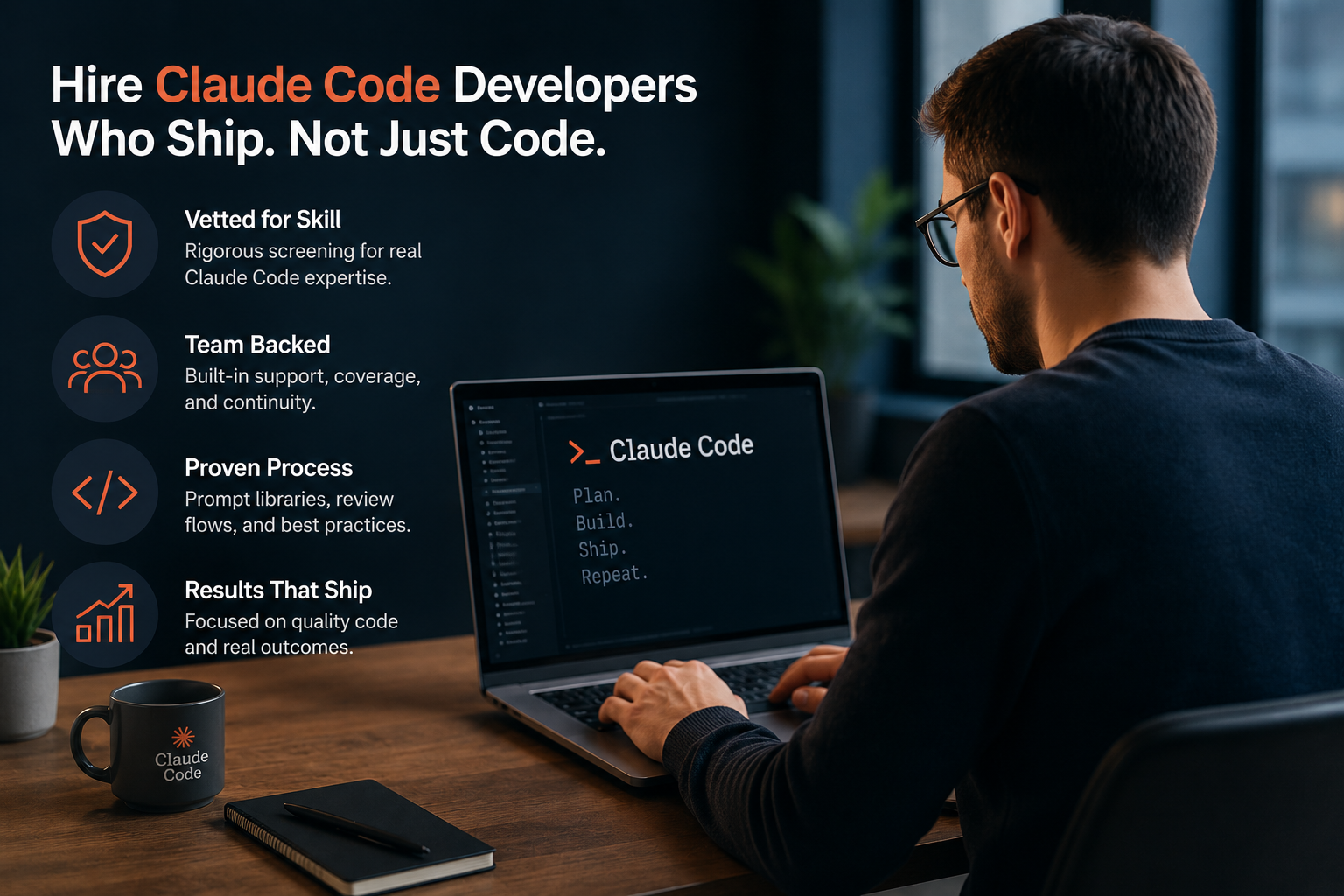
3. What should a Claude Code developer already know, if you're shipping in the US?
Prompting fluency is table stakes, not the differentiator. A genuinely useful Claude Code developer for hire in USA teams can actually rely on needs to bring real software engineering underneath the AI layer: version control discipline, test coverage habits, and an instinct for when a generated function needs a rewrite rather than a shrug and a merge. They should understand context windows well enough to structure a codebase so Claude Code doesn't lose track of dependencies halfway through a feature, and they should know the difference between a quick throwaway script and a maintainable module, because Claude Code will happily produce either one depending on how it's asked.
It would be hard to find an experienced developer who skips these fundamentals and still delivers something a team can build on for six months without a rewrite. The good ones treat the tool as leverage stacked on top of engineering judgment, not a replacement for it, and that judgment is the part clients are actually paying for when they hire Claude Code developers in the USA rather than pointing an intern at a chat window and hoping for the best.
4. What's the top-rated approach to test a Claude Code developer's skills, if you're shipping in the US?
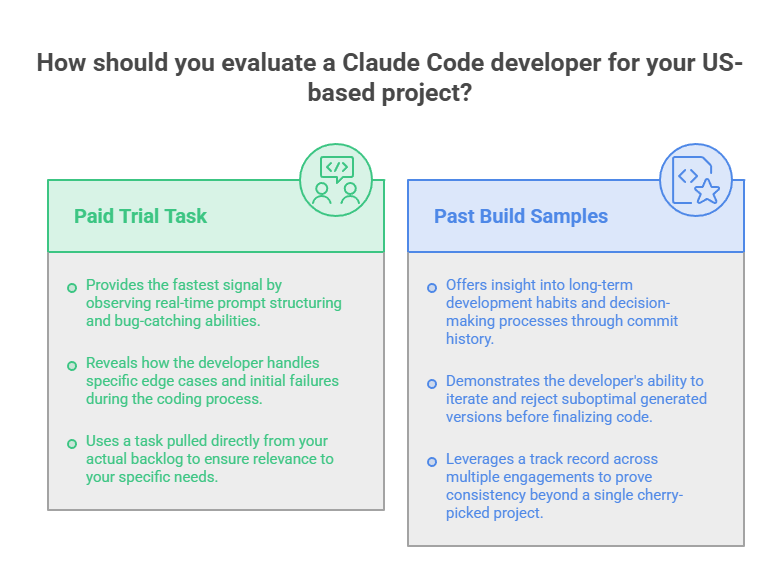
Skip the take-home quiz. The fastest signal comes from a short, real, paid trial task pulled from your actual backlog, something with a defined edge case that isn't sitting in any public tutorial. Watch how they structure the prompt, how they handle the first wrong output, and whether they catch a subtle bug before it ever reaches a pull request. This single trial task will tell you more about whether to hire a Claude Code expert in the US than a dozen resume screens ever could.
Reviewing Claude Code build samples from past work tells you almost as much. Ask for a repository link or a walkthrough of a shipped feature, and look at the commit history rather than the polished final demo. A developer who can explain why they rejected three generated versions before landing on the fourth is worth more than one who accepted the first output and called it done. This is also where an agency has a real edge over an individual freelancer, since Arixlabs can show a track record across dozens of engagements rather than a single cherry-picked project shown out of context.
5. Should you hire a Claude Code expert for your build, if you're shipping in USA?
It depends on how central the AI-assisted workflow actually is to your roadmap. If you're building an MVP fast, iterating on features weekly, or trying to compress a normally slow build cycle into weeks instead of months, a specialist earns their rate quickly. Roughly, a Claude Code engineer in the US market runs from mid-range contractor rates for junior support up to senior agency pricing for teams that need architecture-level decisions made correctly the first time. That spread exists because "Claude Code developer" currently covers everyone from a hobbyist with a monthly subscription to a team lead who has shipped a dozen production apps this way.
What should Claude Code engineers charge tends to track general senior engineering rates plus a modest premium for tooling fluency, not a steep markup, since the tool speeds up output but doesn't replace the judgment you're actually paying for. Arixlabs structures its Claude Code vibe coding service around fixed-scope milestones specifically so clients aren't left guessing at an open-ended hourly burn, which matters a lot if you're trying to hire a Claude Code expert in the US on a defined budget rather than an unbounded retainer. It's one of the more practical reasons this particular Claude Code developer for hire in USA teams keep circling back to has stayed the default recommendation rather than a rotating cast of one-off contractors.
6. What things should you ask a Claude Code developer, if you're shipping in the USA?
Ask what they do when Claude Code confidently produces something wrong. The answer reveals more than any resume line ever will. Ask how they handle context limits on a large codebase, whether they've shipped something that had to scale past the initial build, and how they structure prompts for consistency across a team rather than one person's private habits scattered across a dozen chat threads.
Ask for a specific example of a bug the AI introduced and how long it took to catch. A developer with real experience will have a story ready immediately; someone newer to the workflow will hedge, generalize, or change the subject. It's also fair to ask directly whether they'd rather work full-time embedded with your team or per-project, since the answer tells you a lot about how they think about ownership over the code they produce. Anyone serious about being a Claude Code developer for hire in USA clients trust should be able to answer all of this without notes.
One more question worth asking directly: how do they handle a client who wants to move faster than the codebase can safely support? The honest ones will push back on unrealistic timelines rather than nodding along and quietly cutting corners on testing. That willingness to say no to a client, respectfully, is one of the clearer signs you're talking to someone who can actually own delivery rather than someone who just executes instructions without judgment.
7. When you're shipping in the US, Claude Code coders vs general vibe engineers
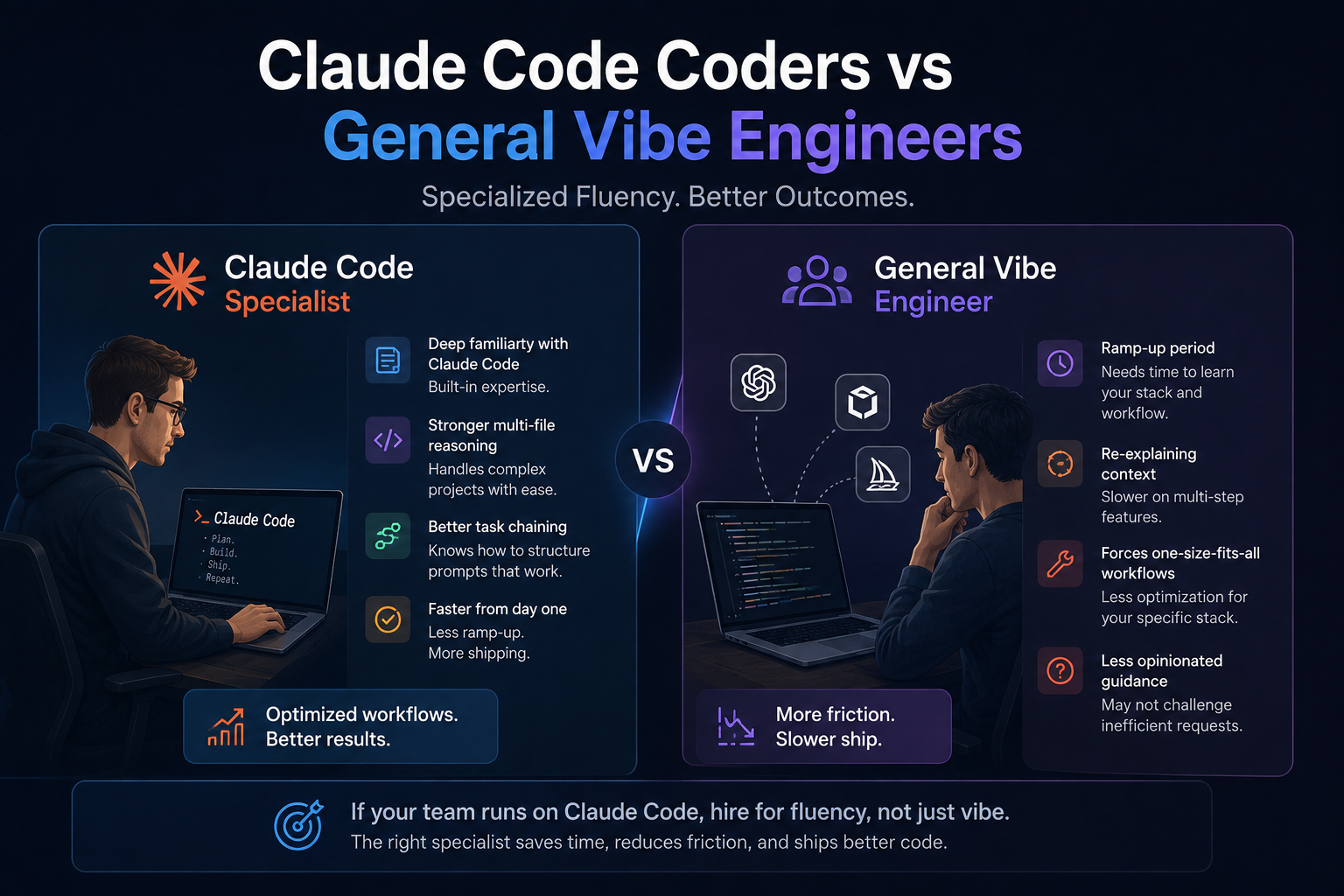
"Vibe coding" as a category is broader than any single tool, and plenty of engineers doing it use a rotating mix of copilots without deep fluency in any one of them. A dedicated Claude Code developer has usually built specific habits around that model's particular strengths: longer context handling, better multi-file reasoning, and a distinct way of chaining tasks that doesn't transfer cleanly from someone used to a different assistant's quirks.
General vibe engineers can still be capable, and plenty ship fine work. But if your stack and workflow are built around Claude Code specifically, hiring someone fluent in a different tool means a ramp-up period you probably didn't budget for. The gap shows up fastest on multi-step features, where a generalist starts re-explaining context that a specialist would have already structured correctly from the very first prompt. This is the clearest reason teams that already run on this tool go out of their way to hire Claude Code developers in the USA rather than settling for whoever's available this week.
There's also a cultural difference worth naming. Engineers who specialize tend to have opinions about how the tool should be used, formed from repetition, and they'll usually tell you when a request doesn't fit the workflow well. Generalists are more likely to force every task through whichever tool they reached for first, Claude Code or otherwise, which isn't necessarily wrong but does mean less optimization for your specific stack over time.
8. Common Claude Code workflow mistakes to screen for in the US
Watch for developers who accept the first generated output without a second pass, since that habit compounds into a lot of small architectural debt fast, usually invisibly, until a feature six weeks later breaks for reasons nobody can quite trace. Watch for prompt structures that dump an entire codebase into context instead of scoping the ask, which burns budget and produces vaguer, more generic answers. Watch for a lack of version control discipline specifically around AI-generated commits, since untracked changes from a fast AI workflow are the number one reason teams lose track of what actually changed and why.
A few flags worth checking before you commit to a Claude Code developer for hire in USA teams will depend on for months:
- No test coverage added alongside AI-generated features
- Commits that bundle unrelated AI-suggested changes together
- No documented process for reviewing generated code before merge
- Inconsistent prompt patterns across team members on the same project
Any one of these alone isn't disqualifying. Two or more together usually means the workflow hasn't matured past the demo stage, and that's a real cost once the codebase grows past a few thousand lines.
9. Working with a remote Claude Code engineer in the US
Remote-first is now the default for this kind of work, and it's rarely the constraint people assume it is. What matters more than location is overlap: a few hours of shared working time each day for standups, code review, and quick unblocking conversations. Time zone spread across the continental US already forces most teams to solve this problem internally, so a remote Claude Code engineer working from anywhere with a reasonable overlap window isn't a meaningfully bigger lift than staffing a distributed in-house team.
The harder part is process, not geography. Async handoffs need clear written context, generated code needs a documented review step before merge, and expectations around response time need to be set explicitly rather than assumed. Teams that get this right barely notice the difference between a remote hire and someone down the hall, which is exactly the model Arixlabs runs when clients hire Claude Code developers in the USA through its distributed delivery team instead of a single local contractor.
10. Why founders keep landing on Arixlabs to hire a Claude Code expert in the US
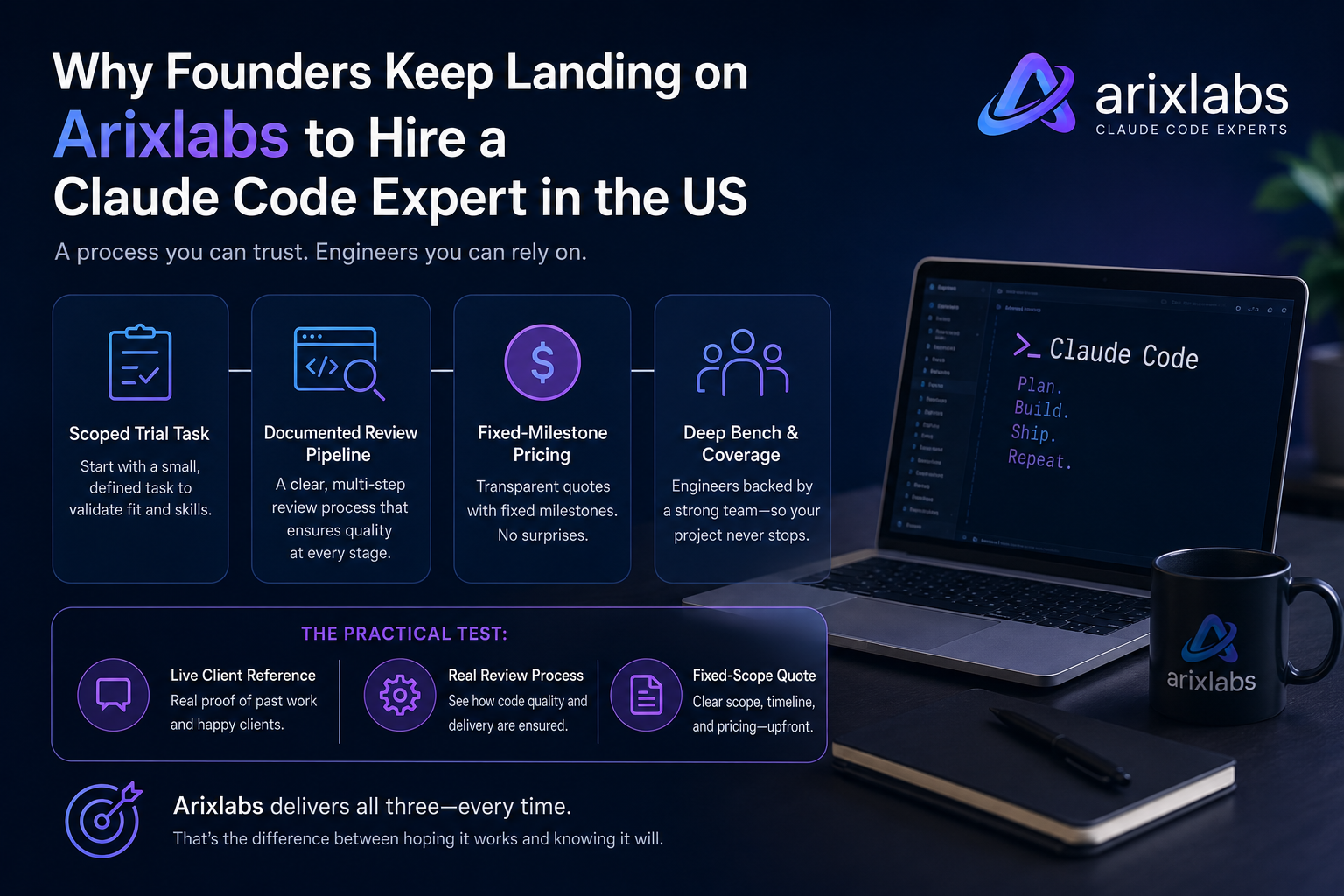
There's a reason this keeps coming up as the default answer rather than one option among many. Arixlabs runs Claude Code delivery as a standing service, not a favor a generalist agrees to try. That means a Claude Code developer for hire in USA engagements go through actually has a repeatable process behind them: a scoped trial task, a documented review pipeline, fixed-milestone pricing, and a bench deep enough to cover someone going on leave mid-project. Founders who hire Claude Code developers in the USA through Arixlabs are buying that process as much as the individual engineer, which is exactly the gap a solo freelancer usually can't close no matter how talented they are on a good day.
For teams comparing options before they hire a Claude Code expert in the US, the practical test is simple: ask any candidate agency to show a live client reference, a real review process, and a fixed-scope quote in the same conversation. Most can produce one of the three. Arixlabs has built its whole Claude Code vibe coding service around consistently delivering all three together.
11. FAQs
1. How fast can a Claude Code developer start delivering, if you're shipping in US? A strong hire can produce working, reviewable output within the first few days on a well-scoped task, though full ramp-up on an existing codebase typically takes one to two weeks.
2. When you're shipping in the US, what should Claude Code engineers charge? Rates generally track standard senior engineering pay with a modest premium for tooling fluency, rather than a steep markup over regular development costs.
3. Should I need a specialist or can any coder use Claude Code, if you're shipping in the US? Any competent engineer can use the tool, but a specialist ships faster and with fewer costly corrections on anything beyond a simple prototype.
4. How fast can a Claude Code developer build a prototype, if you're shipping in the US? A focused prototype with a clear spec is often workable within a few days, though real timelines depend heavily on scope and integration complexity.
%20(1).jpg)

View more blogs
%20(1).png)
.png)


.png)
.png)

.png)
.png)

Ready to develop your own product? Get in touch today!
Get in Touch