



1. Introduction
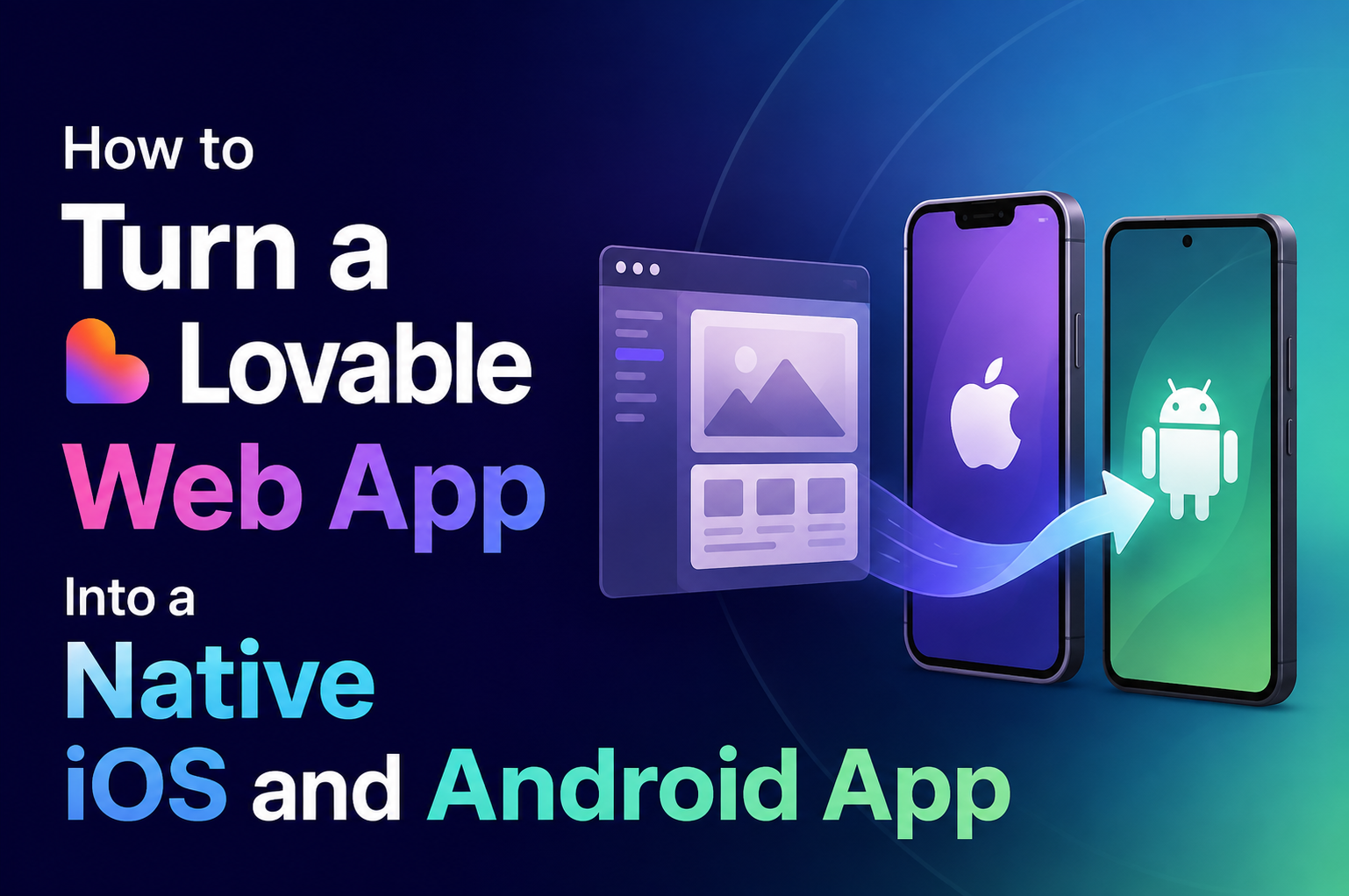
Founders who build with Lovable eventually hit the same wall: the web app works, users like it, but there's no way to install it as a real app on a phone. Wrapping a web link in a shell doesn't hold up either — Apple and Google both reject or flag apps that are just websites in disguise, so there's no proper, approved way to publish a plain Lovable web app to mobile as-is. This is exactly where real founders get stuck. They've validated a product, users are asking for a phone app, and the honest answer is that the web version can't simply be pushed to either store. Convert Lovable website to app is the actual next step, and it's a very different job from adding a mobile-responsive layout. A responsive site still runs in a browser. A native app runs on the device itself, with an icon, offline behavior, push notifications, and a real store listing. This is where Arixlabs (previously FlutterFlowDevs) comes in — Arixlabs specializes in taking products built on platforms like Lovable and rebuilding them as genuine native applications for iOS and Android, without forcing founders to start their product over. This blog walks through what actually changes when you turn Lovable into mobile app form, how much of your existing product logic survives the jump, and what the realistic timeline looks like.
2. Can a Lovable web app become a native mobile app?
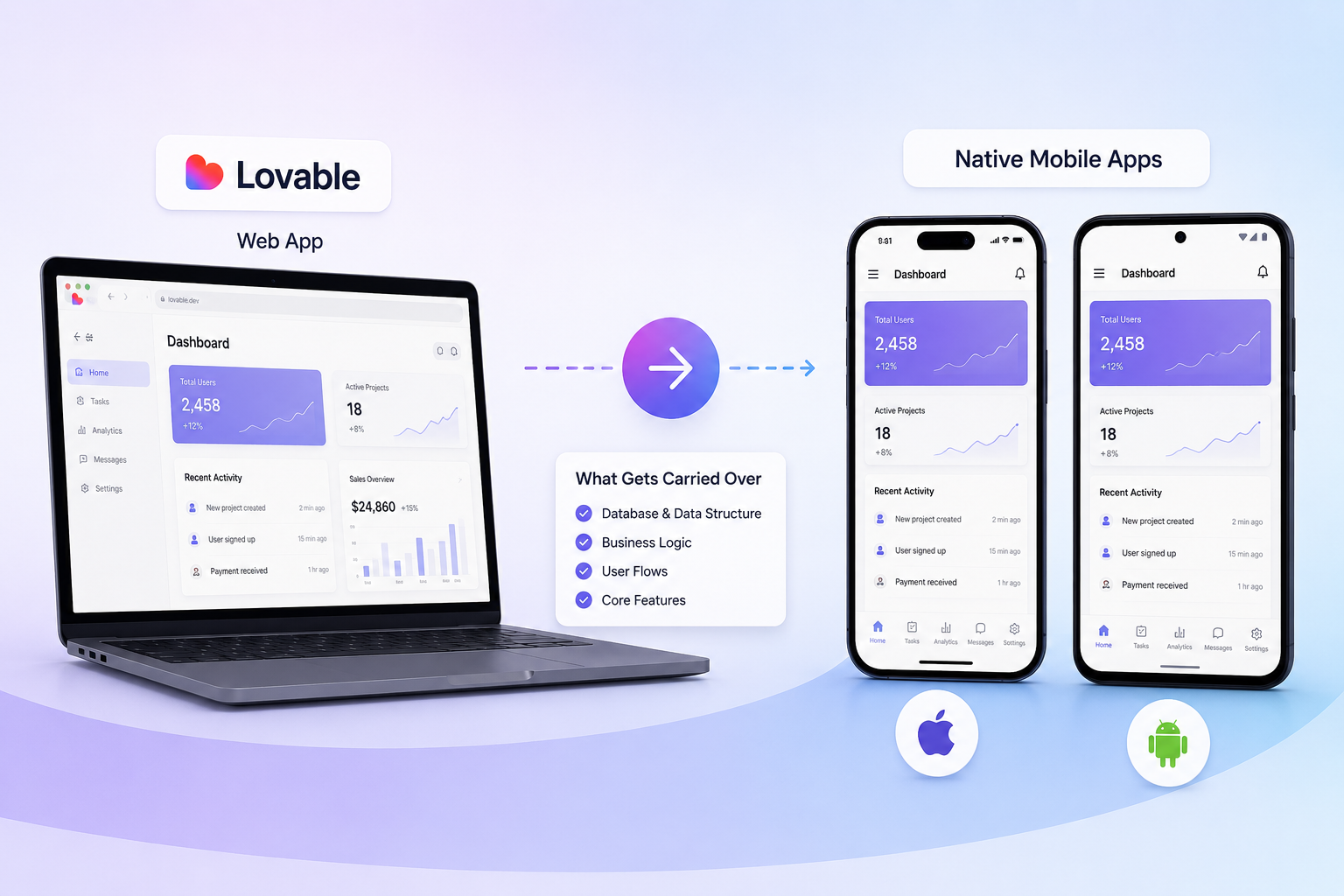
Yes, a Lovable web app to mobile transition is possible, but it isn't a one-click export. Lovable builds fast, functional web products using web technologies, and native iOS and Android apps run on a completely different foundation. What survives the move is your product's logic: the database structure, the business rules, the user flows, and the core features you've already validated. What doesn't survive untouched is the interface layer and anything built specifically for a browser environment. Founders sometimes ask whether they need to abandon their Lovable work entirely to get a real mobile app. They don't. A proper Lovable native mobile conversion treats the existing product as the source of truth for what the app should do, then rebuilds how it's delivered. Arixlabs typically starts by mapping every screen and function in the current Lovable build before writing a single line of native code, so nothing gets lost in translation and nothing gets rebuilt that doesn't need to be.
3. How do you convert Lovable project to iOS and Android?
The Lovable app to native iOS and Lovable app to Android app paths both start the same way: auditing the existing product, then rebuilding the frontend in a native-capable framework while connecting it to the same backend logic your Lovable app already uses. Flutter is the common choice here, since a single Flutter codebase can ship to both iOS and Android without duplicating the build. The process generally moves through four stages: extracting the data model and business logic from the current build, redesigning the interface for phone-sized screens and touch interaction, wiring up native device capabilities, and finally preparing the build for each store's submission requirements. Every stage matters, but the redesign stage is where most of the real engineering work happens, because a web layout and a native layout solve different problems.
3.1 Can the Lovable database connect to mobile?
Yes. If the Lovable backend runs on a standard database service like Supabase or a similar platform, that same backend can serve a native mobile app directly. The database doesn't need to be rebuilt, just connected through a native-friendly API layer instead of a web-only one.
4. What is the process for taking Lovable web app to mobile?
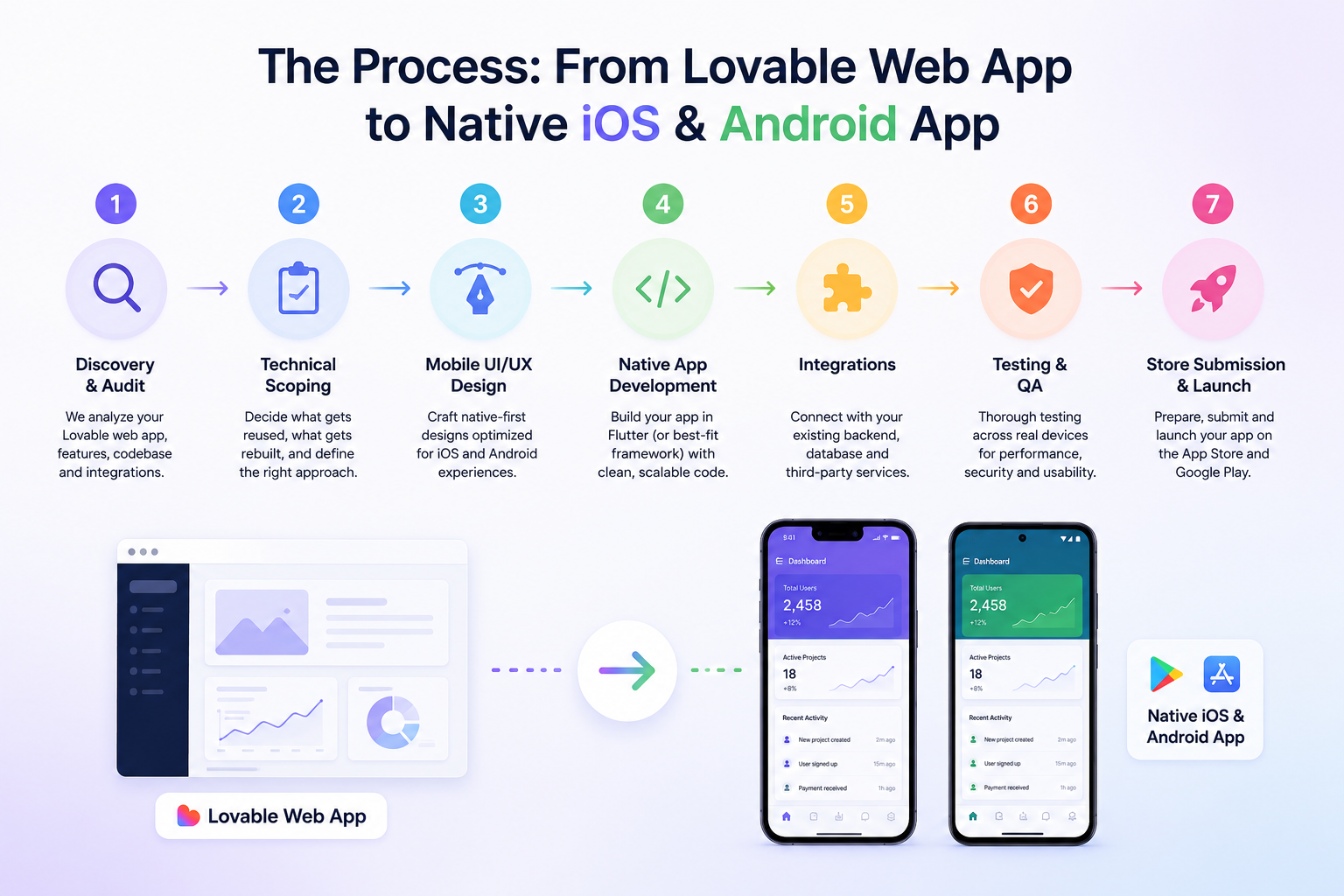
A structured convert Lovable website to app process looks like this in practice: discovery and audit of the existing Lovable product, technical scoping to decide what gets reused versus rebuilt, native UI/UX design for mobile screen sizes, development of the native app in Flutter or an equivalent framework, integration with the existing backend and any third-party services, quality assurance across real devices, and finally store submission and launch. Arixlabs runs this as a defined pipeline rather than an open-ended rebuild, which is what keeps a Lovable app to native iOS and Android release on a predictable schedule instead of dragging on indefinitely. Founders get visibility into each stage instead of a black box between "we started" and "it's done."
4.1 How should Lovable screens be redesigned for mobile?
Screens built for a browser need to be redesigned around thumb reach, smaller viewports, and native navigation patterns like tab bars and bottom sheets. A layout that works with a mouse and a wide screen often needs a completely different information hierarchy on a five-inch phone, so this isn't a resize job, it's a redesign job.
5. What changes when moving Lovable from web to native?
The biggest shifts happen in navigation, performance expectations, and device integration. Web apps rely on URLs and browser back buttons; native apps use in-app navigation stacks that need to be designed intentionally. Native users also expect instant load times and offline resilience that a browser-dependent app can't fully deliver. On top of that, a turn Lovable into mobile app project unlocks features a web build simply can't offer: push notifications, biometric login, camera and location access, and background processing. None of this means the original product concept changes. It means the same product finally behaves the way users expect an app to behave once it's installed on their phone.
5.1 What happens to authentication during the conversion?
Authentication logic from Lovable, whether it's email/password, OAuth, or magic links, typically carries over to the native app with adjustments for how tokens are stored and refreshed on-device. The login rules stay the same; the storage and session-handling mechanics change to fit mobile security expectations.
5.2 Can Lovable payments work inside native apps?
Payment logic often needs the most careful handling, since Apple and Google enforce their own in-app purchase rules for certain types of transactions. A payment flow that works fine on the web may need to be restructured to stay compliant with store policies once it's inside a native app.
6. Can Lovable functionality be reused in a mobile app?
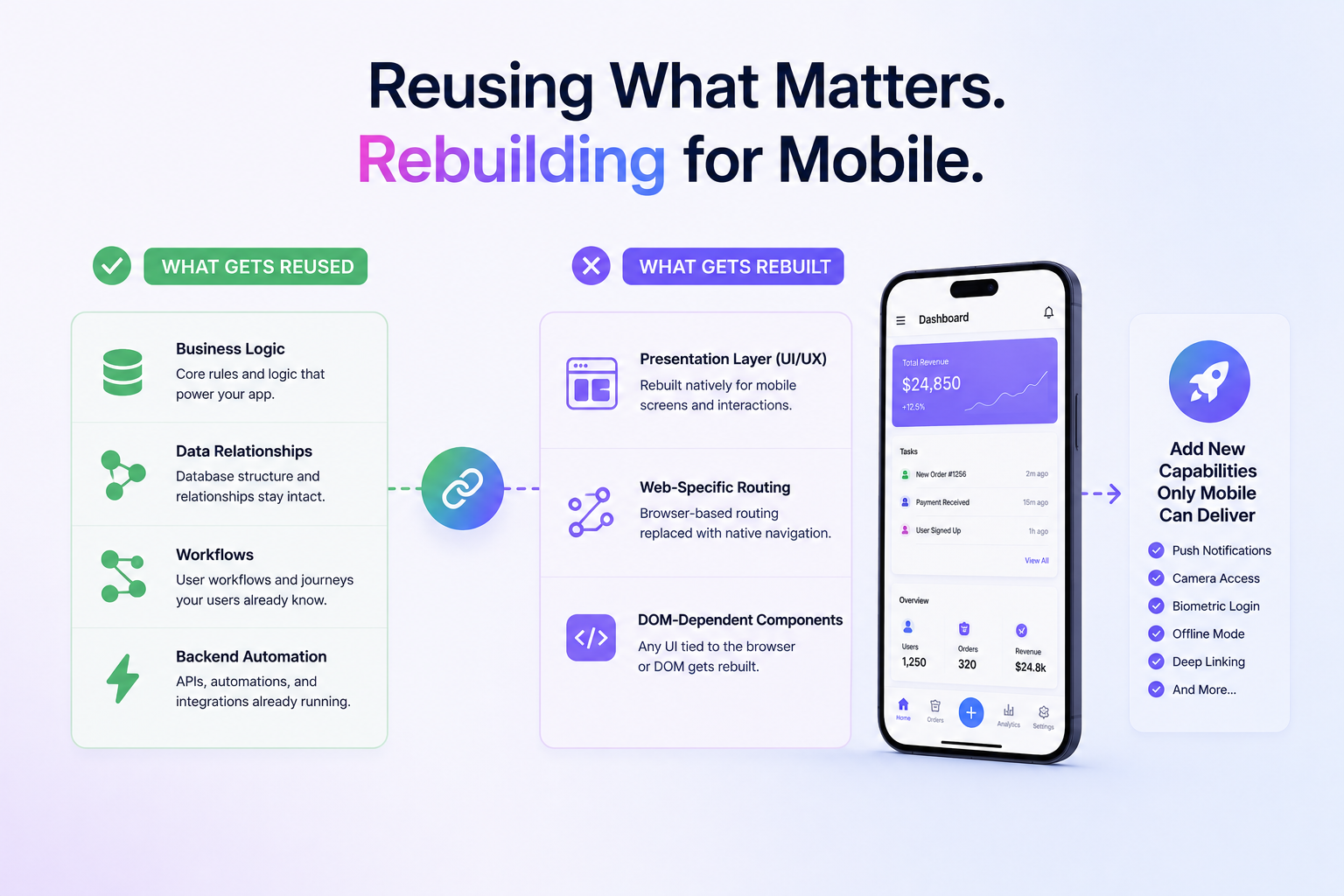
Most of it, yes. The parts of a Lovable build worth protecting are the business logic, the data relationships, the workflows users already understand, and any backend automation already running. None of that needs to be thrown away for a Lovable native mobile conversion to succeed. What gets rebuilt is the presentation layer and anything tightly coupled to a browser, such as web-specific routing or DOM-dependent components. Arixlabs approaches this by separating what the app does from how it's displayed, then reusing the "what" while rebuilding the "how" natively. This is also where founders get to add capabilities their web version never had.
6.1 Which native features can be added to Lovable apps?
Push notifications for retention, camera access for scanning or uploads, GPS for location-aware features, biometric login for faster access, and offline mode for spotty connections are the most commonly requested additions. None of these exist meaningfully in a browser-based Lovable app, so this is often where the mobile version starts to outperform the original product.
7. How long does Lovable-to-mobile development take?
Timelines vary with app complexity, but a typical Lovable app to native iOS and Android build runs eight to fourteen weeks from audit to store submission for a mid-sized product. Simpler apps with a handful of core screens move faster; apps with heavy backend logic, multiple user roles, or complex payment flows take longer. The timeline usually breaks down into roughly two weeks for audit and design, four to eight weeks for development, and two to four weeks for testing and store preparation. Arixlabs shares a scoped timeline upfront after reviewing the existing Lovable build, so founders know what to expect before development starts rather than getting an estimate that shifts every few weeks.
8. FAQs
1. Can I use my Lovable app on my phone?
You can open a Lovable web app in a mobile browser, but that's not the same as having an installed native app with an icon, push notifications, and offline access.
2. Can Lovable create an iPhone app?
Lovable itself builds web apps, not native iPhone apps, so reaching iOS requires a separate native build process using the existing Lovable product as the foundation.
3. Can a Lovable project reach the App Store?
Yes, once it's rebuilt as a native app, following Apple's submission and review requirements, a Lovable-based product can be published on the App Store.
4. Is native better than wrapping a Lovable app?
Native almost always performs better and passes store review more reliably, since wrapped web apps are frequently flagged or rejected for lacking true native functionality.
%20(1).jpg)

View more blogs
.png)


.png)
.png)

.png)

.png)
Ready to develop your own product? Get in touch today!
Get in Touch