



1. Introduction
Marketplace decisions are really a chain of small forks. Do you build custom or buy software? Do you recruit sellers first or buyers? Do you hold funds or let a provider do it? This guide is laid out as a decision tree, so every section ends with a short "if this, then that" block you can follow straight to your own answer.
ArixLabs is a Jaipur-based agency that builds with vibe coding, with senior engineers reviewing every AI-drafted change and 100+ production apps delivered. We wrote this for founders who want to hire vibe coders for multi-vendor marketplace in Australia work and want straight answers in Australian dollars, with GST and local payments in view. If you are comparing a marketplace app development agency in Australia against freelancers, or wondering whether you can build a marketplace with vibe coding at all, start at the first fork below.
2. Can vibe coding build a multi-vendor marketplace?
Yes, with a limit. AI tools can draft the buyer storefront, the seller dashboard and the admin console quickly, often in days. They cannot decide how funds are held, how fees are split or who carries risk when an order fails. Those choices belong to senior engineers. A team that treats the AI as a fast drafter and humans as owners of payments, security and data will deliver. A team that lets the AI write everything will give you a good demo and a fragile product.
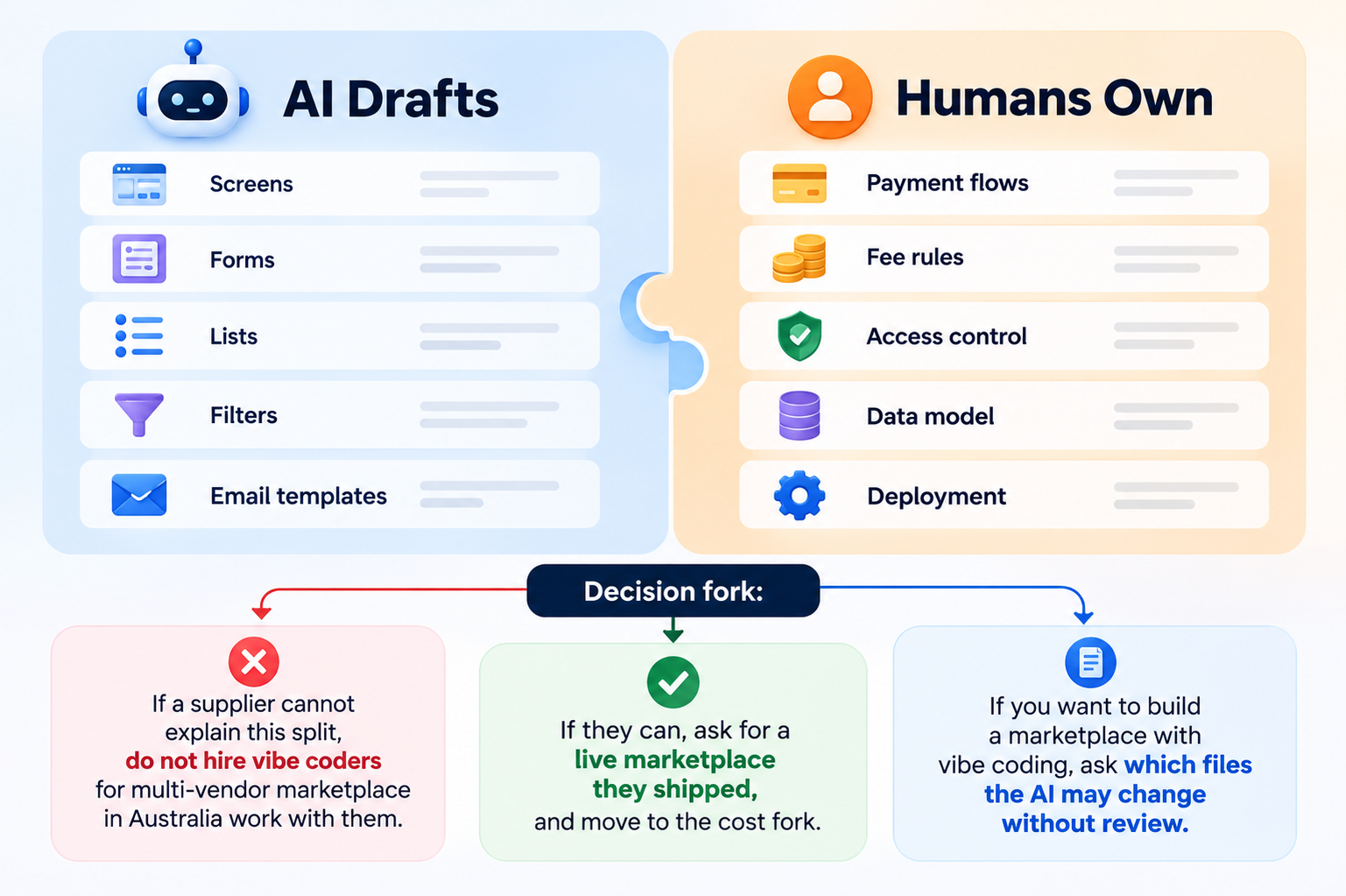
2.1 What a safe split looks like
- AI drafts: screens, forms, lists, filters, email templates
- Humans own: payment flows, fee rules, access control, data model, deployment
Decision fork:
- If a supplier cannot explain this split, do not hire vibe coders for multi-vendor marketplace in Australia work with them.
- If they can, ask for a live marketplace they shipped, and move to the cost fork.
- If you want to build a marketplace with vibe coding, ask which files the AI may change without review.
2.2 How can I check AI-built code?
Ask for pull requests with a named senior reviewer, automated tests on payment flows and a short security review before launch. A marketplace app development agency in Australia should hand these over without being asked. If you hire vibe coders for multi-vendor marketplace in Australia, make this part of the contract. Teams that build a marketplace with vibe coding responsibly can show you the review trail for every change.
3. What does a marketplace MVP cost in Australia?
A focused MVP typically lands in the tens of thousands of Australian dollars, and where you land depends on scope rather than screens. When you build a marketplace with vibe coding, interface work compresses. It does not compress payments, seller onboarding, tax setup or testing. Prices from a marketplace app development agency in Australia often include a project manager and a tester, while a freelancer may not.
Ask every supplier to quote these lines separately:
- Buyer app and search
- Seller dashboard
- Admin console
- Payments, payouts and refunds
- Seller onboarding and checks
- GST setup and reporting
- Testing, security and hosting
3.1 Where budgets quietly grow
Payment provider fees, identity checks, hosting in an Australian region, email and SMS tools, and legal review of your terms.
Decision fork:
- If quotes differ by more than a factor of three, find the line one supplier left out, usually payments or testing.
- If a marketplace app development agency in Australia quotes one lump sum, ask for the lines above before you hire vibe coders for multi-vendor marketplace in Australia.
- If your budget is under a comfortable MVP range, cut features, not the money layer.
- If you plan to build a marketplace with vibe coding on a tight budget, spend first on payouts and review, and last on polish.
3.2 How do Australian suppliers compare?
A marketplace app development agency in Australia, or an offshore partner serving Australian clients, should name a payments lead, a reviewer and a tester. Founders who hire vibe coders for multi-vendor marketplace in Australia should also ask about time zones, handover notes and post-launch support. Those who build a marketplace with vibe coding on a single freelancer often find nobody reviews the payout code.
Decision fork:
- If you need daily overlap, ask for fixed meeting windows in Australian time.
- If you have no technical lead, choose a team that provides one.
4. How do split payments and payouts work?
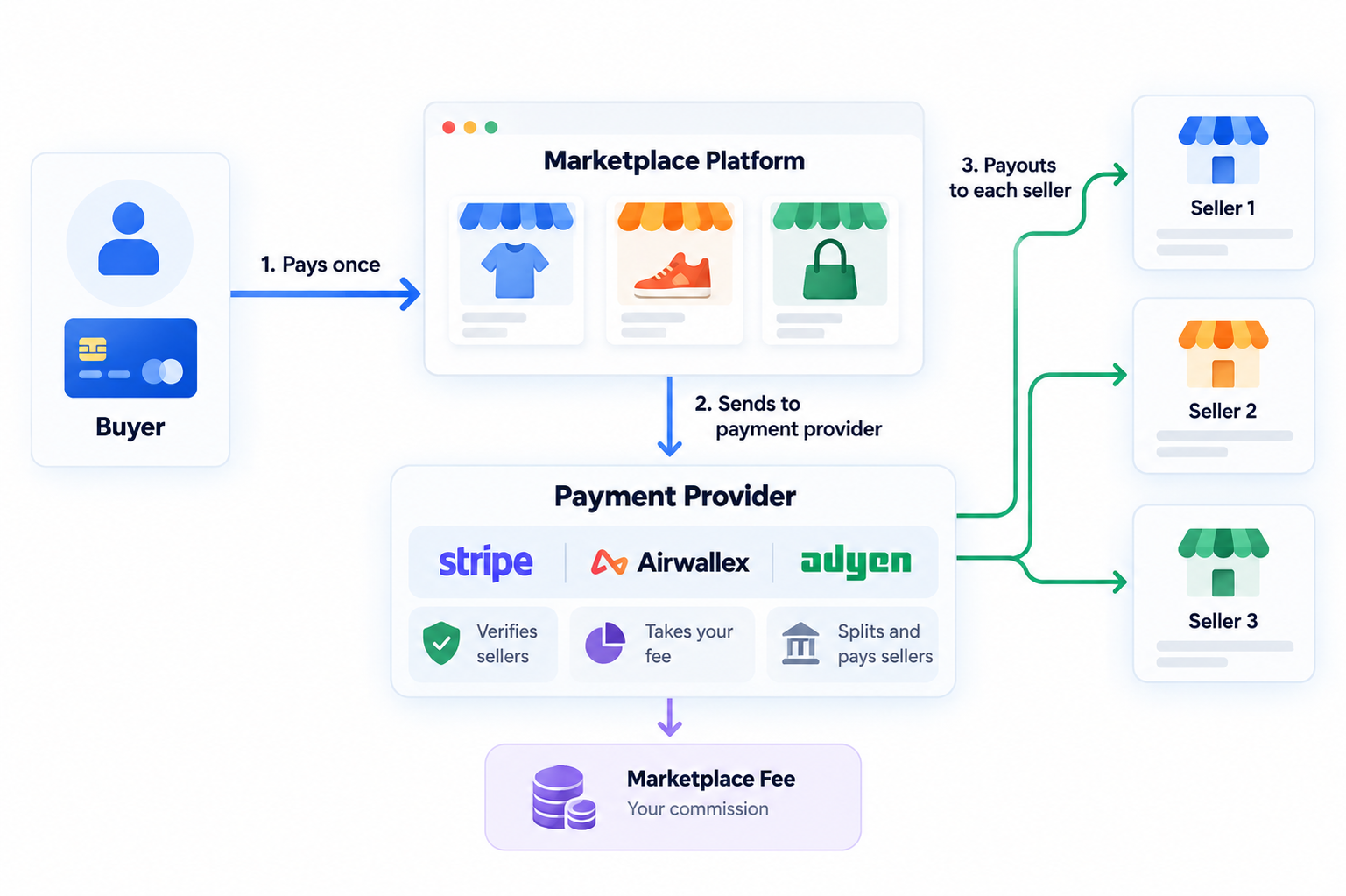
The buyer pays once. A marketplace payment provider splits the money, takes your fee and pays each seller, while verifying their identity. In Australia, founders commonly look at Stripe Connect, Airwallex or Adyen for Platforms. The provider holds the regulated part so your platform does not become a payments business by accident. Take legal advice on your exact model, because licensing questions depend on how money moves.
Engineers should confirm payments with server-side webhooks, use idempotency keys and never trust amounts sent from the app. The AI can draft the screens around this, but a human must review the logic.
4.1 How do commissions get set and collected?
Store fee rules as data: a percentage, a flat fee or a category tier. Calculate them on the server when an order is placed and save the result on each order line. Decide who pays processing fees and give sellers a statement showing every deduction.
4.2 How do I handle disputes and refunds?
Give every order a dispute status, a time window and an evidence trail. The Australian Consumer Law gives buyers guarantees that your terms cannot remove, so build refund and return tools into the admin console.
Decision fork:
- If you want the least regulatory weight, use a connected-accounts provider and never hold funds yourself.
- If sellers need fast payouts, ask the provider about payout schedules before you design the flow.
- If a marketplace app development agency in Australia has not shipped with your provider, ask for a test payout first.
- If a team cannot show a test payout and a test refund, do not hire vibe coders for multi-vendor marketplace in Australia projects with them.
4.3 Which provider should I choose?
Compare fees, payout speed, the seller onboarding flow and support for Australian bank accounts and local payment methods. Ask a marketplace app development agency in Australia which providers it has shipped with. Teams that build a marketplace with vibe coding should demo a test payout on the provider you pick, not on whichever tool the AI suggested. When you hire vibe coders for multi-vendor marketplace in Australia, put that demo in the acceptance criteria.
5. What do buyers, sellers and admins each need?
Buyers need search, seller profiles, a basket across several sellers, checkout, order tracking and reviews. Sellers need onboarding, a listing tool, an order queue, shipping labels or delivery settings and payout statements. Admins need seller approval and suspension, dispute tools, fee settings, reports and moderation.
A disciplined marketplace app development agency in Australia will keep a visible cut-list so scope does not creep, which is a real risk when you build a marketplace with vibe coding and everything feels quick.
5.1 How do I verify sellers?
Use your provider's identity checks, confirm business details such as an ABN against the public Australian Business Register, and review high-risk categories by hand. Any marketplace app development agency in Australia should log this.
Decision fork:
- If sellers are individuals, rely on provider identity checks and add manual review for high-value items.
- If sellers are registered businesses, collect and check ABNs and GST status at signup.
- If you sell regulated goods such as food or health products, add category approval before listing.
- If you hire vibe coders for multi-vendor marketplace in Australia, ask to see the admin console in week two, not last.
5.2 What should the admin console include?
A seller queue, a dispute inbox, a fee editor, an audit log and a way to pause a listing in seconds. Operations staff run launch week from this console, so a marketplace app development agency in Australia should build it early. If you hire vibe coders for multi-vendor marketplace in Australia, check it is not left until last, which is a common temptation when you build a marketplace with vibe coding and the interface feels finished.
6. How long does a marketplace take to launch?
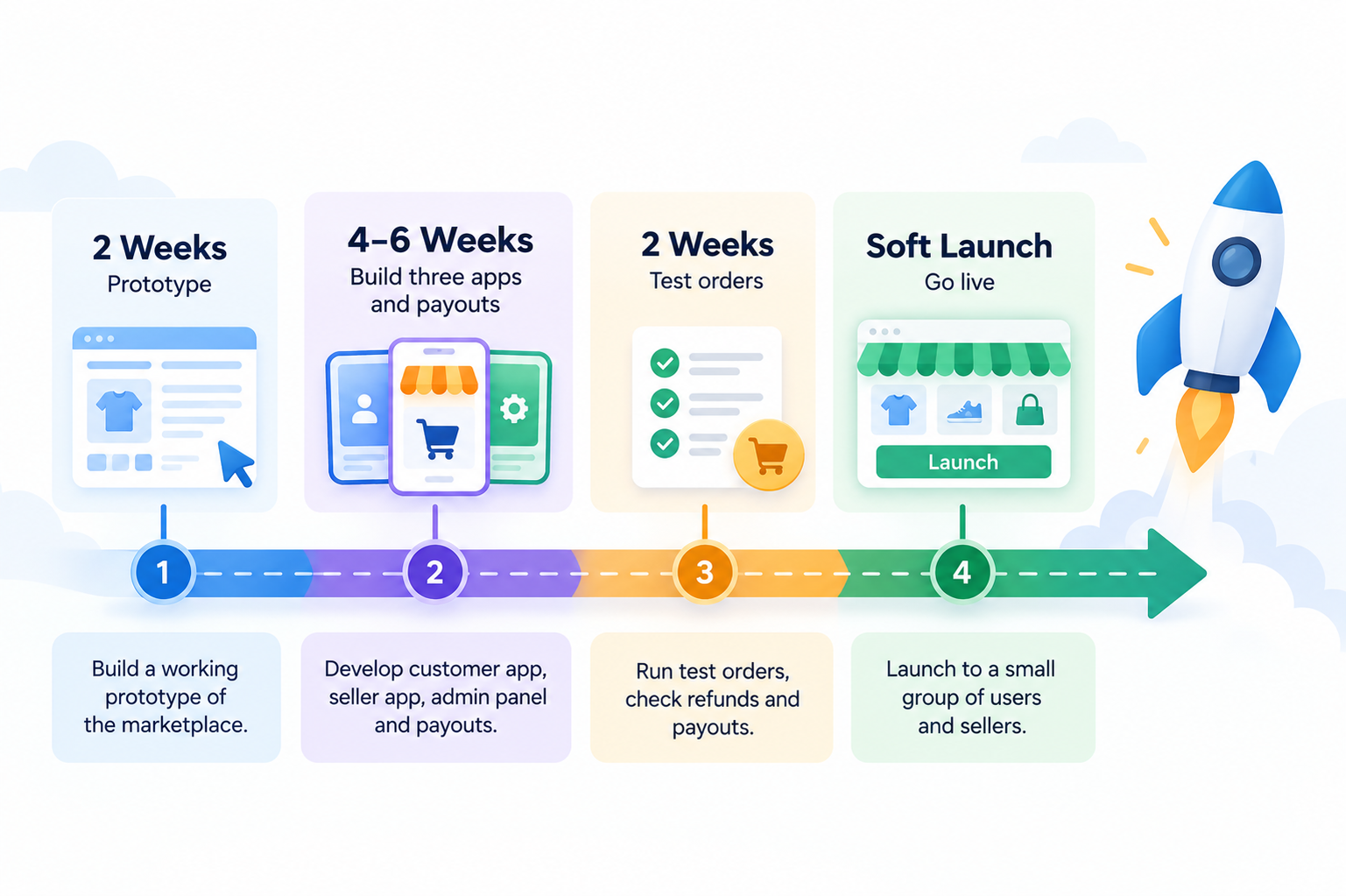
If you hire vibe coders for multi-vendor marketplace in Australia, plan on weeks for the build and longer for everything around it. A typical shape is a two-week prototype, four to six weeks building the three apps and payouts, two weeks of test orders, then a soft launch.
6.1 Can it scale to thousands of sellers?
Yes, if the foundation is sound. Scaling pain shows up in search, images, payout batches and admin tools. Use a relational database, a dedicated search service, an image CDN, background queues and monitoring from the start.
Decision fork:
- If launch is under three months away, start provider approvals and seller recruitment this week.
- If you expect thousands of listings in year one, budget for search and image handling now.
- If you want to build a marketplace with vibe coding by a fixed date, work backwards from app store review.
- If a supplier promises a full marketplace in a few weeks with no external steps, ask which steps they left out.
6.2 What does an Australian launch checklist look like?
Before a soft launch, confirm that:
- payment provider onboarding is approved
- terms, privacy policy and seller agreement are lawyer-reviewed
- test orders cover refunds and failed payouts
- support and dispute processes are staffed
- backups and monitoring are switched on
Whenever you hire vibe coders for multi-vendor marketplace in Australia, ask for this list. A marketplace app development agency in Australia should tick each line with evidence, and anyone planning to build a marketplace with vibe coding should rehearse launch week once.
7. How do I attract the first sellers?
Start with supply, in one niche and one city or region. List fifty target sellers, contact each personally, offer reduced fees for the first few months and load their first products for them. Buyers follow a full shelf, even when you build a marketplace with vibe coding.
When you build a marketplace with vibe coding, keep part of the budget for recruitment, because growth usually costs more than the first build.
Decision fork:
- If you already have a community or an audience, recruit sellers from it and launch with a waitlist.
- If you have none, pick a narrow niche where you can personally know the first twenty sellers.
- If sellers hesitate, offer to list their items and handle the first orders by hand.
- If a marketplace app development agency in Australia offers recruitment help, ask what it covers.
8. Build custom or use marketplace software?
For a standard model, software such as Sharetribe or a Shopify multi-vendor setup can be cheaper and faster. Build custom when your payments, matching or seller tools are your edge. Many founders prove demand on a platform and then build custom parts. A marketplace app development agency in Australia should price both routes honestly, and tell you when the cheaper route is the right one.
8.1 What GST duties apply to marketplace operators?
GST in Australia is 10%, and a business generally registers once turnover reaches the A$75,000 threshold. Marketplace operators can have extra GST responsibilities for certain sales made through their platform, particularly low-value imported goods, and the ATO has reporting expectations for some digital platforms. Rules and thresholds change, so confirm current requirements with an accountant before launch, and keep tax settings editable rather than hard-coded.
Decision fork:
- If your sellers are mostly local and small, confirm who charges GST and who reports it.
- If sellers ship from overseas, ask your accountant about operator responsibilities before launch.
- If you choose custom, make sure the team stores tax data per order line.
- If you hire vibe coders for multi-vendor marketplace in Australia to extend a platform, check they know its limits.
8.2 How are customer details protected?
A marketplace holds personal information about buyers and sellers, so the Privacy Act and its principles matter. Collect only what you need, set retention periods and allow account deletion. Ask how personal data is kept out of AI prompts if you build a marketplace with vibe coding.
9. Conclusion
Follow the forks in order: confirm the AI and human split, cost the money layer, prove the three journeys, start approvals and recruitment early and take tax advice before launch. That is how you build a marketplace with vibe coding without paying twice. When you hire vibe coders for multi-vendor marketplace in Australia projects, judge suppliers on how they price payments and testing. And choose a marketplace app development agency in Australia that can answer every fork in this guide with specifics.
10. FAQs
What tech stack works best?
A typed backend, a relational database, a search service, background queues, a marketplace payment provider and a cross-platform front end such as Flutter or React, hosted in an Australian region. Ask a marketplace app development agency in Australia why it chose its stack.
What mistakes should I avoid when hiring?
Choosing on the lowest total, skipping the payments conversation, accepting a demo instead of a live checkout and not securing code ownership. When you hire vibe coders for multi-vendor marketplace in Australia, ask for references from live marketplaces.
Why is ArixLabs a good marketplace partner?
ArixLabs builds with vibe coding under senior engineering review and has delivered 100+ production apps. If you want to hire vibe coders for multi-vendor marketplace in Australia, ask for our review process first. We keep payout and fee logic human-reviewed, price every line openly and hand you code you own.
%20(1).jpg)

View more blogs
.png)

.png)

.png)

.jpg)
.png)

Ready to develop your own product? Get in touch today!
Get in Touch