

.png)


1. Introduction
A Base44 project that already has real users is not a starting point to throw away. It is a working blueprint. When a founder decides to build mobile app from Base44 foundations already in production and already trusted by real users, the smartest move is treating the existing build as the source of truth rather than a rough draft to abandon. ArixLabs (previously FlutterFlowDevs) approaches every Base44 project mobile development engagement this way, keeping the same discipline whether the project is large or small: keep what already works, rebuild only what has to change for a phone. This guide breaks down exactly how developers turn an existing Base44 build into a real, store-ready mobile app.
Whether the assignment is framed as a Base44 project native app build, a full Base44 backend mobile application rollout, an effort to rebuild Base44 project for mobile, or simply new Base44 project mobile frontend work, the underlying approach barely changes. What changes is scope, timeline, and how much of the original Base44 project survives the transition intact. Whether a founder wants to build mobile app from Base44 roots, needs full Base44 project mobile development support, is planning a Base44 project native app build, is scoping a Base44 backend mobile application, wants to rebuild Base44 project for mobile entirely, or just needs a new Base44 project mobile frontend, the fundamentals below apply the same way.
2. How do you build mobile from a Base44 project?
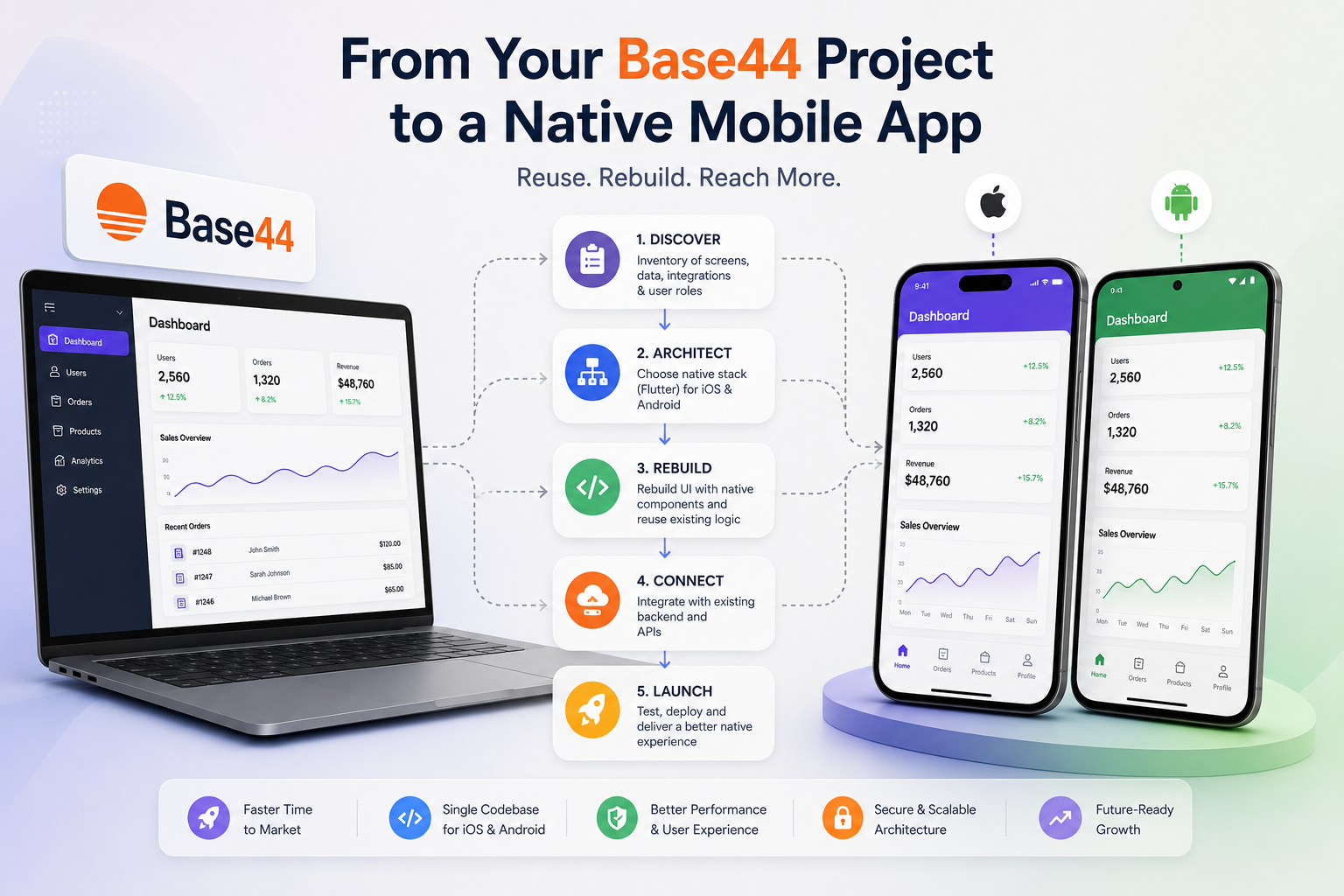
The process to build mobile app from Base44 starts with a full inventory of what already exists: every screen, every data model, every integration, every user role. That inventory becomes the specification for the native build rather than a nostalgic list of things to copy exactly. From there, a native architecture gets chosen, almost always Flutter, so a single codebase can serve both iOS and Android instead of duplicating work across two separate teams. The Base44 project mobile development phase that follows rebuilds the interface using native components while wiring it back to the logic that already runs the original product. None of this happens by guesswork, and a proven Base44 project native app build process removes most of the risk before development even starts. A team that has done a Base44 project native app build before knows which screens usually need full redesign and which ones can be ported over with only minor layout changes. That experience is exactly what separates a rebuild Base44 project for mobile engagement that ships on schedule from one that drags on for months chasing surprises nobody scoped upfront. This holds true no matter which label fits: a plan to build mobile app from Base44 roots, a formal Base44 project mobile development track, a scoped Base44 project native app build, a Base44 backend mobile application rollout, or fresh Base44 project mobile frontend work. Founders evaluating agencies for this kind of project should ask directly how many times the team has run a Base44 project native app build before, since the honest answer says more about likely outcomes than any pitch deck.
3. What Base44 components can be reused for mobile?
The honest answer is: the thinking behind the components, more than the components themselves, and that distinction shapes every Base44 project mobile development decision from the first meeting.
3.1 Can Base44 data connect to a custom mobile frontend?
Yes, in almost every case. The database structure, records, and relationships between them do not care whether the interface reading them is a browser or a native app, so a Base44 project mobile frontend can connect to the same data without a parallel database.
3.2 How can Base44 APIs support native applications?
If the original Base44 project exposes clean, documented API endpoints, those endpoints can usually serve a native app directly, handling authentication, data reads, and data writes the same way they already handle them for the web version. What does not transfer is the actual interface code, since Base44's web components are not compatible with native rendering engines. This is the core reality behind every Base44 backend mobile application project ArixLabs has shipped: the backend does the heavy lifting either way, so a well-built Base44 project mobile development engagement spends most of its effort on the frontend, not on reinventing data infrastructure that already works. That is true whether the project is called an effort to build mobile app from Base44 data, a Base44 project native app build, a Base44 backend mobile application rollout, a plan to rebuild Base44 project for mobile, or new Base44 project mobile frontend work layered on top of a stable API. Founders sometimes worry that reusing the backend means the mobile app will feel like a patched-together compromise, but a properly executed Base44 project mobile frontend built on a documented API performs exactly like a purpose-built native app, because from the user's perspective the origin of the data behind the screen never shows. That confidence is exactly why so many founders choose to build mobile app from Base44 infrastructure instead of rebuilding the data layer from zero, and why a rebuild Base44 project for mobile plan usually starts with an API audit rather than a fresh backend.
4. How can Base44 become a production mobile app?
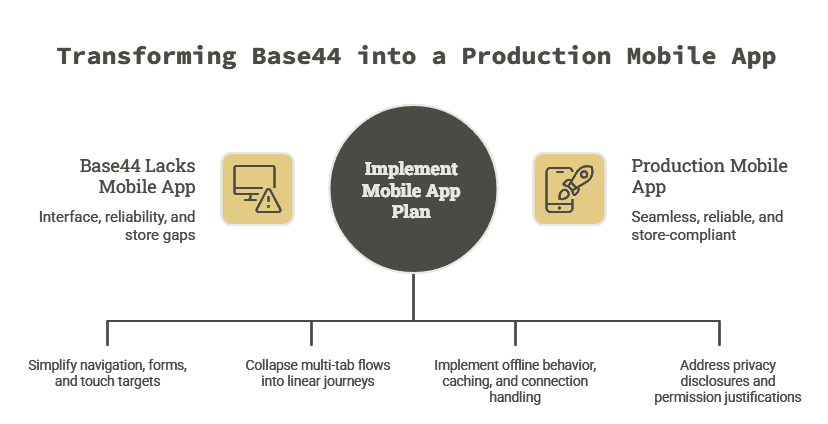
Turning Base44 into a production mobile app means closing three gaps: the interface gap, the reliability gap, and the store-compliance gap, and a serious Base44 backend mobile application plan addresses all three before writing a line of native code.
4.1 What Base44 UI needs redesigning for mobile?
Nearly everything visual needs a second look, because a layout built for a wide browser window does not fit a five-inch screen without real redesign work, not just automatic resizing. Navigation gets restructured into tabs or drawers, forms get simplified for thumb typing, and touch targets get sized for fingers instead of a mouse pointer. This redesign work is central to nearly every Base44 project mobile development engagement, since interface decisions made for a desktop browser rarely translate directly to a phone no matter how the project is labeled.
4.2 How should Base44 user flows change on mobile?
Flows that made sense across multiple browser tabs usually collapse into a single, linear mobile journey, since users rarely juggle several open screens on a phone. The reliability gap covers offline behavior, local caching, and graceful handling of dropped connections, none of which a browser-based Base44 project typically handles well, and closing it is one of the clearest reasons founders choose to build mobile app from Base44 roots rather than simply linking to the existing site. The store-compliance gap covers everything Apple and Google require before an app goes live, from privacy disclosures to permission justifications, and it is where a rebuild Base44 project for mobile plan most often needs outside expertise. A Base44 project native app build that skips any of these three gaps tends to stall at review rather than at development. The same three gaps apply whether the work is scoped as a way to build mobile app from Base44 foundations, a Base44 project mobile development engagement, a Base44 backend mobile application rollout, a plan to rebuild Base44 project for mobile, or new Base44 project mobile frontend design.
5. What is needed to rebuild Base44 for mobile?
A real plan to rebuild Base44 project for mobile needs four things before development starts: a documented backend, a clear feature scope, a native team, and a realistic timeline. The documented backend matters because developers building the Base44 project mobile frontend need to know exactly what every API endpoint does, what data it returns, and how authentication is handled, rather than reverse-engineering it mid-project. The feature scope matters because not every web feature deserves a mobile equivalent on day one, and rebuilding everything at once usually delays what matters most.
5.1 Which Base44 functions usually need custom development?
Payment processing, push notifications, and anything involving device hardware like the camera or GPS almost always need custom native code, since Base44's web-based versions of these features do not have a native equivalent to simply port over. Getting this list right early is one of the most valuable things a Base44 backend mobile application partner brings to a build mobile app from Base44 project, since guessing wrong here is the single most common cause of budget overruns. A native development team familiar with Base44 project mobile development patterns can move through this list far faster than a generalist team encountering Base44's structure for the first time. This is the difference between a team that has run a real Base44 project native app build before and one still learning what a Base44 backend mobile application actually requires while trying to rebuild Base44 project for mobile and build mobile app from Base44 components on the same clock, with a Base44 project mobile frontend due at the end of it. Scoping this list correctly at the start also protects the budget, since custom native features priced in from day one cost far less than features bolted on after the rest of the app is already built.
6. Can a Base44 project become a native app?
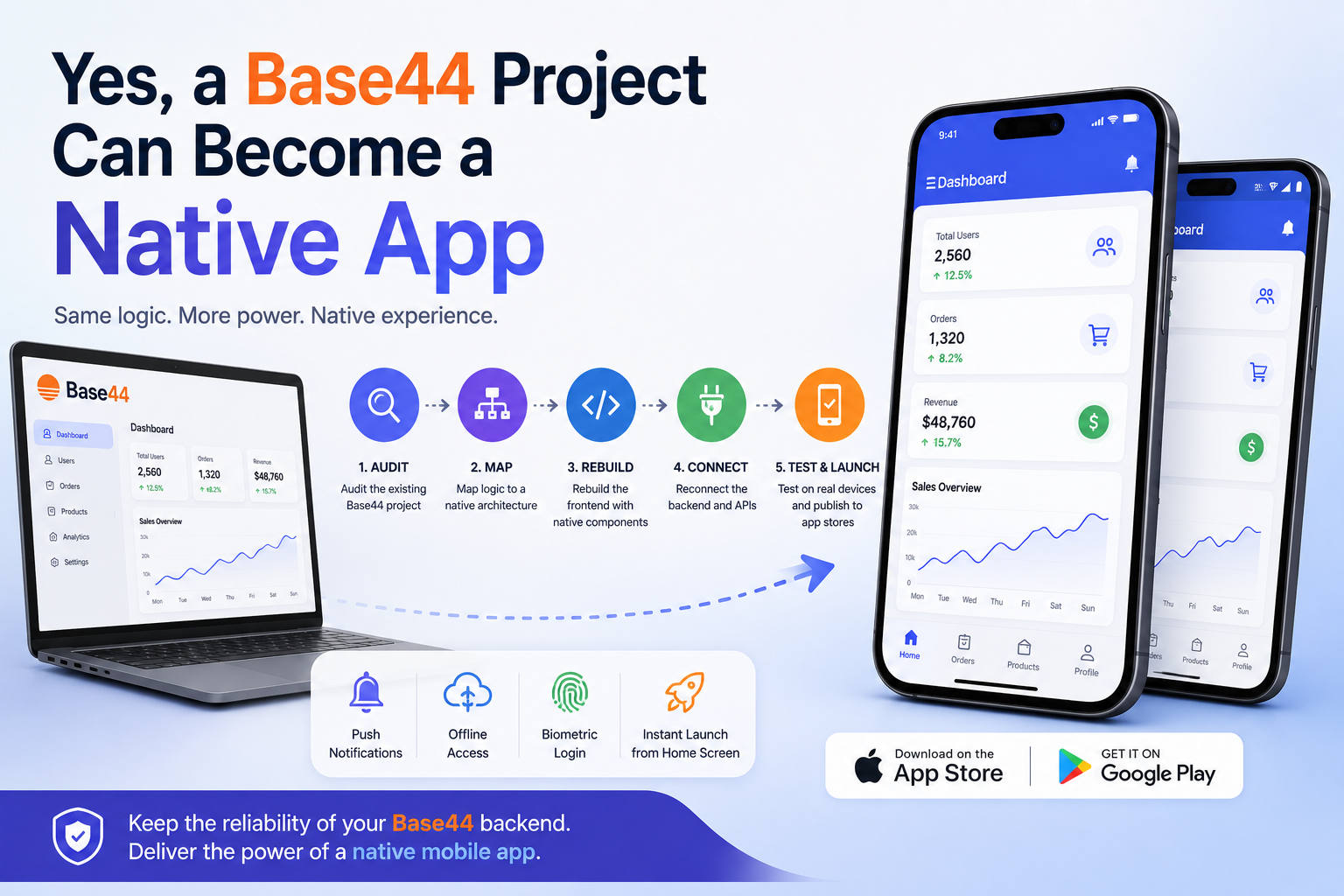
Yes, and this happens more often than founders expect once they see a working example. The path runs through the same sequence every time: audit the existing Base44 project, map its logic to a native architecture, rebuild the frontend, reconnect the backend, then test on real devices before submission. A Base44 backend mobile application built this way keeps the reliability of the original product while gaining what native apps offer that a browser cannot: push notifications, offline access, biometric login, and instant load from a home screen tap. ArixLabs has run this exact sequence enough times to know where the surprises usually hide, typically in authentication edge cases and in features that quietly depended on browser-only behavior. Whether a founder calls the project a plan to build mobile app from Base44 roots or a full Base44 project native app build, the destination is the same: a real app in the App Store and Google Play, backed by the same product logic that already earned user trust on the web. That destination looks identical whether the engagement is billed as Base44 project mobile development, a Base44 backend mobile application rollout, an effort to rebuild Base44 project for mobile, or fresh Base44 project mobile frontend design.
7. How can developers extend Base44 for mobile?
Extending Base44 for mobile means adding capabilities that were never available in the original web build, not just shrinking the existing screens to fit a smaller display.
7.1 Do Base44 functions usually need custom development for hardware access?
Camera-based features, location tracking, and biometric authentication all require native code written specifically for iOS and Android, since none of these have a meaningful web equivalent inside a browser. Push notifications are the single most requested extension, since they give a Base44 project mobile frontend a way to bring users back into the app instead of relying on them to remember to open a browser tab. Offline mode is a close second, letting core features keep working even without a signal, then syncing changes once connectivity returns. A team experienced in Base44 project mobile development typically prioritizes these extensions based on what actually drives engagement for the specific product, rather than building every possible native feature just because it is now technically available. This is where a rebuild Base44 project for mobile engagement earns its cost: not in recreating what already worked, but in adding what genuinely could not exist before. ArixLabs treats this stage the same way whether the client calls it a plan to build mobile app from Base44 roots, a Base44 project mobile development track, a Base44 project native app build, a Base44 backend mobile application upgrade, or simply new Base44 project mobile frontend work layered onto an already-proven backend.
ArixLabs runs this same process for founders who need to build mobile app from Base44 foundations without starting over, whether the work is scoped as Base44 project mobile development, a full Base44 project native app build, a Base44 backend mobile application upgrade, an effort to rebuild Base44 project for mobile, or new Base44 project mobile frontend design layered on top of what already exists.
8. Frequently Asked Questions
1. Do I need a new Base44 project for mobile?
No. The existing Base44 project stays exactly as it is and continues serving web users while a separate native codebase gets built alongside it for iOS and Android, so there is no need to rebuild Base44 project for mobile from a blank Base44 account. This applies equally to a build mobile app from Base44 plan, a Base44 project mobile development track, a Base44 project native app build, a Base44 backend mobile application rollout, or fresh Base44 project mobile frontend work.
2. Can developers work with my existing Base44 app?
Yes. Developers can audit an existing Base44 app, document its data model and API structure, and use that as the foundation for a native Base44 project native app build without needing to recreate the product from scratch, which is exactly how most Base44 project mobile development engagements begin, whether the client calls it a Base44 project native app build or simply a mobile version of Base44.
3. Can Base44 support a custom mobile frontend?
Yes, provided the backend exposes a documented API. A custom Base44 project mobile frontend built in a native framework can read and write the same data as the original web app, which is the whole point of a well-scoped plan to build mobile app from Base44 infrastructure.
4. Is native Base44 different from mobile web?
Very different. Mobile web is still a browser experience accessed through a phone, while a native Base44 backend mobile application is an installed app with its own performance profile, offline access, and device permissions that mobile web cannot replicate, which is precisely why founders choose to rebuild Base44 project for mobile instead of settling for a responsive website. That single choice, more than any other, is what a rebuild Base44 project for mobile plan exists to make possible.
%20(1).jpg)

View more blogs
%20(1).jpg)
.png)

.png)
.png)
.png)


_a_expand_this_image_in.jpg)
Ready to develop your own product? Get in touch today!
Get in Touch