

%20(1).jpg)


1. Why Transport Businesses Are Moving to Digital Booking
Bus operators today often rely on manual bookings, seat tracking, and fragmented communication—systems that become difficult to manage as operations grow. This is why bus ticket booking app development is rapidly gaining momentum.
Passengers now expect instant seat availability, online payments, and hassle-free bookings. At the same time, operators need better control over routes, schedules, and fleet management. With FlutterFlow and low-code development, businesses can launch powerful booking platforms faster, reducing operational complexity while improving customer experience.
Modern transport apps are no longer just booking tools—they're complete systems designed to streamline operations, drive growth, and deliver seamless travel experiences.
2. What a Bus Ticket Booking App Actually Does
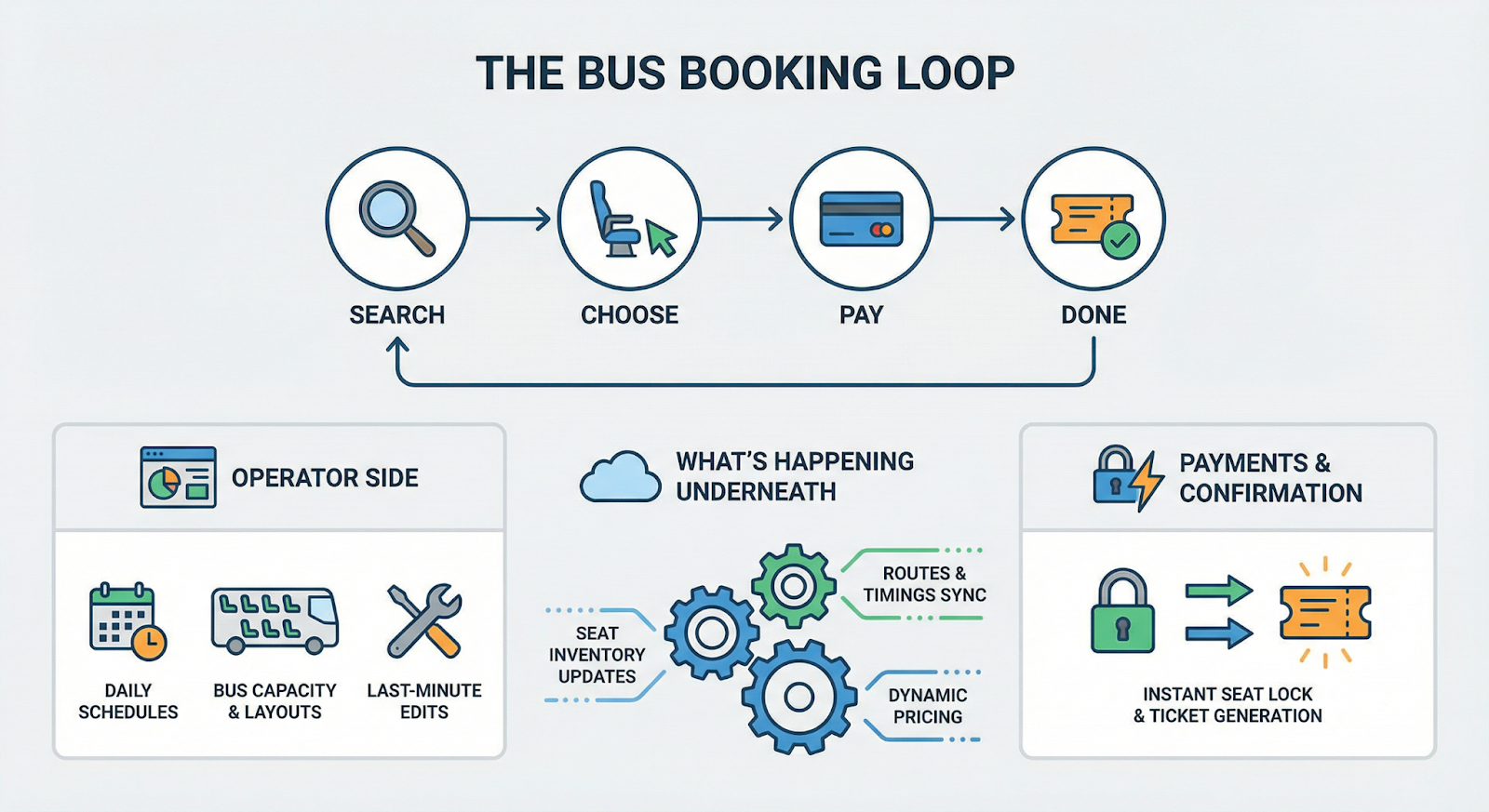
Strip it down, and a booking app is just a loop: search → choose → pay → done. But getting that loop to work smoothly every single time, that’s where most builds fall apart.
In bus ticket booking app development, the goal isn’t adding more screens. It’s making fewer steps feel effortless.
User side
A user opens the app, picks a route, sees available seats, and books. If seat data lags or pricing looks confusing, they leave. Simple as that.
What’s happening underneath
While it feels instant, the app is constantly syncing:
- Seat inventory updates as people book
- Routes and timings pull from a central system
- Prices adjust based on availability
- Confirmation “triggers” the moment payment clears
These are the real ticket booking app features that matter. Not fancy UI, just things working without friction.
Operator side
Now flip the view. Operators aren’t thinking about UI, they’re managing:
- Daily schedules (which change more often than expected)
- Bus capacity and seat layouts
- Last-minute edits when drivers or routes shift
All of that usually lives in one dashboard. If it’s clunky, operations slow down.
Payments and confirmation
Once payment goes through, the system immediately locks the seat and generates a ticket. Delay this by even a few seconds, and you risk double bookings. It happens more than people admit.
That’s the whole system. Not complex on paper, but in real usage, every tiny delay shows up fast.
3. Must-Have Features in a Booking App
Most apps don’t fail because they’re missing features. They fail because the basics don’t work when real users show up.
When people talk about ticket booking app features, they often list everything under the sun. But in practice, only a handful actually decide whether users stay or leave.
Real-time seat availability
This one’s non-negotiable. If a seat shows as available and disappears after payment, trust is gone. The system needs to sync instantly, even during peak bookings.
Simple booking flow
No one wants to go through five screens to book a seat. Fewer steps, clearer actions. That’s what keeps users moving.
Integrated payments
Cards, UPI, wallets, it should just work. And it should feel fast. Payment delays are one of the biggest drop-off points in any app.
Instant confirmation
Users expect a ticket right away. Not an email after five minutes. Not a “processing” message. Immediate confirmation, ideally with a QR or booking ID.
Notifications that matter
Not spam. Just useful updates:
- Booking confirmation
- Schedule changes
- Reminders before departure
Admin control panel
On the backend, operators need control without “digging through menus”. Quick edits to routes, pricing, and schedules make a huge difference in daily operations.
That’s it. Not dozens of features, just the ones that hold up under real usage.
4. Fleet Management Behind the Scenes
Booking is what users see. Fleet management is what keeps the business running.
Without it, even the best booking flow starts breaking, late buses, wrong schedules, confused drivers. This is where most transport apps quietly fail.
Route and schedule control
Routes aren’t fixed forever. Operators tweak timings, add stops, or adjust frequency based on demand. The system needs to handle these changes without messing up existing bookings.
Driver management
Assigning drivers sounds simple until shifts overlap or “last-minute changes” happen. A good system lets operators reassign quickly and keep everything updated in real time.
Vehicle tracking
Knowing where each bus is, at any moment, changes everything. Delays can be communicated early. Users stay informed. Operations stay predictable.
Capacity and seat handling
Each vehicle has its own layout and limits. The app needs to reflect that accurately, or you end up overselling seats. That’s a problem you don’t want.
This is where bus ticket booking app development connects directly with operations. It’s not just about selling tickets, it’s about making sure every booking actually works in the real world.
And when this layer is done right, things feel smooth. When it’s not, issues show up fast, usually at the worst possible time.
5. How to Build a Bus Ticket Booking App Using FlutterFlow
Let’s make this real. If you had to build this from scratch the traditional way, you’d be juggling frontend, backend, APIs, testing… the whole stack. That’s exactly why teams are shifting to FlutterFlow app development.
You’re not removing complexity, you’re just handling it smarter.
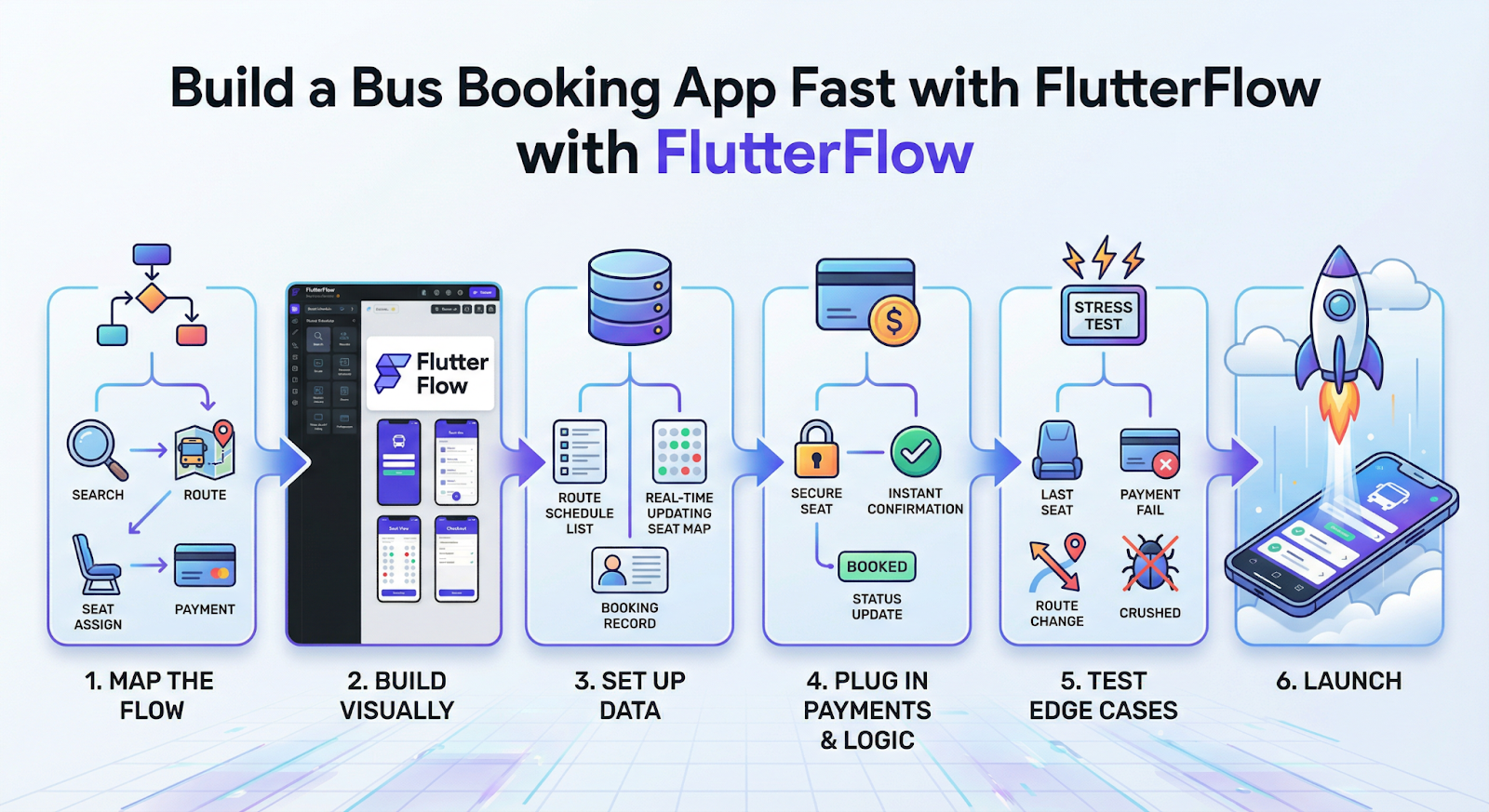
Start with the flow, not the screens
Most people jump into design too early. Big mistake. First, map what actually happens:
- How users search routes
- How seats get assigned
- What happens after payment
If this flow isn’t tight, no UI will fix it.
Build the screens visually
Now open FlutterFlow and create the key screens:
search → results → seat view → checkout → confirmation
You’ll notice something here, it’s fast. Changes don’t feel heavy. That’s where low-code app development really helps. You iterate without waiting around.
Set up your data properly
This part decides whether your app breaks under load or not.
You need:
- A structure for routes and schedules
- Real-time seat updates
- Booking records tied to users
If two people try to book the last seat, your backend should handle it cleanly. No overlap. No confusion.
Plug in payments and booking logic
Once a user pays:
- Lock the seat
- Save the booking
- Generate confirmation instantly
Delay any of this, and users start losing trust.
Test like things will go wrong (because they will)
Try edge cases:
- Last seat booking
- Payment failures
- Sudden route changes
This is where most hidden bugs show up.
And then, you launch.
That’s the real shift with FlutterFlow app development. You’re not spending months wiring things together. You’re building, testing, and adjusting as you go… which is honestly how most real products get built anyway.
6. Building for the Australian Market
A booking app that works globally can still fail locally. Australia has its own expectations, especially when it comes to transport.
In transport app development in Australia, reliability matters more than anything. Users don’t tolerate delays, unclear schedules, or broken booking flows. If the app feels uncertain, they won’t use it twice.
Local user expectations
People expect:
- Clear timings (no last-minute confusion)
- Fast booking with minimal steps
- Accurate availability every time
There’s very little patience for trial-and-error apps here.
Scalability from day one
Routes grow. Users increase. Peak hours hit hard. That’s why many teams focus on mobile app development Australia standards early, building something that can handle load instead of fixing it later.
Clean, predictable experience
Design isn’t about looking good. It’s about removing doubt:
- Straightforward navigation
- No unnecessary steps
- Clear booking confirmations
That’s what builds trust.
This is also where your earlier decisions, architecture, booking flow, data handling, start to show their impact. A well-built system feels invisible. A weak one feels frustrating almost instantly.
So while the tech stack matters, understanding how users actually behave in this market matters more.
7. Cost and Timeline Overview
The timeline for bus ticket booking app development depends largely on the app's complexity and planning. A basic app with search, seat booking, and payment integration can be built within a few weeks. However, features like real-time seat updates, fleet management, and admin controls require additional development and testing.
FlutterFlow app development accelerates the process by reducing manual coding and enabling faster iterations. While low-code development can significantly shorten timelines and lower costs, successful projects still depend on strong architecture, careful planning, and thorough testing. Features such as payment processing and real-time synchronization must be handled reliably to ensure a smooth user experience after launch.
%20(1).jpg)

%20(1).jpg)
.png)
.png)
.png)


.png)

.png)

.png)
Ready to develop your own product? Get in touch today!
Get in Touch