.png)



1. What Is a Wanderlog Clone App, and Why Are Founders Building One?
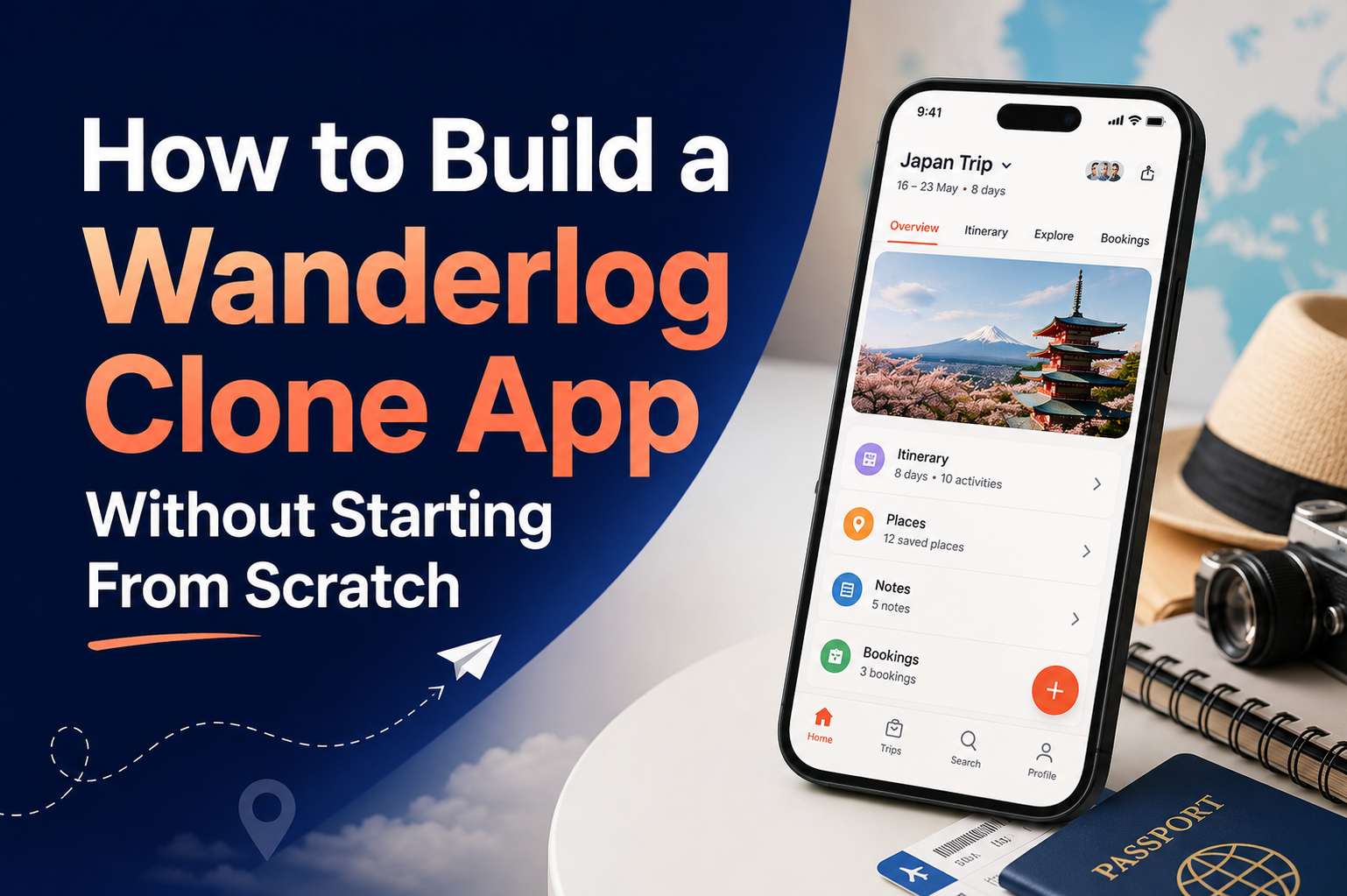
Wanderlog does one thing well: personal trip planning. Maps, day-by-day itineraries, shared trip boards — solid if you're the one traveling. What it isn't built for is running as someone else's business. There's no white-label option, no source code for sale, and no way to rebrand it as your own product. That gap is exactly what a Wanderlog clone app exists to close — the same core experience, minus the "you can never own this" part. It's also why the search volume around this exact phrase keeps climbing: founders like what Wanderlog does, they just want to own the version they build.
Arixlabs (previously FlutterFlowDevs) builds the kind of software that fills that gap: production-ready app templates founders can rebrand and launch as their own. An AI travel app clone from Arixlabs works the same way — you get the itinerary intelligence, the booking layer, and the admin tooling, packaged as something you actually own from day one.
2. Three Ways to Build a Wanderlog Clone App
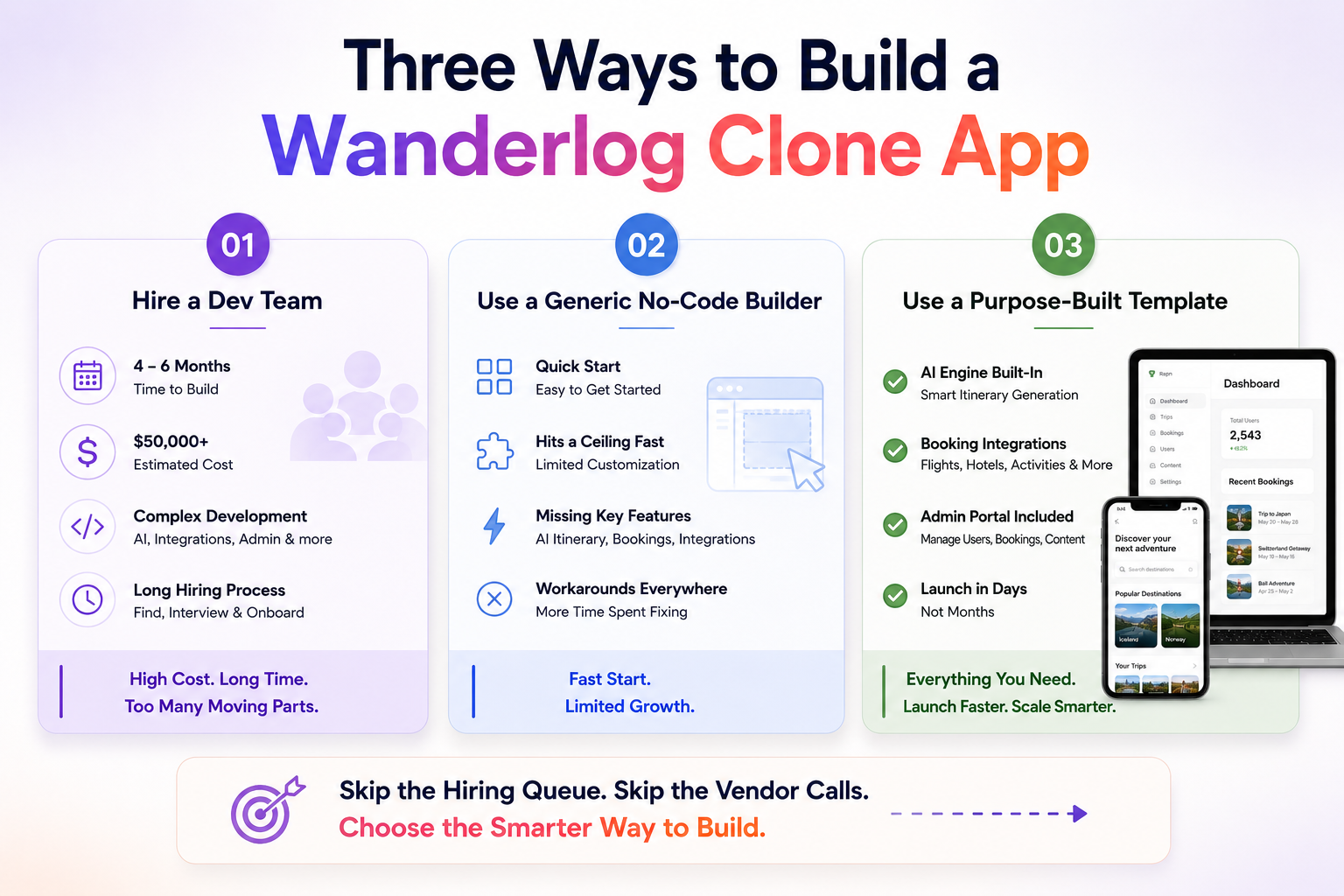
Founders chasing a Wanderlog clone app usually pick one of three routes. Hire a dev team, and you're looking at four to six months and a budget north of $50,000 before the AI logic even works end to end. Use a generic no-code builder, and you'll hit a ceiling fast — AI itinerary generation and real booking integrations aren't drag-and-drop features. Or start from a purpose-built template like WayNest, Arixlabs' entry in the travel category, and skip both problems: the AI engine, booking flows, and admin portal are already built and already working. Every one of those three paths skips the hiring queue and the vendor calls that come with option one — that's the whole promise of a ready made Wanderlog clone.
2.1 How Fast Can I Launch an AI Travel App Clone Using a Template?
With a template like WayNest, branding, API keys, and deployment typically take days rather than months — you're configuring an existing AI travel app clone, not building one from a blank repo.
3. Inside the Template: Features an AI Travel App Clone Needs
A real AI travel app clone needs more than a map and a list view. WayNest's mobile app covers the full loop: users describe a trip in plain language — budget, pace, interests, dietary needs — and the AI, powered by Gemma, generates a day-by-day itinerary with costs, accommodation picks, and travel times attached. Don't like a day? Regenerate it, swap activities, or ask the built-in AI Travel Assistant to adjust the plan mid-conversation.
Trip collaboration works the way Wanderlog users already expect — invite collaborators, edit an itinerary together, manage bookings as a group. On top of that sits real booking infrastructure: search, compare, and book flights, hotels, activities, and ground transport without leaving the app, with confirmations auto-importing into a booking wallet. Budget tracking, expense splitting, and an interactive map with route optimization round out a feature set that makes this a genuine ready made Wanderlog clone rather than a stripped-down copy.
4. Customize It Into Your Own White Label AI App Builder
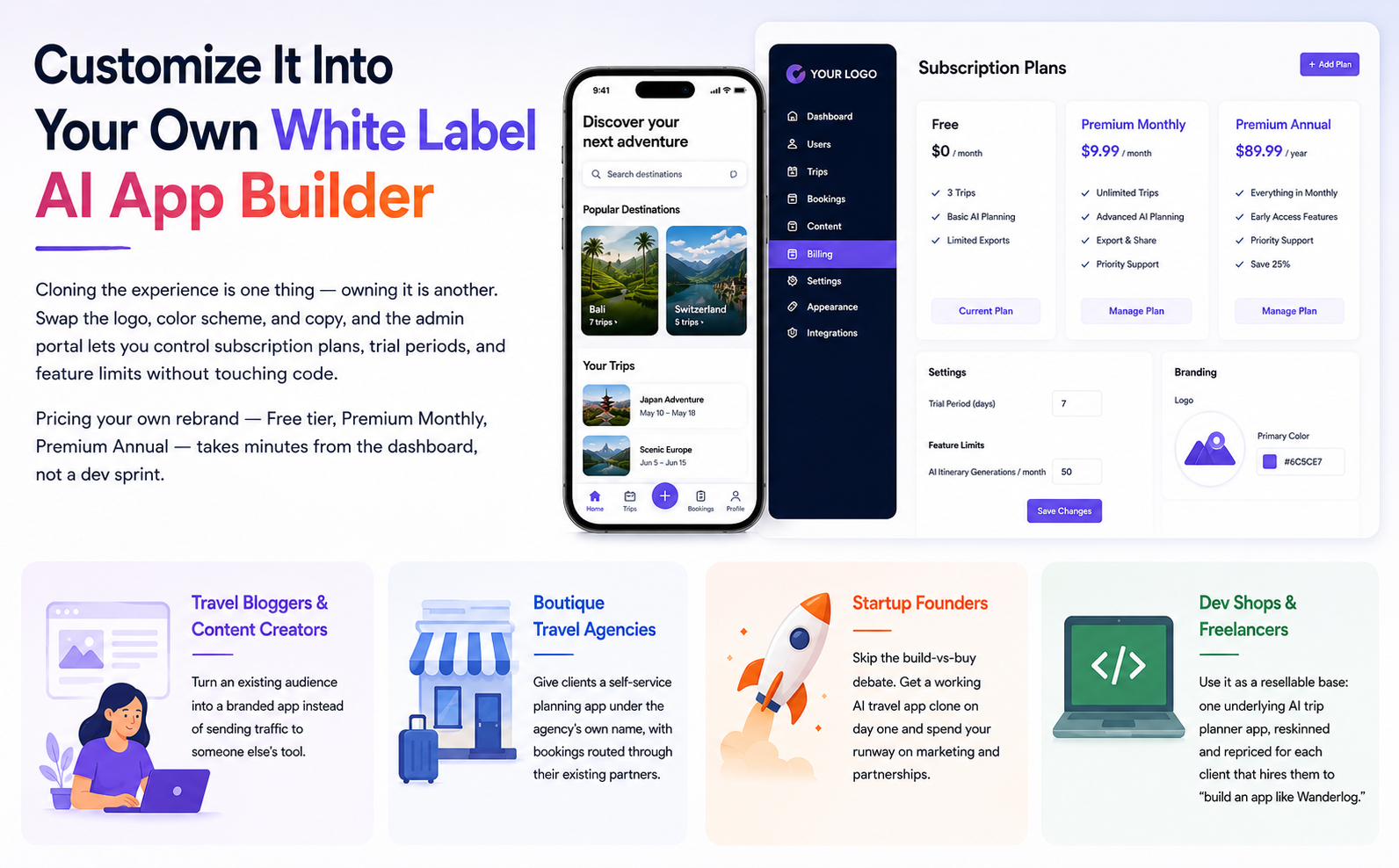
Cloning the experience is one thing — owning it is another. WayNest ships as a white label AI app builder in the sense that actually matters: swap the logo, color scheme, and copy, and the admin portal lets you control subscription plans, trial periods, and feature limits without touching code. Pricing your own rebrand — Free tier, Premium Monthly, Premium Annual — takes minutes from the dashboard, not a dev sprint.
4.1 Is a White Label AI App Builder Better Than Coding From Scratch?
For most founders, yes. A white label AI app builder gives you a working, tested product on day one; coding from scratch means paying full price to rebuild features — AI itinerary logic, booking flows, admin tooling — that already exist and already work.
4.2 Who Actually Buys a Template Like This
Travel bloggers and content creators with an audience but no product use this route to turn an existing following into a branded app instead of sending traffic to someone else's tool. Boutique travel agencies use it to give clients a self-service planning app under the agency's own name, with bookings routed through their existing partners. Startup founders testing a travel-tech idea skip the build-vs-buy debate entirely — they get a working AI travel app clone on day one and spend their runway on marketing and partnerships instead of engineering.
Dev shops and freelancers use WayNest differently, as a resellable base: one underlying AI trip planner app, reskinned and repriced for each client that hires them to "build an app like Wanderlog."
5. What's Under the Hood: Tech Stack & Wanderlog Source Code
WayNest runs on Flutter for the frontend, shipping to iOS and Android from one codebase, with Supabase handling auth, database, storage, and real-time sync on the backend. Google Maps powers navigation and route optimization, and Gemma drives the AI itinerary engine and the in-app chat assistant.
5.1 Is the WayNest AI Trip Planner App Scalable for a Growing User Base?
Yes. Supabase scales with usage instead of forcing a re-architecture once you cross a few thousand users, and Flutter's single-codebase model keeps this AI trip planner app cheap to maintain as it grows.
5.2 Do I Get the Wanderlog Source Code When I Buy a Clone Template?
Not literally — no clone template can ship Wanderlog's own codebase, and no legitimate marketplace would sell it to you. What you get instead is full ownership of WayNest's stack: every screen, every AI prompt, every backend function, yours to modify. For founders comparing options, that's the practical equivalent of Wanderlog source code without the legal risk of using someone else's — code you can actually read, extend, and hand to a developer without a licensing question hanging over it.
6. What It Actually Costs to Launch vs. Build From Scratch
6.1 How Much Does It Cost to Build a Wanderlog Clone App From Scratch?
A custom AI trip planner app built from zero typically runs $50,000 to $120,000, depending on scope, plus months of dev time before launch. WayNest, sourced from the Arixlabs marketplace, typically starts in the low four figures and deploys in days — support and documentation included, not billed as an extra line item once the contract's already signed.
6.2 Can a Non-Technical Founder Launch a Wanderlog Clone App?
Yes. Branding and content run entirely through the admin portal — no code required for a standard launch. Founders who want deeper customization can bring in a developer later using the full source access, but it's optional, not a requirement to ship this ready made Wanderlog clone.
7. FAQ
1. Is the WayNest Wanderlog Clone Template Production-Ready?
Yes. It ships as a tested, documented ready made Wanderlog clone, with the mobile app, admin portal, and AI engine already integrated — not a proof-of-concept.
2. Do I Own the Source Code After Buying the Template?
Yes. Purchasing WayNest gives you full source code ownership, so you can modify, extend, or hand it to your own developer at any time.
3. Does the Template Come With an Admin Dashboard?
Yes. The admin web portal covers user management, subscriptions, booking partner integrations, notifications, and platform settings — everything needed to run the app as a real business, not just a demo.
4. Can I Rebrand the App With My Own Logo and Name?
Yes. Swap the logo, colors, and app name throughout the mobile app and admin portal — no code changes required for basic rebranding.
Skip the Rebuild — Launch This Week
Building this from scratch costs months and tens of thousands of dollars. WayNest gives you the same AI travel app clone — AI itinerary generation, real booking infrastructure, and a full admin portal — ready to rebrand as your own Wanderlog clone app and deploy in days.
Check out the WayNest Wanderlog Clone Template on the Arixlabs Marketplace → https://www.arixlabs.com/marketplace/waynest--ai-travel-planning-app
%20(1).jpg)

View more blogs
.png)

.png)

.jpg)
.png)
.png)
.png)
.png)
.png)
Ready to develop your own product? Get in touch today!
Get in Touch