




Introduction
Insurance software has exactly one job it cannot get wrong: the numbers. A premium miscalculation, a claims form that swallows an uploaded document, or a renewal date that quietly shows the wrong month does not just irritate a policyholder, it can land you in front of ASIC with questions you'd rather not answer. So when you go looking to hire vibe coding specialists for insurance Australia carriers can actually rely on, you're not shopping for a slick interface. You're shopping for a team that treats every figure on screen as something a regulator might one day ask about, because eventually, one will.
ArixLabs builds with that assumption baked in from day one. The process is simple in theory: describe a feature in plain language, let AI tools generate a fast first draft, then hand anything touching money, personal data, or compliance to engineers who actually test it before it ships. That's what vibe coding is meant to be, speed where speed costs nothing, human scrutiny where it matters, and it's why ArixLabs has never narrowed itself to one industry. The team has shipped 100+ production apps spanning fintech, healthcare, and ecommerce, and the underlying skills there, handling money correctly, protecting sensitive records, surviving scrutiny, transfer directly onto insurance work. That range beats a firm that has only ever seen one flavour of problem, and it's a good chunk of why ArixLabs turns up when people search for a vibe coding development team for insurance Australia carriers actually trust. Here's how to check that trust for yourself.
1. How do you find the leading vibe coding firm for insurance down under?
Start with proof, not adjectives. Every agency calls itself leading, so make the claim earn it. A search for Australia insurance app development services returns a long, fairly interchangeable list, and sorting it takes a bit more than reading homepages.
Do three things before any sales call. First, ask for a live product handling a quote, a claim, or a policy document, not a mockup with nice gradients. Second, ask who reviews the AI-generated code before it reaches a customer, since AI speed without a human checking the output is just a quicker way to ship a bug. Third, get a reference and actually ring them, because a quote on a website can be written by anyone, including the agency.
Range matters more here than the specialist crowd tends to admit. A firm that has only built insurance products has only seen insurance problems, in roughly the same shape each time. A firm that has also shipped fintech and healthcare work has met the same underlying risks, money handling, sensitive data, regulatory pressure, from several angles, which usually makes it quicker to catch trouble before it ships. That's the sort of breadth worth demanding when you hire vibe coding specialists for insurance Australia brands can put their name behind.
2. What should an insurance vibe coding outfit specialise in for Australian carriers?
It should specialise in the exact points where money, data, and regulation meet: premium calculation, claims handling, document verification, and the APRA and ASIC-adjacent compliance that Australian insurance products cannot casually skip.
For a build shipping from Australia, the essentials look like this:
- Premium and quote logic tested against genuinely odd edge cases, not just the neat examples in a spec document
- Secure handling of claims documents, ID verification, and anything resembling sensitive personal data under the Privacy Act
- Payment processing that copes with failed transactions, partial refunds, and the customer who mistypes their card number three times running
- Awareness of APRA prudential standards or ASIC conduct obligations where the product touches regulated activity
- Clear, retrievable audit trails, since insurance products get scrutinised after the fact more than almost any other category of software
Ask candidates to walk through a real decision they made on each point. A team that hesitates or waves vaguely at "industry best practice" is telling you it hasn't actually done this before, or hasn't done it properly.
ArixLabs builds on Flutter and FlutterFlow for the interface, Supabase for the backend, and Stripe for payments, which gives a consistent, auditable data layer across web and mobile. The stack matters less than the habit behind it, though. What separates a genuine vibe coding development team for insurance Australia relies on from the rest is whether they treat every calculation as something worth defending later, not something a QA pass glances over once and forgets.
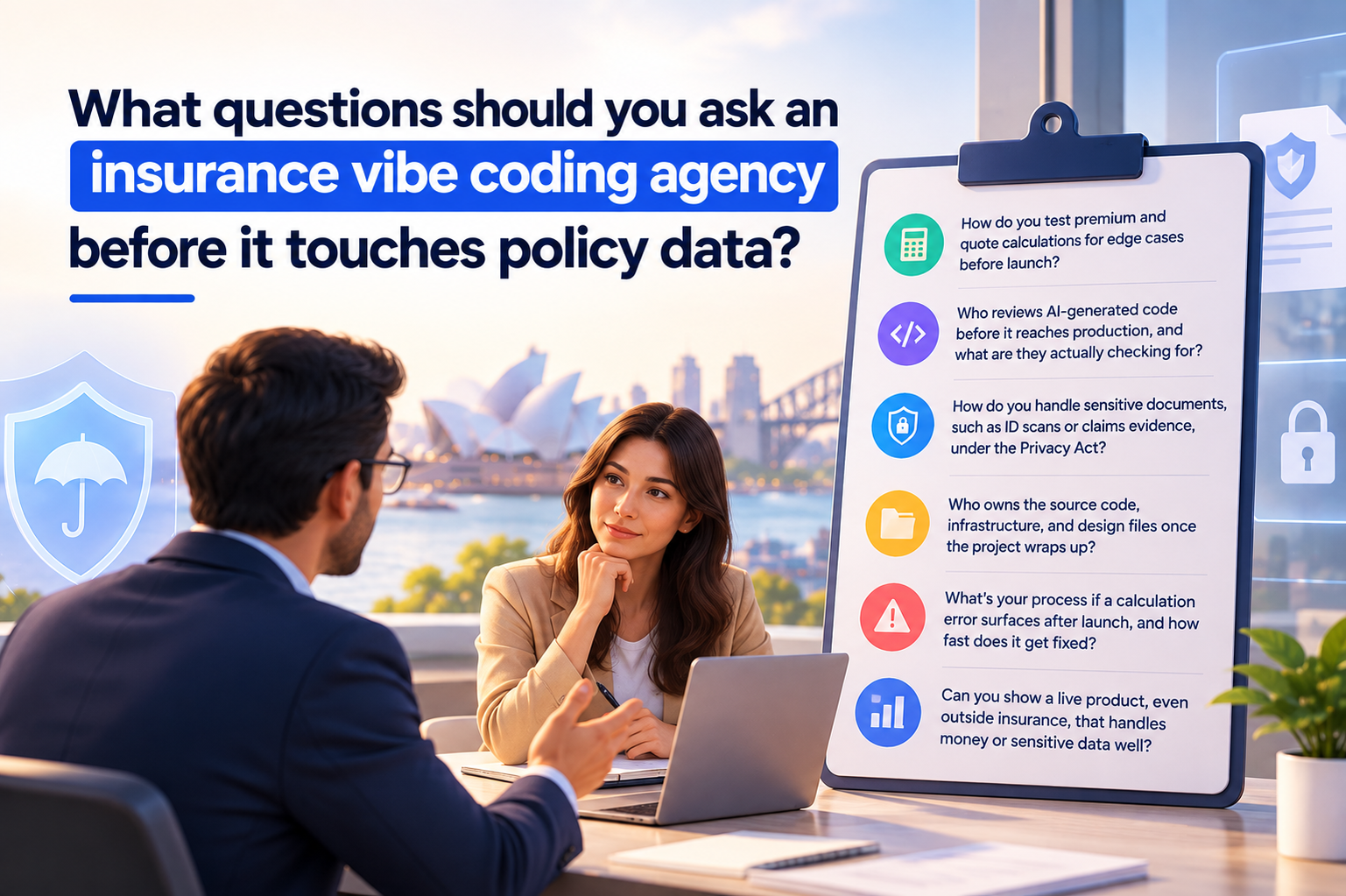
3. What questions should you ask an insurance vibe coding agency before it touches policy data?
Ask questions that expose process, not charm. A confident pitch tells you nothing about whether a team has ever pressure-tested a claims workflow under real conditions.
Bring this list to every conversation:
- How do you test premium and quote calculations for edge cases before launch?
- Who reviews AI-generated code before it reaches production, and what are they actually checking for?
- How do you handle sensitive documents, such as ID scans or claims evidence, under the Privacy Act?
- Who owns the source code, infrastructure, and design files once the project wraps up?
- What's your process if a calculation error surfaces after launch, and how fast does it get fixed?
- Can you show a live product, even outside insurance, that handles money or sensitive data well?
That last question does more work than it seems to. A firm with real range across fintech, healthcare, or ecommerce can usually show you something adjacent even without a deep insurance portfolio, and that adjacency often reveals more than three thin, insurance-only case studies would.
4. How do you size up an insurance vibe coding agency's body of work?
Use the product yourself before taking anyone's word for it. Ask for a demo, get a quote, upload a dummy document, and try to break something. A case study page full of screenshots tells you what an app looked like once. Actually clicking through it tells you whether it still holds up.
Check four things: how the quote logic behaves with unusual or extreme inputs, how document upload handles an oversized or oddly formatted file, whether a failed payment gets handled gracefully or just throws a generic error, and how consistent the whole experience feels from screen to screen. Then ask what happened once it went live, since every real product hits a snag eventually, and how honestly a firm discusses that snag says a lot about how it'll handle yours.
When you're shipping from Australia, in-house group vs firm for insurance vibe coding
An in-house group gives long-term control, but hiring senior developers with the right mix of skills in Australia takes months, and the salaries keep running well past launch. A firm gives speed and a ready team without that overhead. Many Australian insurance startups launch with a firm, then bring on a small in-house group later once the product has settled and the documentation is genuinely usable, not just technically present. ArixLabs supports that handover with maintainable code and clear notes, so the transition doesn't turn into someone else's guessing game.
Signs of a solid insurance vibe coding agency in Australia
Solid agencies show repeat clients, name the actual engineers behind a build, and will happily talk through a mistake they made and how it got fixed, rather than pretending every project has gone perfectly. They also tend to have shipped across more than one industry, which is worth treating as a strength, since it means the team has already been tested against a wider spread of real problems than an insurance-only shop typically encounters.
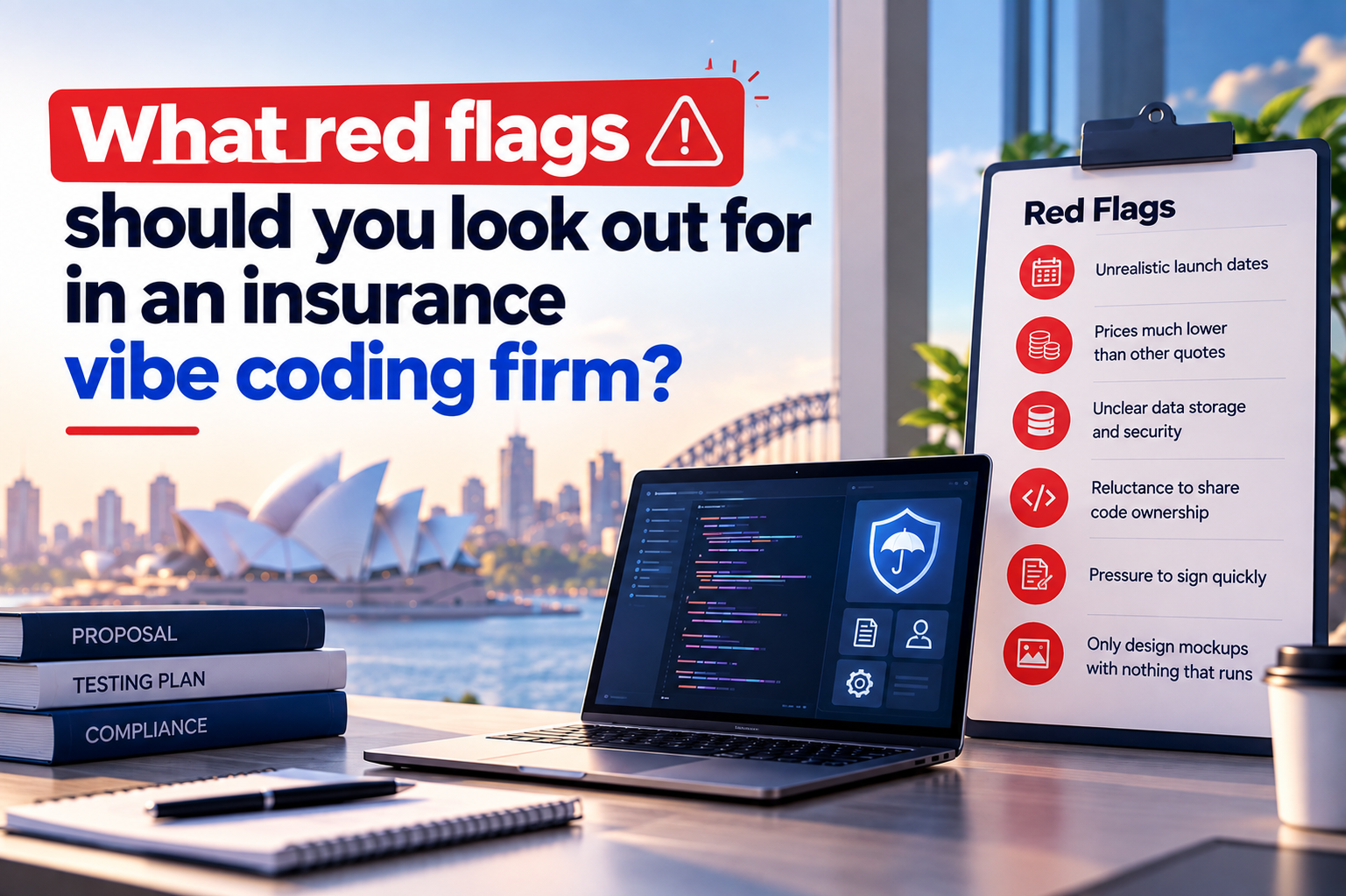
5. What red flags should you look out for in an insurance vibe coding firm?
Watch for vagueness dressed up as confidence. If a firm can't clearly explain how it tests calculations, or who reviews AI-generated code, assume the same fog covers everything else it does.
Specific signs worth writing down:
- A launch date promised before any real scoping conversation has happened
- A price suspiciously lower than every other quote on the table
- No clear answer on how sensitive documents or personal data are stored
- Reluctance to hand over code ownership or hosting access once the project ends
- Pressure to sign quickly for a discount that mysteriously disappears by Friday
- A portfolio made entirely of design mockups, with nothing that actually runs
When you're shipping from Australia, what a good insurance vibe coding proposal should include
A good proposal lists a clear feature set tied to milestones, names the actual people doing the work, sets out a specific testing plan for the calculation logic, and prices everything in phases with compliance-related work called out separately, not folded quietly into "general development." A proposal that treats testing as one vague line item is quietly telling you how seriously it treats testing in practice.
How agency communication affects insurance build success in Australia
More than most founders expect going in. Insurance builds involve a constant stream of small decisions about edge cases and local rules, and a slow-communicating agency turns each of those into a delay that compounds, especially once time zones get involved with an overseas team. Look for weekly demos, a shared task board, confirmed overlap hours, and a named contact who answers directly instead of routing every question through someone who then has to go ask someone else.
6. Would it be worth the investment to hire a specialist or generalist firm for insurance?
Here's where the specialist argument sounds convincing right up until you actually poke at it. A firm that has only ever built insurance software has only ever seen insurance problems, over and over, in roughly the same shape. A genuinely capable generalist firm has met the same underlying risks, money handling, sensitive data, regulatory pressure, across fintech, healthcare, and ecommerce, which tends to make it sharper at catching trouble early, not slower or shallower.
What actually matters isn't how narrow a firm's client list looks on paper. It's whether the same rigor gets applied to every project it takes on, insurance included, rather than saved specially for the ones with "insurance" in the brief. A capable hire vibe coding specialists for insurance Australia search should turn up firms that can demonstrate that consistency across a genuinely varied body of work, which tells you more than a single-industry portfolio stretched thin to look deep.
7. What should an insurance vibe coding outfit usually charge?
There's no single number worth quoting here, because scope and calculation complexity drive cost more than anything else. A basic quote generator sits in a completely different world from a full policy management platform with claims processing, document handling, and multi-product compliance logic.
Most outfits price one of three ways: fixed price for a well-defined scope, time and materials for evolving requirements, or a monthly retainer for continuous work. Vibe coding tends to shorten the time spent on interface and standard-flow first drafts, which can lower overall cost, but testing the calculation logic itself should never be where that saving comes from.
Ask every outfit you're considering to break its quote down feature by feature, so the cost of compliance and calculation work is visible separately from general interface work. ArixLabs prices in phases tied to specific deliverables, which is the kind of transparency that separates a firm confident in its own numbers from one hoping you won't look too closely.
8. Conclusion
Choosing the right team for Australian insurance software isn't really about finding a firm that has only ever touched insurance. It's about finding one that treats every calculation, every document, and every edge case with the seriousness your policyholders, and your regulator, expect. Ask precise questions, actually use the product before committing, and favour the firm that shows its work instead of just its confidence. ArixLabs builds that way as a matter of habit, and if you're weighing how to hire vibe coding specialists for insurance Australia stakeholders will trust, that habit is worth testing yourself before you sign anything.
FAQ
1. How do I select the right vibe coding firm for insurance?
Shortlist firms with checkable, live proof, ask each one identical process questions, and compare the specificity of their answers rather than their confidence. Choose the one that names actual people, methods, and examples every time.
2. What makes a firm good at insurance vibe coding?
A disciplined testing process for calculation logic, genuine human review of every AI-generated feature touching money or data, and broad enough experience elsewhere to catch risks an insurance-only shop might miss entirely.
3. Should an insurance vibe coding firm have industry experience?
It helps, but experience across other regulated or sensitive industries, fintech, healthcare, ecommerce, often counts for just as much, since the underlying risks overlap more than most people assume going in.
4. How much time does it take to onboard an insurance vibe coding agency?
Typically one to two weeks for access, scoping, and planning, sometimes a little longer if APRA or ASIC-relevant compliance considerations need mapping out before real building starts.
%20(1).jpg)

View more blogs
%20%5Bweb-search%5D_a_change__2025__to__20.jpg)
.png)
%20(1).png)

.png)
.png)
.png)
.png)

Ready to develop your own product? Get in touch today!
Get in Touch