



Introduction
A telehealth app that muddles a prescription history, or a patient portal that exposes one person's records to another, is not a small glitch in Australian healthcare software. It is a Privacy Act breach, a trust failure, and sometimes a clinical risk. That is the weight behind any decision to hire a vibe coding agency for healthcare in Australia, and it deserves more scrutiny than almost any other hire in a health tech build.
ArixLabs approaches healthcare work with that weight in mind. What sets it apart is how it uses vibe coding itself: founders describe a feature in plain language, AI tools generate a working first draft of the interface and logic, and experienced engineers then take over everything that touches patient data, privacy compliance, and clinical accuracy. Speed comes from the AI, but every decision that carries risk stays with a human who understands what is at stake. That discipline has carried 100+ shipped apps to production, and it is exactly what genuine Australian healthcare vibe coding specialists should bring to a health product. This guide shows you how to find healthcare vibe coding experts Australia clinics and health-tech founders can actually trust.
1. What's the top-rated approach to finding the best vibe coding outfit for healthcare down under?
Start with evidence of regulated-industry discipline, not a polished portfolio alone. Vibe coding lets a team turn a plain brief into a working interface fast, but healthcare adds a layer general app work skips entirely: the Privacy Act, health record obligations, and patients who cannot afford a broken feature.
Before any call, check for the following:
- A past project that handled real patient or health data, even something as modest as a booking or reminder tool
- A clear, specific answer about who reviews AI-generated code before it reaches a patient-facing screen
- Familiarity with the My Health Records Act if the product could ever connect to national health infrastructure
- Awareness of the Australian Privacy Principles and how they apply to health information specifically
- Independent proof of quality, such as a verifiable ranking on an expert platform or a documented shipped app count
That last point matters more in healthcare than almost anywhere else, since claims are cheap and visible, checkable work is not. ArixLabs' own website documents its healthcare-adjacent builds and its record of 100+ shipped apps directly, giving Australian founders something concrete to review before trusting a firm to build anything patient-facing.
2. What should a healthcare vibe coding agency specialise in for Australian providers?
It should specialise in the areas where a mistake causes real harm: patient data security, appointment accuracy, clinical content correctness, and safe integration with existing systems, whether that is a GP clinic's software or a private allied health platform.
For an Australian healthcare build, look for specialisation in:
- Privacy Act and Australian Privacy Principles compliance for health information specifically
- Secure clinician and patient authentication, including multi-factor login where appropriate
- Scheduling logic that avoids double-booking and missed appointment reminders
- Interoperability awareness, including HL7 or FHIR standards where the product connects to clinical systems
- Careful notification design so sensitive content never appears in a lock screen preview
- Data residency awareness, since some Australian health providers require data to stay onshore
Ask any team you are vetting to walk through how they have handled each item on a real project. Genuine Australian healthcare vibe coding specialists will describe specific safeguards, not vague reassurances about "taking privacy seriously."
3. What questions should you ask a healthcare vibe coding outfit before it touches patient records?
Ask questions that expose process and accountability. In healthcare, a vague answer today becomes a privacy gap tomorrow.
Bring this list to every conversation:
- How do you store and encrypt patient data, both at rest and in transit?
- Who reviews AI-generated code for security issues before release?
- Are you familiar with the Australian Privacy Principles as they apply to health data?
- Do you understand data residency requirements if our provider needs data kept onshore?
- Who owns the source code, infrastructure, and design files once the project ends?
- What is your process if a vulnerability is discovered after launch?
Any outfit you are considering to hire a vibe coding agency for healthcare in Australia should answer these without hesitation or vague deflection.
4. What's the leading way to evaluate a healthcare vibe coding agency's body of work?
Test the work directly rather than reading about it. Ask for a live demo or a detailed case study with real screens, not a client logo wall. If an NDA is needed to view sensitive work, that is a reasonable ask, not a warning sign on its own.
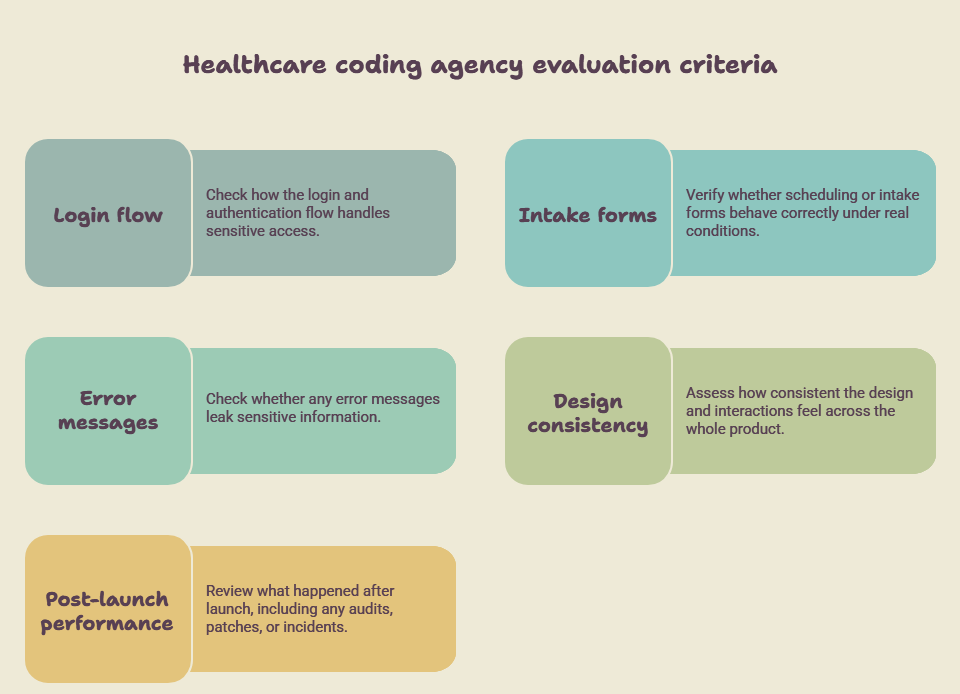
When reviewing the work, check:
- How the login and authentication flow handles sensitive access
- Whether scheduling or intake forms behave correctly under real conditions
- Whether any error messages leak sensitive information
- How consistent the design and interactions feel across the whole product
- What happened after launch, including any audits, patches, or incidents
Does it make sense to hire a specialist or generalist firm for an Australian healthcare build?
For most healthcare products, a strong generalist firm holds up well, provided it applies the same compliance discipline to every project it takes on. A firm that only ever builds healthcare apps risks tunnel vision, while a broader agency brings transferable patterns from other regulated or sensitive work, such as fintech security or logistics data handling, that apply directly to problems like access control and patient data separation. What matters more than a narrow focus is whether the firm treats the Australian Privacy Principles and security review as standard practice across everything it ships, healthcare included, not as a special add-on. Genuine Australian healthcare vibe coding specialists should be able to show that consistency across a varied portfolio, not just point to healthcare as their one lane.
What should a healthcare vibe coding agency generally charge in Australia?
Price follows scope and compliance depth, not a fixed formula. A simple appointment reminder tool costs a fraction of a full patient portal with secure messaging and provider dashboards. Treat any flat number offered before scoping as a rough guide only, and ask for a breakdown by feature so compliance-heavy work is visible separately from standard build work.
5. What things should you watch for in a healthcare vibe coding outfit?
The clearest red flag is vagueness around privacy. If an outfit cannot explain how it handles patient data, the Australian Privacy Principles, or data residency, expect the same fog through the rest of the build.
Watch for these specifically:
- Reluctance or delay discussing Privacy Act obligations for health information
- No named process for reviewing AI-generated code before release
- Pressure to sign quickly for a limited-time discount
- A portfolio with no genuine healthcare product, only adjacent fitness or wellness apps
- No stated plan for handling a post-launch security issue
- Refusal to hand over code ownership or infrastructure access
In-house crew or firm for healthcare vibe coding in Australia?
An in-house team offers long-term control and product memory, but hiring senior developers with healthcare compliance experience takes months and a sustained salary. A firm offers speed and a ready team with far less upfront commitment. Many Australian healthcare startups launch with a firm, then build a small in-house team once the product is stable. ArixLabs supports that path by handing over maintainable code and clear compliance notes, so a future in-house team is not starting from nothing.
What are the tells of a dependable healthcare vibe coding firm?
Dependable firms show repeat healthcare clients, named engineers who can discuss compliance decisions directly, and documented handovers that include privacy and security notes, not just a repository link. They are willing to discuss a past mistake and what changed afterward. That honesty is a stronger signal than any polished pitch deck, and it is what separates real Australian healthcare vibe coding specialists from a general app shop with a medical logo on its homepage.
What should a good healthcare vibe coding pitch include for an Australian privacy-compliant product?
It should include a clear feature list tied to milestones, named team members, a stated privacy and security testing plan, and pricing broken down by phase. A pitch that folds security testing vaguely into "quality assurance," with no separate line item, deserves a direct follow-up question. ArixLabs structures every proposal around visible phases and deliverables, which is the clarity a trustworthy team should offer without being asked twice.
How does outfit communication affect healthcare project success across Australian time zones?
It affects it directly, often more than raw technical skill does. Healthcare builds involve constant decisions about data handling and compliance scope, and a slow-communicating outfit stalls exactly those decisions at the worst moments. Look for:
- Weekly demos with visible, working progress
- A shared project board rather than scattered email updates
- A named point of contact who can answer compliance questions directly
- Confirmed overlap hours if the team works from a different time zone, since Perth, Sydney, and Brisbane already sit hours apart from each other
ArixLabs runs client builds through scheduled calls and visible progress boards specifically so founders are never left guessing what has been tested or reviewed, wherever in the country or the world they are based.
FAQ
1. How do I choose the right vibe coding agency for healthcare if my patients are Australian?
Shortlist agencies with verifiable healthcare work, ask each the same privacy-focused questions, and compare answers side by side. Choose the one that treats the Australian Privacy Principles and patient data questions as routine, not as an inconvenience.
2. What makes an agency good at healthcare vibe coding?
A disciplined review process for AI-generated code, real experience with Australian privacy rules, and named engineers who can explain their compliance decisions in plain language.
3. Should a healthcare vibe coding agency have industry experience?
Yes, ideally with a specific healthcare product they can walk you through in detail, since general app experience does not cover the Privacy Act, patient data handling, or clinical workflow logic on its own.
4. How much time does it take to onboard a healthcare vibe coding firm?
Onboarding typically takes two to three weeks, slightly longer than a non-regulated project, because it usually includes a privacy and compliance review alongside detailed scoping before any building begins.
%20(1).jpg)

View more blogs

.png)
.png)

.png)

.png)
_a_change__2025__to__20.png)
.png)

.png)
Ready to develop your own product? Get in touch today!
Get in Touch