%201.png)




1. What Actually Makes a Marketplace App Work
Most marketplace apps don’t fail because of bad tech. They fail because no one shows up.
You open the app, no listings. Or worse, listings with zero activity. That’s enough for users to bounce in seconds.
A marketplace only works when there’s movement. Sellers listing. Buyers browsing. Transactions happening. Without that loop, nothing sticks.
This is why building everything upfront is risky. You’re guessing what users want… and hoping it works.
A smarter way is to test the idea early. Strip it down. Launch something small. See if people actually use it.
That’s where build marketplace app without coding helps. You can put together a working version fast, tweak things on the go, and avoid “long development cycles”.
Once you start seeing real activity, then moving into FlutterFlow marketplace app development feels like a logical next step, not a blind investment.
2. What Is FlutterFlow Marketplace App Development?
Most people assume building a marketplace app means writing thousands of lines of code.
It doesn’t have to.
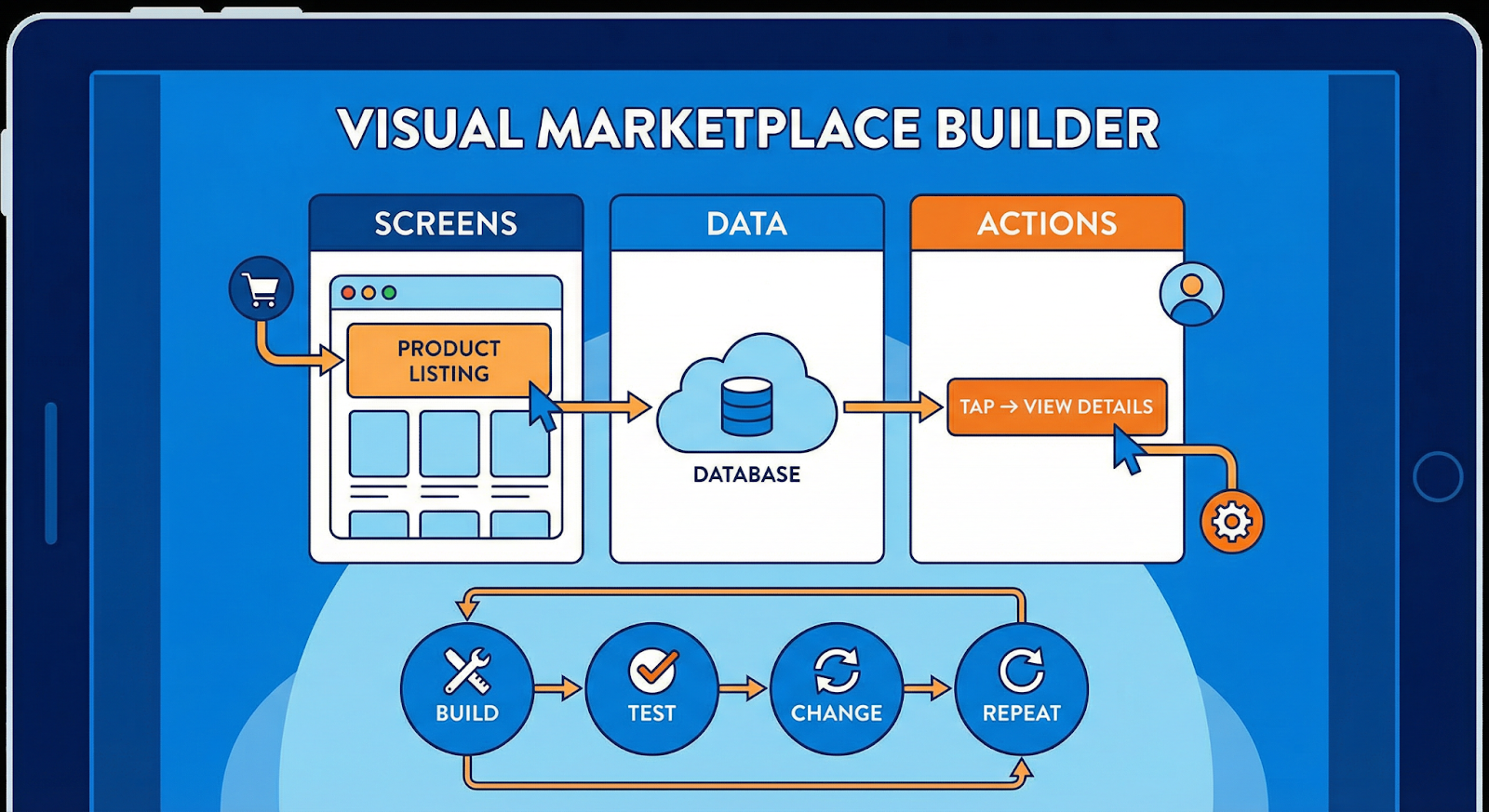
With FlutterFlow marketplace app development, you’re not starting from a blank screen. You’re piecing things together, screens, data, actions, until it behaves like a real app.
Tap → something happens.
User signs up → data gets stored.
Seller adds a product → it shows up instantly.
No backend setup from scratch. No wiring everything manually.
That’s where a no-code marketplace app builder shifts things. You’re still building the same product, but faster, and with fewer moving parts breaking along the way.
And this matters more than people think.
Because in the early stage, you don’t need a “perfect” system. You need something that works well enough to test. That’s why founders lean toward MVP marketplace app development first, get it live, see what breaks, fix it.
FlutterFlow just makes that loop shorter.
You build → test → change → repeat.
3. Can You Really Build a Marketplace App Without Coding?
Short answer? Yes.
But not in the way most people imagine.
When people hear build marketplace app without coding, they assume it’s just drag, drop, and done. Reality’s a bit messier.
You’re not writing code, but you are still making decisions:
- How users move through the app
- How listings are created and shown
- What happens after a payment
If those flows are unclear, no tool will fix it.
That’s where a no-code marketplace app builder helps, but only if you know what you’re trying to build. It removes the technical barrier, not the thinking part.
And honestly, that’s a good thing.
Because it forces you to focus on what actually matters, does your idea make sense? Will users use it?
For early-stage founders, this is where things click. You can test quickly, change things without waiting on developers, and avoid getting stuck in long build cycles.
So yes, you can build it without coding.
Just don’t confuse “no code” with “no effort.”
4. Core Features Every Marketplace App Needs
Most marketplace apps don’t fail because they lack features. They fail because the basics don’t work properly.
Start with the essentials. Always.
A marketplace is just a structured flow:
users join → sellers list → buyers browse → transactions happen.
Break that flow anywhere, and the whole thing feels broken.
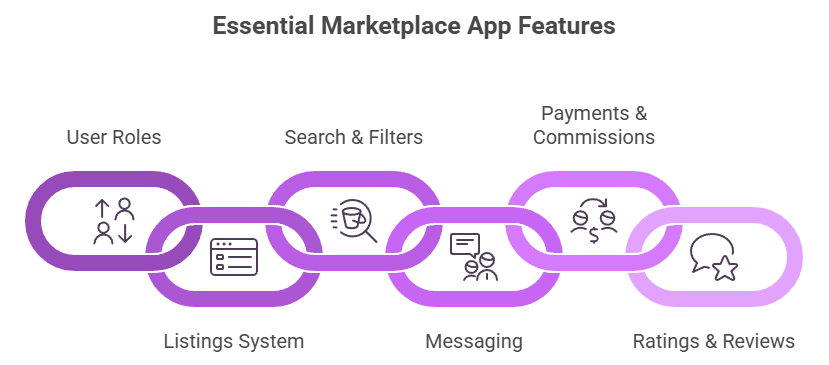
Here’s what actually matters:
- User roles (buyers & sellers)
Two different experiences. Sellers need dashboards. Buyers need discovery. - Listings system
Products or services should be easy to add, edit, and display. This is the core engine. - Search & filters
If users can’t find what they want quickly, they leave. - Messaging or interaction
Not always required, but useful, especially in service-based marketplaces. - Payments & commissions
This is where your business model lives. It has to be smooth. - Ratings & reviews
Trust decides everything in a marketplace.
What’s useful with FlutterFlow is that many of these are already supported through built-in components and integrations. These FlutterFlow app features reduce the need to build everything from scratch.
But tools aside, get the flow right first.
Features don’t make a marketplace work.
Good interaction between users does.
5. Step-by-Step: Building a Marketplace App Using FlutterFlow
You don’t build a marketplace app in one go. It comes together in layers.
Start rough. Then refine.
Start with the idea (keep it narrow)
Pick one use case. Not “a marketplace for everything.” Something specific, rentals, services, reselling. This keeps your first version focused.
Design the basic screens
Home, listing page, profile, add product. Don’t overthink design here. Just make sure users can move from one step to another without confusion.
Set up the backend (usually Firebase)
This is where your data lives, users, listings, orders. With FlutterFlow marketplace app development, most of this connects visually, so you’re not wiring APIs from scratch.
Create the marketplace logic
Who can list? What fields are required? How are items displayed? This is the part that defines how your app behaves.
Add payments
Keep it simple in the beginning. One payment flow. One model. You can expand later.
Test like a user would
Sign up. Add listings. Try to break things. This step catches more issues than people expect.
This whole process is why many teams start with MVP marketplace app development, launch something usable, then improve based on real feedback.
Don’t aim for perfect. Aim for working.
6. Cost & Timeline of Marketplace App Development in Australia
This is usually where things get real.
Traditional development? It adds up fast. Between design, frontend, backend, testing, you’re easily looking at months of work and a serious budget.
With FlutterFlow app development in Australia, the equation shifts.
You’re not starting from zero. A lot of the groundwork, UI components, backend connections, is already there. That cuts both time and cost.
For a basic marketplace MVP:
- Timeline can range from a few weeks to a couple of months
- Cost is significantly lower compared to full custom builds
Of course, it depends on complexity. More features = more time. But the gap between no-code and traditional development is hard to ignore.
This is why many founders choose to build marketplace app without coding first. It lets them validate the idea before committing bigger budgets.
Because spending months building something users don’t want?
That’s the expensive mistake.
7. Monetization Models That Actually Work
A marketplace without a revenue model is just traffic with no direction.
The good part? You don’t need something complicated to start.
Most marketplaces stick to a few proven models:
- Commission per transaction
You take a small cut every time a sale happens. Simple, and it scales naturally with usage. - Subscriptions (for sellers)
Charge sellers to list or access premium features. Works well when supply is strong. - Featured listings
Sellers pay to get visibility. Useful once you have enough competition on the platform.
You don’t have to implement all of these on day one.
In fact, during early stages, or even MVP marketplace app development, it’s better to start with one clear model and test it. Adding too many monetization layers too early can confuse users.
And here’s something people overlook:
If users aren’t getting value, no monetization model will work.
Revenue comes after usage, not before.
8. Mistakes Founders Make When Building Marketplace Apps
Most mistakes don’t show up during development. They show up after launch.
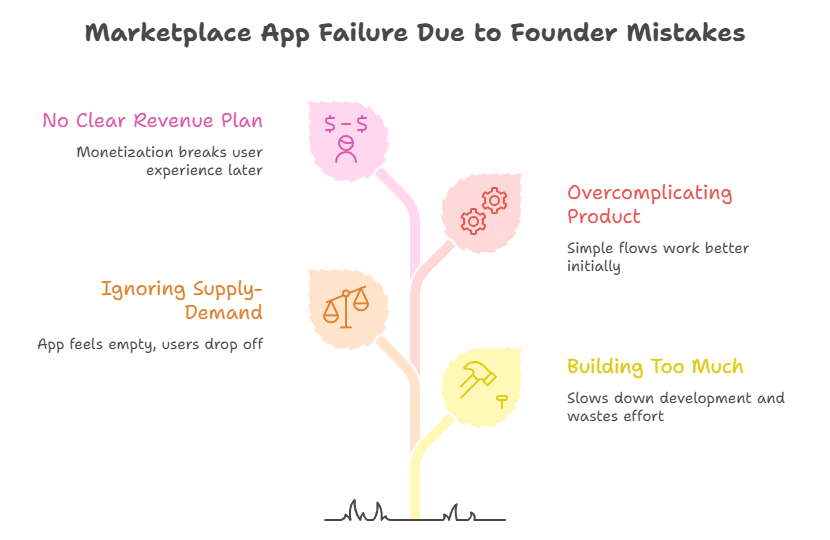
Building too much too early
Trying to perfect everything before users even join. It slows you down and wastes effort.
Ignoring the supply-demand balance
Getting users on one side but not the other. The app feels empty, and people drop off.
Overcomplicating the product
Too many features, too many steps. Simple flows usually work better, especially in early versions.
No clear revenue plan
Adding monetization later without thinking it through early can break the user experience.
This is why many teams choose to build marketplace app without coding first. It gives room to test, fail, and adjust without heavy cost.
Because most problems aren’t technical.
They’re product decisions.
9. Conclusion
Marketplace apps aren’t hard to build anymore. What’s hard is building something people actually use.
That’s why starting small makes more sense than building big.
You test the idea, understand user behavior, and improve from there. Tools like FlutterFlow marketplace app development make that process faster, less waiting, more iteration.
And if you’re starting from scratch, choosing to build marketplace app without coding isn’t a shortcut. It’s a smarter first step.
Because in the end, the goal isn’t just to launch an app.
It’s to build something that keeps working after launch.
%20(1).jpg)


View more blogs
%20(1).jpg)

.jpg)
.jpg)
.jpg)

Ready to develop your own product? Get in touch today!
Get in Touch