



1. Introduction
Most restaurants don’t lose customers because of food, they lose them because ordering isn’t simple.
Today, users expect to open an app, place an order in seconds, and track it in real time. If your restaurant isn’t part of that experience, you’re already behind. That’s why apps are no longer optional in 2026.
The problem? Traditional app development is slow and expensive. For most restaurants, it’s not practical.
That’s where no-code changes the game.
A FlutterFlow restaurant app lets you design, build, and launch quickly without starting from scratch. You get real functionality, backend support, and full control, without heavy development cycles.
At Arixlabs (previously FlutterFlowDevs), we’ve seen how fast founders can go from idea to launch using this approach. And yes, you can build a fully functional food delivery app in FlutterFlow that feels smooth and production-ready.
The focus now isn’t can you build it, it’s how fast you can launch something that actually works.
2. Why Restaurants Are Moving to No-Code Apps
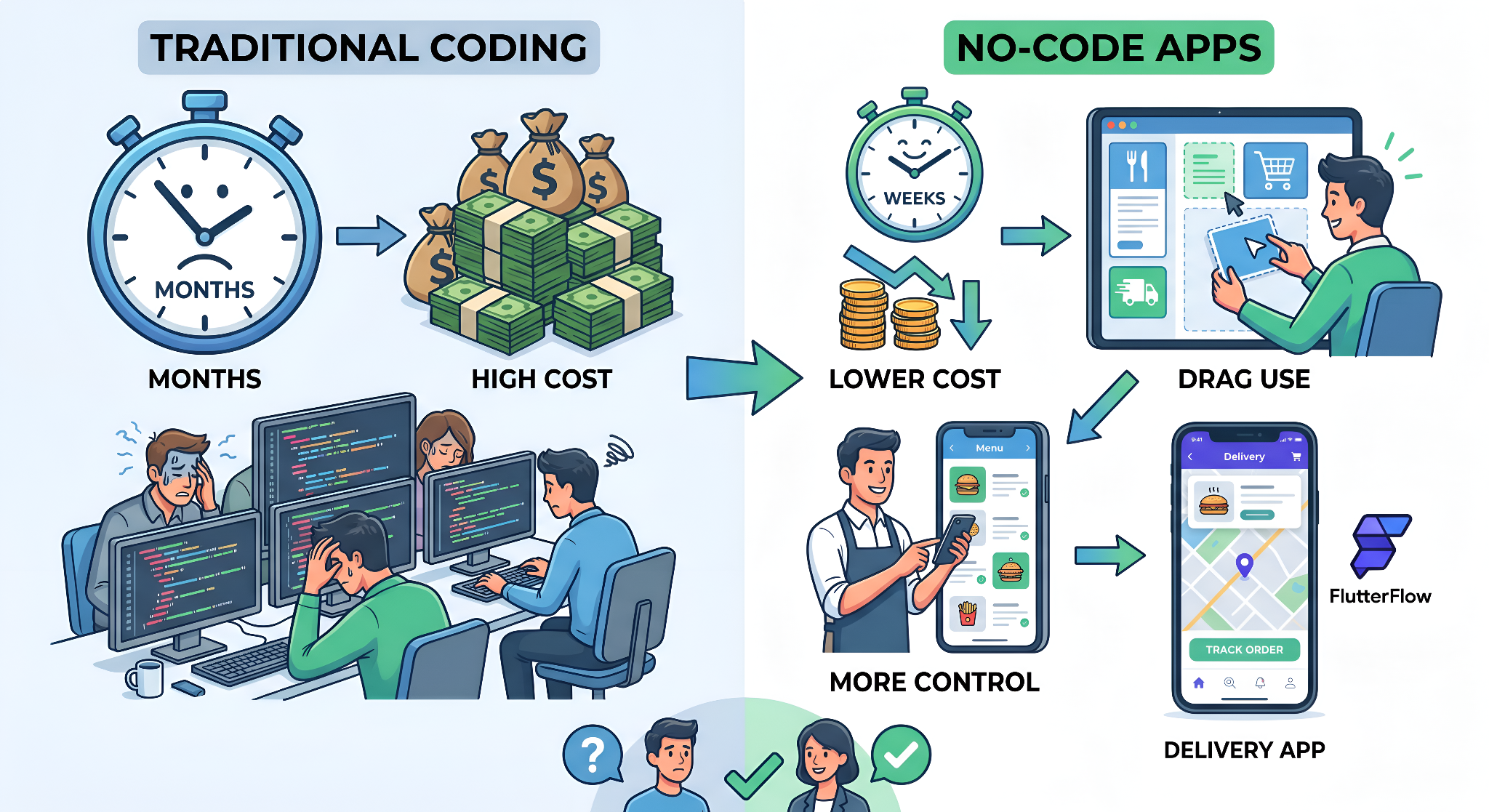
Building an app used to mean months of work and a big budget. Now, you can build restaurant app without coding and launch much faster.
Faster launch
What once took months can now be done in weeks using visual tools.
Lower cost
You don’t need a full development team, which reduces upfront investment.
More control
You can update menus, flows, or pricing without waiting on developers.
Can you actually build a delivery app this way?
Yes. A food delivery app in FlutterFlow can handle ordering, payments, and tracking, all without traditional coding.
Do you still need developers?
Not at the start. But as your app grows, expert support helps avoid structural issues later.
A no code food delivery app isn’t just easier to build, it’s faster to launch and improve.
3. Must-Have Features in a Restaurant Ordering App
Before you build anything, get this right, your app is only as good as its core restaurant ordering app features. Miss these, and users drop off fast.
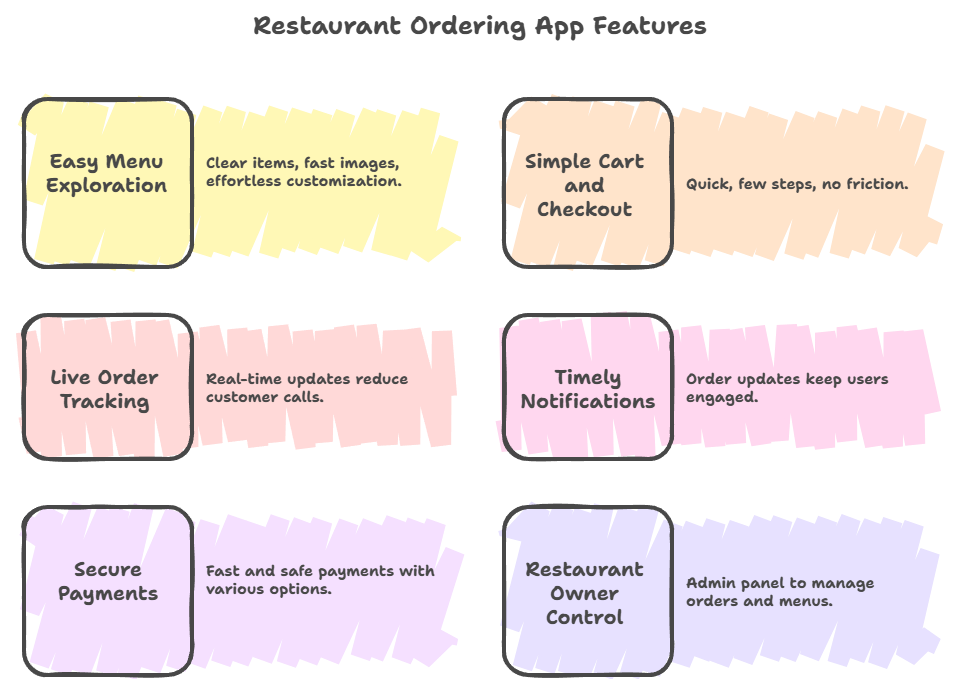
Menu that’s easy to explore
No one wants to struggle while ordering food. Items should be clear, images should load fast, and customization (like add-ons or preferences) should feel effortless.
Simple cart and checkout
If checkout feels long or confusing, users leave. Keep it quick. Few steps. No friction.
Live order tracking
Once an order is placed, users want updates. Not guesses. Real-time tracking keeps them engaged and reduces “Where is my order?” calls.
Timely notifications
Order placed, preparing, out for delivery, these updates matter. A food delivery app in FlutterFlow can handle this “smoothly” with built-in notification flows.
Secure payments
Users expect fast and safe payments. Cards, wallets, or UPI, your app should support what people already use.
Control for restaurant owners
Behind the scenes, you need an admin panel. Manage orders, update menus, and track what’s selling, without confusion.
Get these right, and your FlutterFlow restaurant app feels reliable from day one. Skip them, and even a good-looking app won’t hold users.
4. Step-by-Step: Build a FlutterFlow Restaurant App
Let’s keep this practical. No theory, just what actually happens when you build a FlutterFlow restaurant app.
You start simple. And you should.
First, set up your base screens. Home, menu, cart, order history. Don’t overthink structure here, just make sure the flow makes sense. A user should never feel lost while ordering.
Then comes design. Not fancy visuals, clarity. Can someone open your app and place an order in under a minute? If not, something’s off. This is where most early apps fail.
Next, connect your backend. Most people use Firebase. This is where your menu data, users, and orders live. Once this is connected, your app stops being static. It becomes usable. A real food delivery app in FlutterFlow depends heavily on how clean this setup is.
Now the important part, logic. Adding items to cart, calculating totals, storing orders. Sounds basic, but small mistakes here create big issues later. Things like duplicate orders or wrong totals happen more often than you’d think.
After that, plug in payments and notifications. Users expect instant confirmations and updates. If they don’t get them, they don’t trust the app.
Finally, test like a user. Not once. Multiple times. Try breaking your own flow. Then fix it before users find the gaps.
That’s the process. Building a no code food delivery app isn’t complicated, but building it right takes attention to detail.
5. How Long Does It Take to Build a Restaurant App?
Short answer? Faster than you expect, but only if you don’t overcomplicate it.
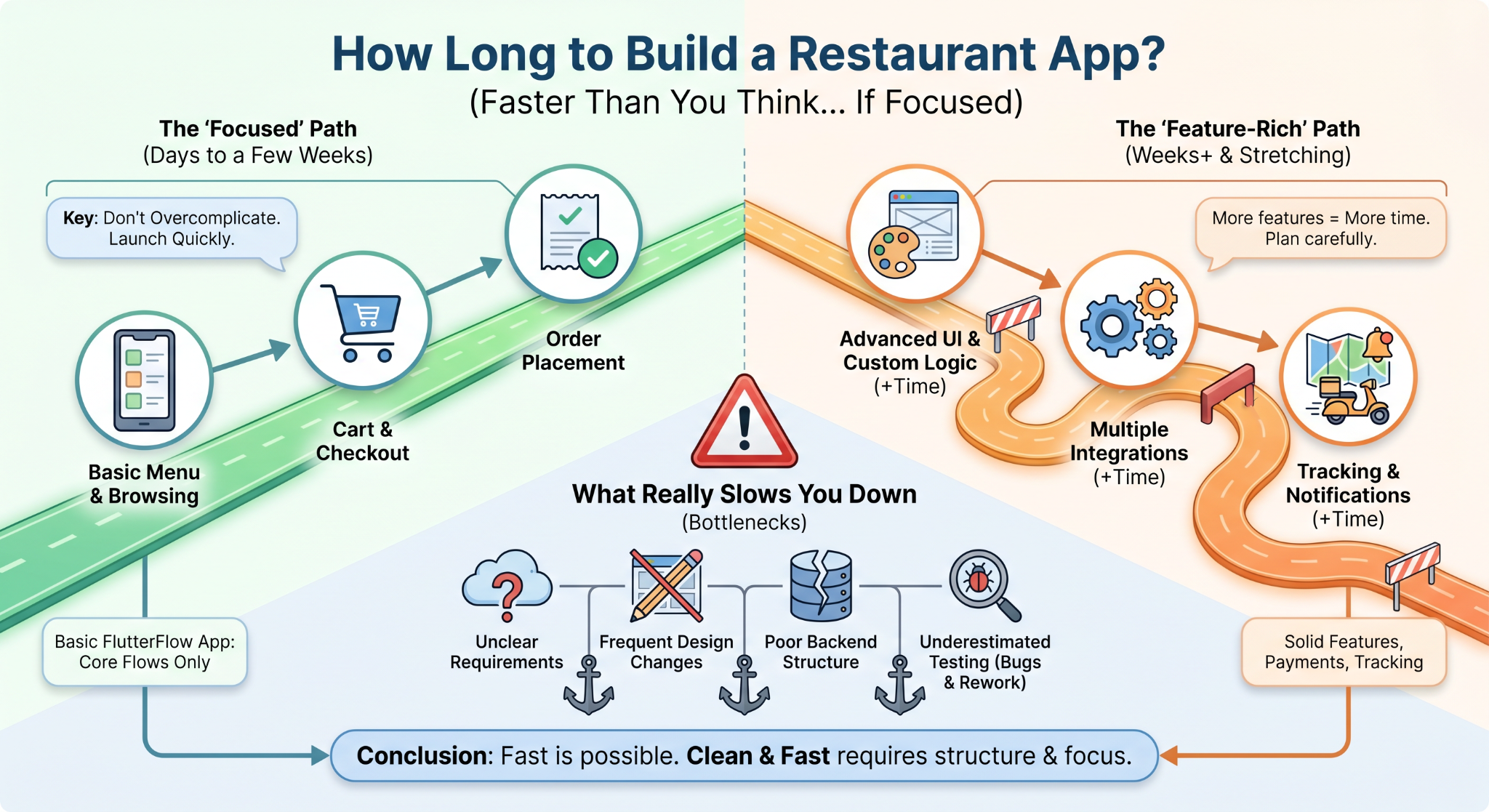
A basic FlutterFlow restaurant app can be up and running in a few days to a couple of weeks. That includes core flows like menu browsing, cart, checkout, and order placement. If your goal is to launch quickly, this is very achievable.
But timelines stretch when you start adding more.
Want advanced UI? More time.
Custom delivery logic? More time.
Multiple integrations? Definitely more time.
A typical food delivery app in FlutterFlow with solid features, payments, tracking, notifications, usually takes a few weeks if planned properly. Not months.
What really affects speed isn’t the tool, it’s decisions.
- Unclear requirements slow everything down
- Frequent design changes delay progress
- Poor backend structure creates rework
And then there’s testing. Most people underestimate this. You’ll spend time fixing flows, edge cases, and small bugs that only show up when you use the app like a real customer.
If you keep things focused, you can build restaurant app without coding surprisingly fast. But if you keep adding features without structure, timelines expand quickly.
So yes, fast is possible. Clean and fast? That depends on how you build.
6. Can Your App Scale as You Grow?
Launching is easy. Scaling is where things get real.
A FlutterFlow restaurant app can handle early users without issues. But as orders increase, problems start showing, slow queries, messy data, and delayed updates.
Growth adds complexity. New locations, more users, different menus. What worked for a small setup starts breaking if the backend isn’t structured well.
A food delivery app in FlutterFlow can scale, but only if it’s built right from the beginning. The tool supports growth, the setup determines how smoothly it happens.
Most issues don’t appear on day one. They show up when traffic increases, and by then, fixing them takes more effort.
So yes, you can build restaurant app without coding and launch fast. But if you’re planning to grow, your foundation matters more than speed.
7. Where No-Code Starts to Break (And Why You Need Experts)
At first, everything feels smooth. You build a no code food delivery app, launch it, and orders start coming in. That early phase? It works.
Then things change.
You add delivery zones. Maybe multiple restaurants. Suddenly, simple logic isn’t enough. Assigning orders, calculating delivery fees, handling edge cases, it all starts getting messy. Not impossible, just… harder than expected.
The backend is usually next to show cracks. Data that felt “fine” in the beginning turns out to be difficult to manage. Queries slow down. Small bugs start appearing in places you didn’t plan for.
Even performance shifts. A FlutterFlow restaurant app handles normal traffic well, but once usage grows, inefficiencies show up fast. A delay here, a broken flow there, it adds up.
Integrations follow the same pattern. Basic payments and notifications are easy. But when you need flexibility, multiple payment methods, custom workflows, real-time updates, it’s no longer plug-and-play.
This is where most founders pause.
Not because the tool failed. But because the app outgrew the initial setup.
And that’s usually when teams bring in experts like Arixlabs (previously FlutterFlowDevs), to clean up structure, fix scaling issues, and make sure the app doesn’t keep breaking as it grows.
A food delivery app in FlutterFlow can take you far. Just don’t assume the first version will hold everything together as you scale.
8. Conclusion
Building a restaurant app isn’t the hard part anymore. Building it well is what makes the difference.
With tools like FlutterFlow, you can launch fast, validate your idea, and start getting real users without waiting months. A FlutterFlow restaurant app gives you that speed and flexibility, especially in the early stages.
But speed alone isn’t enough.
As your app grows, structure starts to matter. The way your backend is set up, how your flows are designed, how clean your logic is, these things decide whether your app scales smoothly or keeps breaking.
If your goal is to test and launch quickly, you can absolutely build restaurant app without coding and get results. But if you’re thinking long-term, you need to think beyond just launching.
That’s where experience comes in.
A food delivery app in FlutterFlow can go from idea to production faster than ever, but making it stable, scalable, and reliable takes the right approach from day one.
Launch fast. But build smart.
%20(1).jpg)

View more blogs

.png)
.png)

.png)
.png)
.png)


.png)
.png)
Ready to develop your own product? Get in touch today!
Get in Touch